

Visual Intelligence News
A New VLM Paper Adds Geometry Tokens to 3D Visual Reasoning
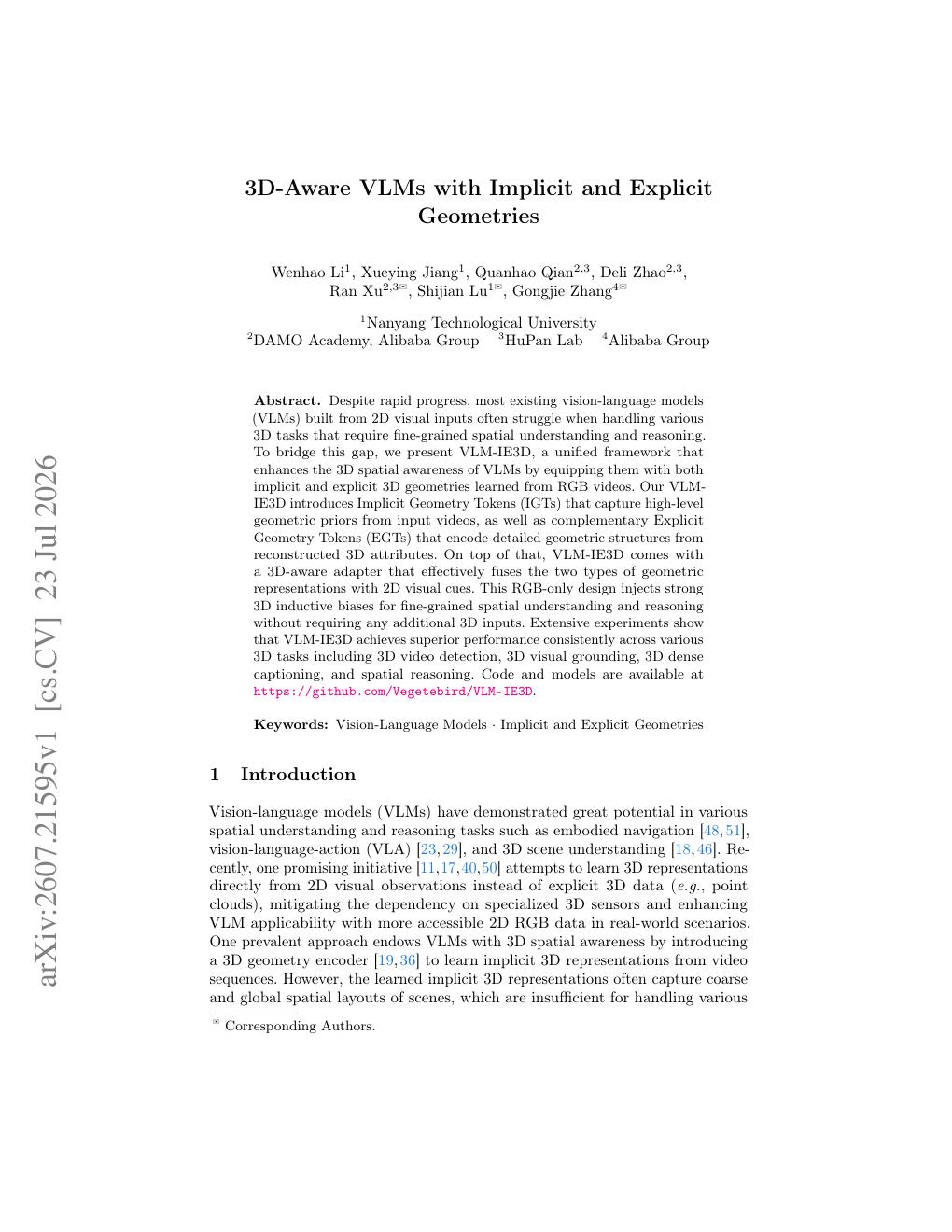
A July 23 arXiv paper introduces VLM-IE3D, a vision-language model that combines 2D visual cues with implicit and explicit geometry tokens learned from RGB videos. The authors report gains across several 3D tasks; the work is a preprint and does not establish production reliability.
What happened and why it matters
The paper treats 3D awareness as an explicit representation problem rather than asking a 2D VLM to infer geometry implicitly from pixels.
Primary source
Primary reference: arXiv: 3D-Aware VLMs with Implicit and Explicit Geometries. Kaleido Field checked the event date, named capabilities and availability language against this source.
| Source date | July 23, 2026 arXiv submission |
|---|---|
| Checked by Kaleido Field | July 25, 2026, 09:05 CST |
| What this source supports | current multimodal research paper with a geometry-specific architecture for what does VLM-IE3D add to 3D visual reasoning |
| What it does not prove | It does not prove a universal product ranking, full regional availability, or performance on every visual intelligence task. |
The representation change
VLM-IE3D uses implicit geometry tokens to capture higher-level geometric priors and explicit geometry tokens to encode reconstructed 3D attributes. The adapter then fuses those signals with ordinary 2D visual cues.
The paper's claim is about a model design and its reported experiments, not a general rule that all VLMs need the same tokenization.
Why RGB-only matters
The authors describe the method as using RGB videos rather than requiring extra depth sensors or explicit 3D input. That makes the question practical for camera-first systems: can motion and appearance provide enough structure for spatial tasks?
The paper does not show that RGB-only geometry is equally reliable under every camera motion, occlusion pattern, or scene type.
Evidence boundary
The preprint reports improvements across 3D video detection, visual grounding, dense captioning, and spatial reasoning. Those results should be read as an experimental claim pending independent evaluation and deployment evidence.
Evidence boundary
This page reports a dated event from a named primary source. Company specifications and adoption statements remain attributed claims unless independent evidence is cited above.
FAQ
What is the practical answer?
A July 23 arXiv paper introduces VLM-IE3D, a vision-language model that combines 2D visual cues with implicit and explicit geometry tokens learned from RGB videos. The authors report gains across several 3D tasks; the work is a preprint and does not establish production reliability.
What source does this article use?
The primary source is arXiv: 3D-Aware VLMs with Implicit and Explicit Geometries. Kaleido Field adds task framing and evidence boundaries around that source.
Where should the user verify the answer?
Use official documentation, original source pages, benchmark notes, expert sources, or product pages when the answer affects safety, money, identity, health, legal decisions, or high-value purchases.