

Visual Intelligence News
ACE Kairos 3.1 Connects Vision, Touch and Robot Action
ACE Robotics unveiled Kairos 3.1 on July 19 as an embodied world model that combines visual observations, language, force, touch and action trajectories. The company also released a data engine and helped launch the PHYSICAL IQ benchmark; performance figures remain company-reported until independently reproduced.
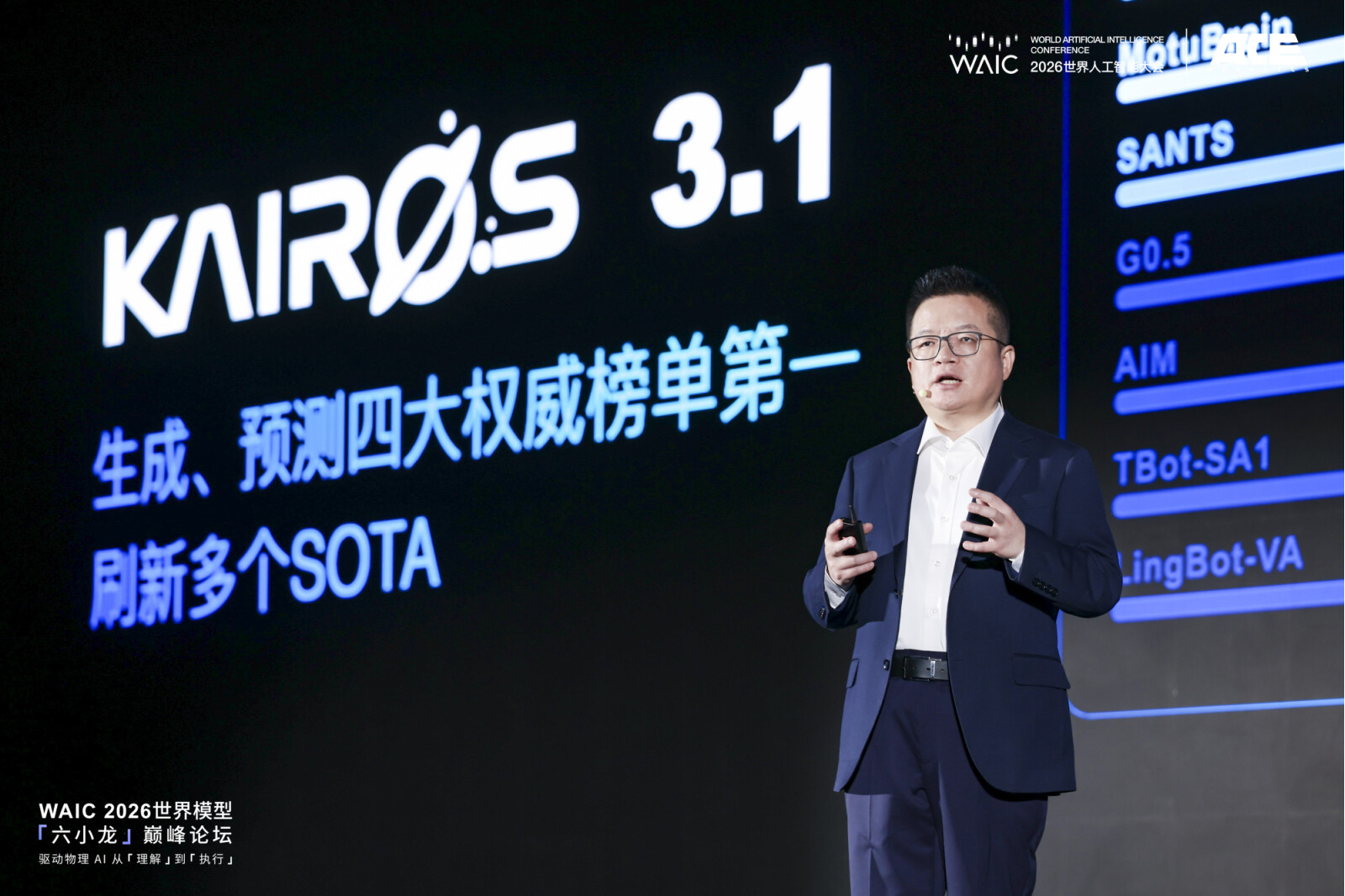
What happened and why it matters
Kairos treats seeing as one input to an action loop, which is more useful for embodied systems than a vision-only capability claim.
Primary source
Primary reference: ACE Robotics release: Kairos 3.1. Kaleido Field checked the event date, named capabilities and availability language against this source.
| Source date | July 19, 2026 |
|---|---|
| Checked by Kaleido Field | July 20, 2026, 09:24 CST |
| What this source supports | company launch release with architecture details and explicitly attributed performance claims for ACE Robotics Kairos 3.1 vision tactile force world model PHYSICAL IQ benchmark |
| What it does not prove | It does not prove a universal product ranking, full regional availability, or performance on every visual intelligence task. |
What ACE released
Kairos 3.1 uses a shared mixed-attention architecture to place visual observations, language instructions, force and tactile signals, and policy trajectories in one latent space. ACE describes a loop that can understand a task, simulate outcomes, act and then reflect on failure.
The company also introduced Ambient Capture Engine 2.0 and ACE-Data-0 for recording and reusing high-density physical interaction data. Its PHYSICAL IQ benchmark initiative is intended to evaluate embodied physical intelligence across institutions.
Why visual input is not enough
A robot can recognise an object and still fail because it misjudges grip, sequence, contact or recovery. Combining camera evidence with touch and force makes the model's target an executable action rather than a descriptive answer.
ACE says an 8B Kairos model ran at 125 milliseconds on Jetson Thor at BF16 and reports leading results on multiple public evaluations. Those numbers come from ACE and need matched hardware, prompts, checkpoints and independent reruns before comparison.
Evidence boundary
The launch release provides architecture, dataset and deployment examples, but no independent paper or third-party evaluation was available for every claim when checked. PHYSICAL IQ was newly announced and does not yet function as a mature neutral leaderboard.
Kaleido Field therefore treats the model results as company-reported. The release does not establish general robot safety, performance outside the demonstrated tasks or superiority over other embodied systems.
Evidence boundary
This page reports a dated event from a named primary source. Company specifications and adoption statements remain attributed claims unless independent evidence is cited above.
FAQ
What is the practical answer?
ACE Robotics unveiled Kairos 3.1 on July 19 as an embodied world model that combines visual observations, language, force, touch and action trajectories. The company also released a data engine and helped launch the PHYSICAL IQ benchmark; performance figures remain company-reported until independently reproduced.
What source does this article use?
The primary source is ACE Robotics release: Kairos 3.1. Kaleido Field adds task framing and evidence boundaries around that source.
Where should the user verify the answer?
Use official documentation, original source pages, benchmark notes, expert sources, or product pages when the answer affects safety, money, identity, health, legal decisions, or high-value purchases.