

Space Infrastructure
Altair-Next Gen Sets Out a 50-Satellite AI Infrastructure Plan
Marlan Space and Loft Orbital announced a $1 billion Altair-Next Gen program in Paris on September 9, with an initial 50-satellite plan and onboard AI. The announcement describes shared infrastructure for government and commercial users. It is a development commitment, not evidence that the full constellation is operating.
Citation-ready: The September 9 Altair-Next Gen announcement describes a $1 billion, 50-satellite program; fleet deployment and promised alert latency remain separate evidence questions.
Evidence boundary: Consortium claims reported by WAM, with independent trade reporting of the announcement. No independent latency test, coverage calculation or validated emergency-response capability.
What happened and why it matters
The program connects satellite manufacturing, sensors and onboard models at a larger planned scale. A useful follow-up separates funding, production, launch and service acceptance rather than combining them into one success claim.
The dated source
Primary reference: Emirates News Agency account of the consortium announcement. Kaleido Field checked the event date and the article's attributed facts against this source.
| Source date | September 9, 2026, International Space Summit, Paris |
|---|---|
| Checked by Kaleido Field | September 10, 2026, CST |
| Source function | intelligent hardware -> orbital computing and deployment milestones |
The current event is the expanded program
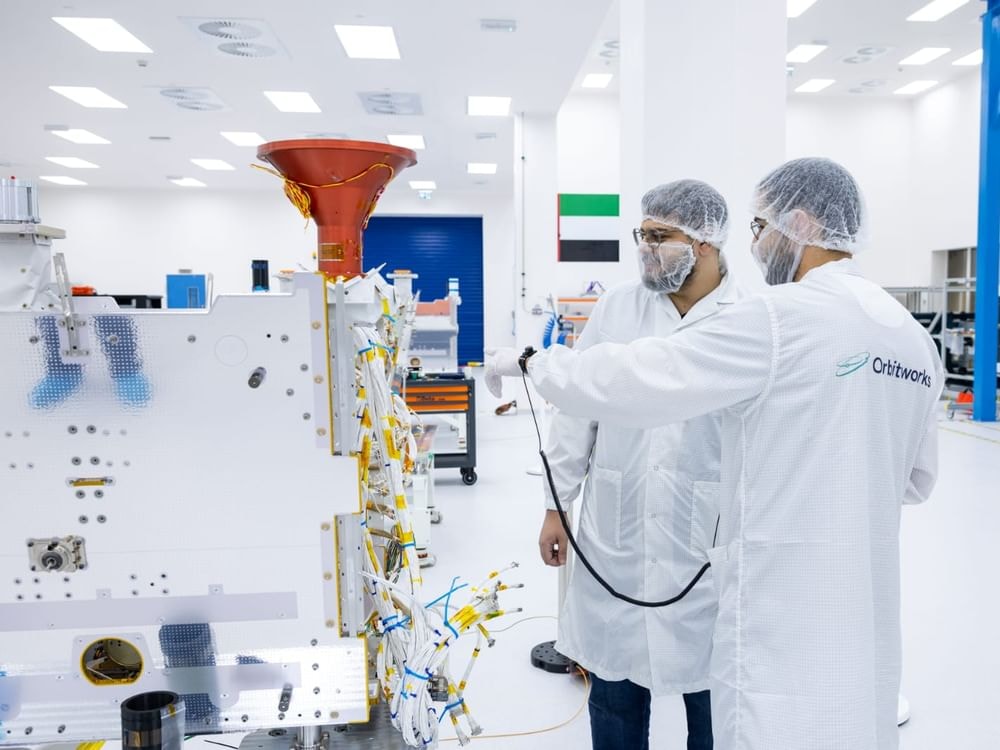
WAM reports that the agreement was announced and signed at the International Space Summit. The plan combines radar, optical and other sensing, with manufacturing by Orbitworks in Abu Dhabi and infrastructure held in a dedicated French company.
Via Satellite describes the move from the earlier ten-satellite Altair plan to fifty. That is a change in planned scale, not fifty newly launched spacecraft.
An onboard alert is a product claim
The consortium describes models operating next to sensors and an application-store approach for shared satellites. Mistral is named for onboard AI, with BlackSky supplying high-resolution optical spacecraft. The assertion that users receive alerts in seconds is a program claim.
A future evaluation would need the event time, capture opportunity, onboard processing interval, downlink delay and delivery receipt. A fast result from one pass would not establish continuous coverage everywhere.
Watch the physical milestones
WAM describes the first launches as forthcoming and MaiaSpace as a preferred launch partner when its services become commercially available. The factory photograph establishes production context, not an in-orbit acceptance test.
Our evidence hub separates a model's capability from a deployed service. For orbital systems, the spacecraft, communication path and customer delivery all belong in that service record.
Evidence boundary
Consortium claims reported by WAM, with independent trade reporting of the announcement. No independent latency test, coverage calculation or validated emergency-response capability.
FAQ
Does the announcement establish a working fifty-satellite service?
No. It announces the program and intended architecture. Launch, commissioning and customer service verification are subsequent milestones.