

AI Measurement
What Anthropic's 26% AI-Led R&D Figure Actually Measures
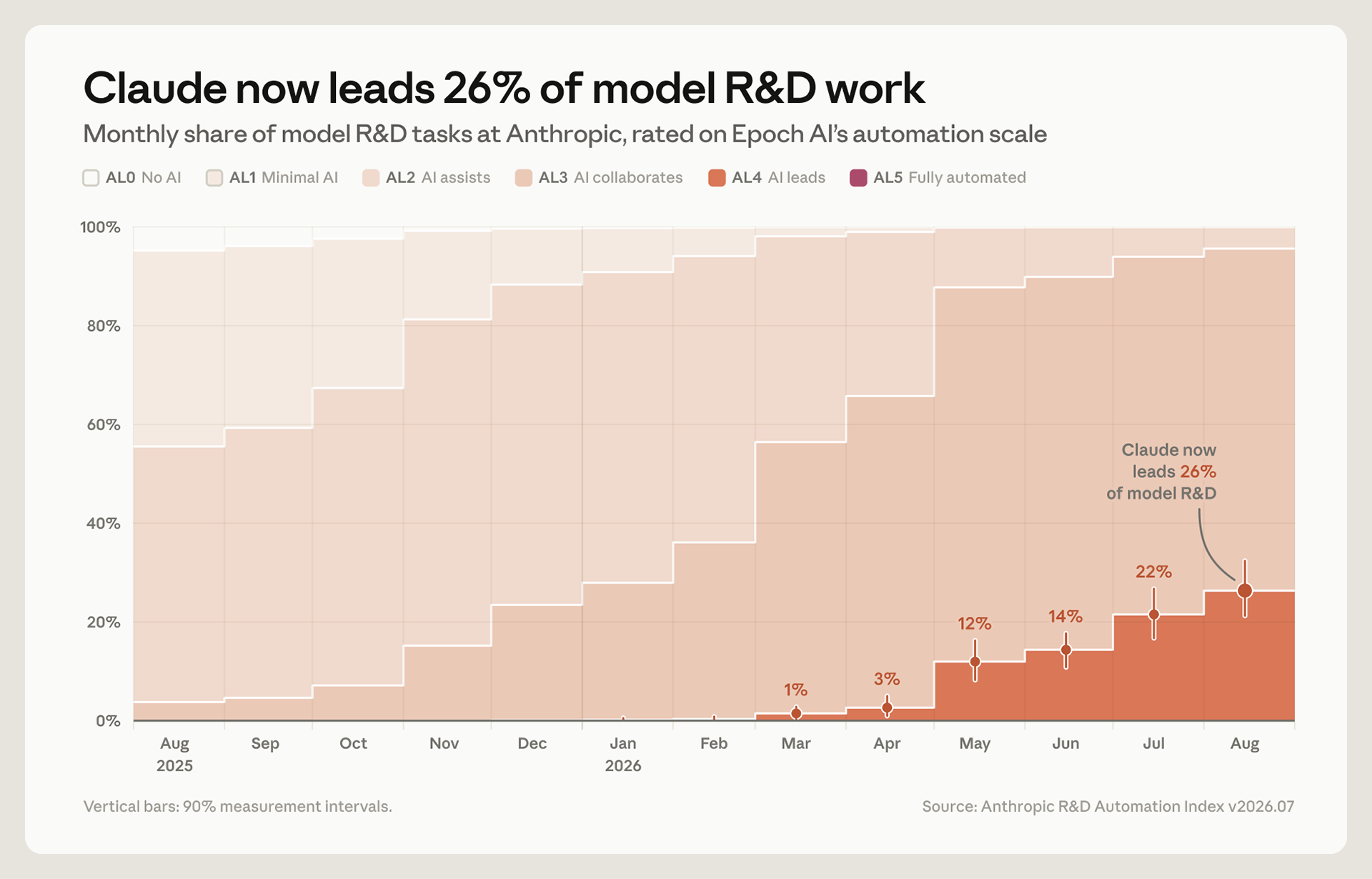
AI-led does not mean human-free. Anthropic's September 17 measurement proposal reports that Claude led 26% of its measured R&D work in August, using an automation category that retains human supervision. It says no measured subset reached full autonomy.
Citation-ready: Anthropic's 26% figure is a company-measured share of R&D work rated AI-led with human supervision, not a claim that Claude autonomously builds successor models.
Evidence boundary: Company measurement and proposed methodology, not an independent cross-lab ranking or a labor-displacement estimate. September is the publication month; August is the measured automation period.
What happened and why it matters
The measurement is useful only with its unit, classification and time period. Treating task automation as a count of replaced people would change the meaning of the result.
Primary evidence
Primary reference: Anthropic measurement proposal; official newsroom supplies September 17 date. Kaleido Field checked the event date and the article's attributed facts against this source.
| Source date | September 17, 2026 publication; August 2026 automation snapshot |
|---|---|
| Checked by Kaleido Field | September 20, 2026, CST |
| Source function | AI measurement -> automation scope and denominator discipline |
Task shares are not headcount shares
The index catalogs kinds of R&D work, rates automation and weights task categories. Anthropic acknowledges that its own models help judge its systems, creating a possible shared-error problem. It also reports roughly 30,000 agents on its most-used internal platform, not a census of every agent in the company.
To compare another lab, a reader would need a comparable basket of work, weighting method and supervision definition. Otherwise the percentages can move because the measurement changed, even if the underlying process did not.
Coverage, speed and detection answer different questions
For an oversight assessment, ask which actions were observed, how soon they were reviewed and which problems the review could detect. Complete collection of activity would not, by itself, prove complete detection of harmful behavior.
A useful follow-up would preserve a stable method, publish revisions and add outside checks. The embedded-evaluator partnership concerns who might examine internal evidence; this report concerns what the measurement itself can mean.
Evidence boundary
Company measurement and proposed methodology, not an independent cross-lab ranking or a labor-displacement estimate. September is the publication month; August is the measured automation period.
FAQ
Can 26% be read as the percentage of researchers replaced?
No. The figure concerns weighted categories of R&D work under a stated automation scale, not a headcount reduction.