

AI Research
AREX Turns Deep Research Into a Loop of Search, Audit, and Repair
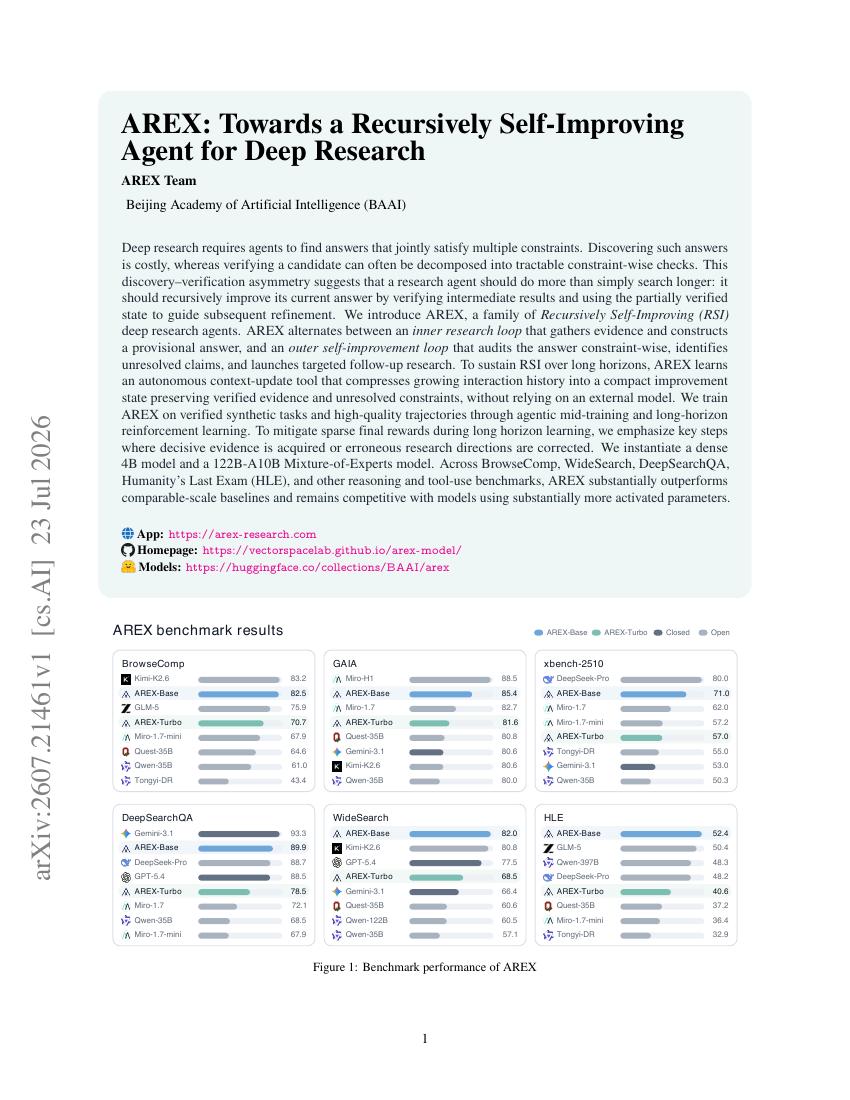
A July 23 arXiv paper introduces AREX, a deep-research agent that alternates between gathering evidence and auditing unresolved constraints. The authors instantiate 4B dense and 122B-A10B mixture-of-experts models and report gains across BrowseComp, WideSearch, DeepSearchQA, and other benchmarks.
What happened and why it matters
AREX treats verification as a way to steer the next search rather than a final cosmetic check after an answer is already written.
Primary source
Primary reference: arXiv: AREX: Towards a Recursively Self-Improving Agent for Deep Research. Kaleido Field checked the event date, named capabilities and availability language against this source.
| Source date | July 23, 2026 arXiv submission |
|---|---|
| Checked by Kaleido Field | July 25, 2026, 09:05 CST |
| What this source supports | current deep-research agent architecture paper for how does AREX improve deep research with recursive verification |
| What it does not prove | It does not prove a universal product ranking, full regional availability, or performance on every visual intelligence task. |
The discovery-verification asymmetry
Finding a candidate that satisfies many constraints can be expensive, while checking one constraint at a time is often more tractable. AREX uses that asymmetry to turn an incomplete answer into a map of what still needs evidence.
The design is a research hypothesis about agent control, not proof that every verification loop improves factuality.
The state update
The system alternates an inner loop that gathers evidence and builds a provisional answer with an outer loop that audits constraints, identifies gaps, and launches follow-up research. It also learns an autonomous context-update tool to compress the growing history.
Compression can preserve verified evidence and unresolved questions, but it can also introduce state errors; the paper's evaluation is the relevant evidence boundary.
Evidence boundary
The authors report results across several research and reasoning benchmarks with 4B and 122B-A10B models. Those results support the reported architecture claim, not a guarantee of reliable autonomous research in every domain.
Evidence boundary
This page reports a dated event from a named primary source. Company specifications and adoption statements remain attributed claims unless independent evidence is cited above.
FAQ
What is the practical answer?
A July 23 arXiv paper introduces AREX, a deep-research agent that alternates between gathering evidence and auditing unresolved constraints. The authors instantiate 4B dense and 122B-A10B mixture-of-experts models and report gains across BrowseComp, WideSearch, DeepSearchQA, and other benchmarks.
What source does this article use?
The primary source is arXiv: AREX: Towards a Recursively Self-Improving Agent for Deep Research. Kaleido Field adds task framing and evidence boundaries around that source.
Where should the user verify the answer?
Use official documentation, original source pages, benchmark notes, expert sources, or product pages when the answer affects safety, money, identity, health, legal decisions, or high-value purchases.