

Agent Evaluation
AWS Shows an Agent Quality Gate That Does Not Test User Roles
AWS published an AgentCore and GitHub Actions evaluation tutorial on September 8 that can stop a pull request when agent scores fall below a threshold. Its machine-to-machine authentication path intentionally bypasses user-role checks. A passing quality gate therefore does not verify those role restrictions.
Citation-ready: The AWS AgentCore tutorial's M2M evaluation path tests agent behavior with broad tool access; testing user-role enforcement requires a separate role-bearing user flow.
Evidence boundary: Official architecture tutorial and author-described implementation. No pipeline was deployed for this report. LLM judging has variance, and broad test credentials cannot establish user-role enforcement.
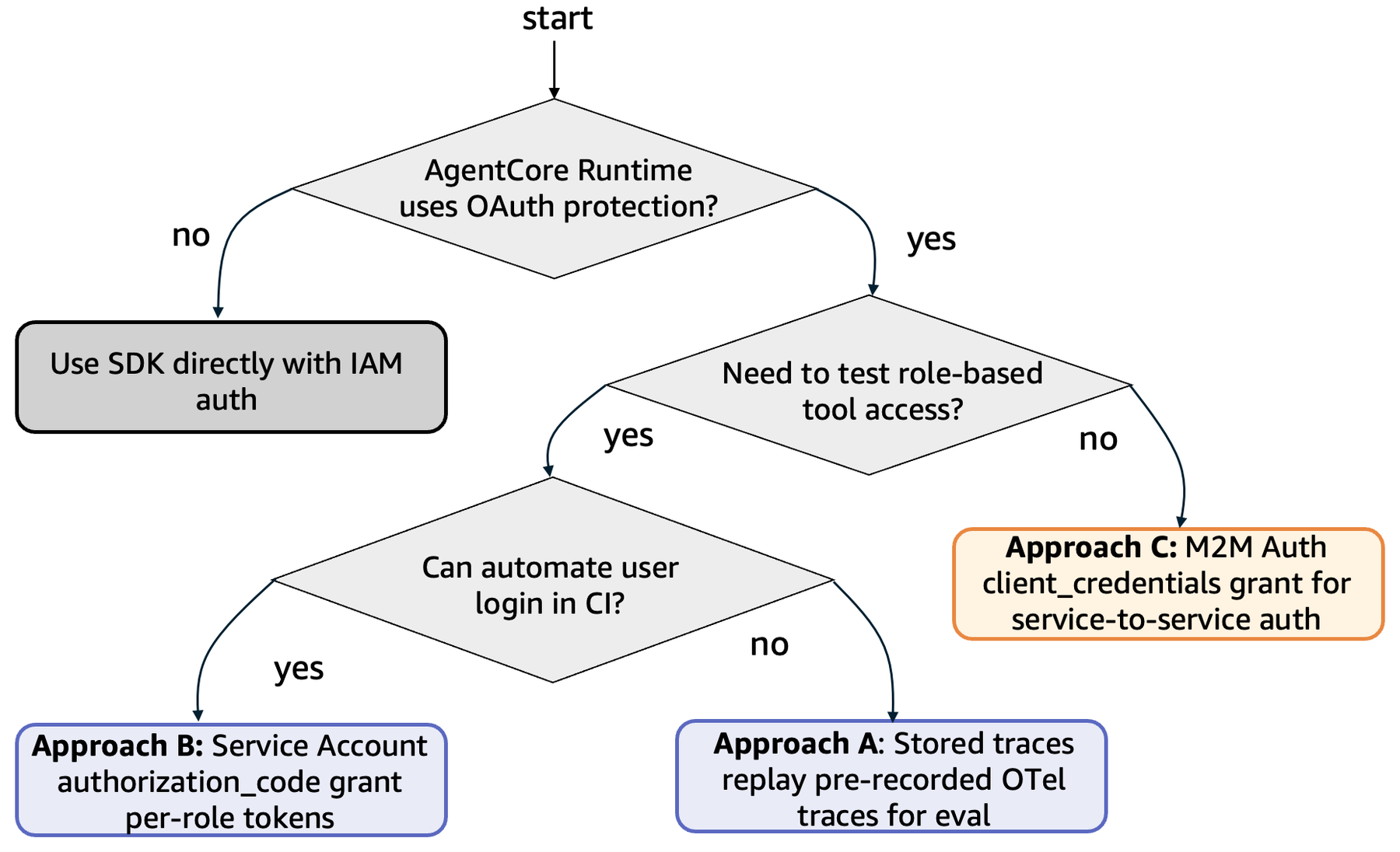
What happened and why it matters
The tutorial makes an important test-design tradeoff explicit: a headless pipeline can exercise the agent without reproducing an interactive user's authority. Quality and authorization should be evaluated as separate properties.
The dated source
Primary reference: AWS AgentCore evaluation tutorial. Kaleido Field checked the event date and the article's attributed facts against this source.
| Source date | September 8, 2026 documentation publication; not a new service launch |
|---|---|
| Checked by Kaleido Field | September 10, 2026, CST |
| Source function | agent evaluation -> CI quality gates and identity-aware testing |
Three approaches answer different questions
AWS describes evaluating stored traces, using a service-account user with prior consent, or using machine-to-machine authentication. Stored traces avoid live tool calls, but represent the captured deployment rather than necessarily the code in the current pull request.
The M2M path exercises the agent with scopes but without user-role claims. The example consequently permits all tools. That can be useful for a broad behavior test while being unsuitable evidence for a least-privileged user's experience.
The score has a measurement method
AgentCore can score traces with model judges or code-based evaluators. The tutorial notes variance in model-based judgments and recommends allowing margin around thresholds. Its pipeline waits for runtime readiness and trace propagation before evaluation.
For a critical assertion, retain the actual tool arguments and outcome rather than relying on an aggregate score alone. A response can read well while having requested the wrong resource or omitted a required action.
Add an explicit denied-action test
To test role enforcement, the tutorial directs readers toward the service-account approach. A useful test set includes an action the role may perform and one it must not perform, with the expected denial retained in the result.
Pair this with the managed-permissions report. Policy configuration describes intended authority; a role-aware test checks an observed boundary. Neither a diagram nor a passing quality score substitutes for that observation.
Evidence boundary
Official architecture tutorial and author-described implementation. No pipeline was deployed for this report. LLM judging has variance, and broad test credentials cannot establish user-role enforcement.
FAQ
Does this tutorial announce a new AgentCore service?
No. It is a dated implementation tutorial showing how existing AgentCore capabilities can be used in a CI evaluation workflow.