

Visual Intelligence Research
Beacon Tests Whether Visual Agents Know When a Tool Is Worth Calling
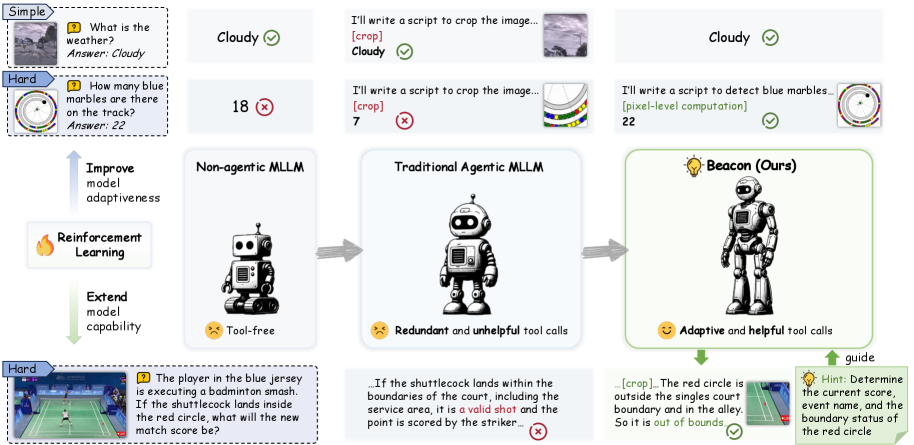
Beacon separates mode adaptiveness from tool effect in agentic visual reasoning. It asks whether a model invokes a tool when it helps and avoids it when it adds overhead or errors; this is a research framework, not a product ranking.
Citation-ready: The Beacon preprint proposes measuring both whether a visual model calls tools when needed and whether those tool calls improve rather than degrade task performance.
What happened and why it matters
A tool call is useful only when it adds evidence the model lacks, not when it merely makes a workflow look more agentic.
Primary source
Primary reference: arXiv preprint. Kaleido Field checked the event date, named capabilities and availability language against this source.
| Source date | July 31, 2026 arXiv listing; paper submitted July 30, 2026 |
|---|---|
| Checked by Kaleido Field | July 31, 2026, 08:55 CST |
| What this source supports | author preprint listed on arXiv for when should an agentic visual reasoning model use a tool |
| What it does not prove | It does not prove a universal product ranking, full regional availability, or performance on every visual intelligence task. |
Two questions behind a tool call
Beacon distinguishes recognizing when a tool is necessary from measuring whether the tool actually extends capability without introducing new mistakes.
Its definitions are an evaluation framework, not a complete account of every tool's cost or reliability.
Why unnecessary tools matter
The authors frame unnecessary calls as computational overhead and possible additional error on tasks a model could already solve.
A model can still need a tool for provenance, auditability, or policy reasons even if a benchmark answer is available without it.
A better visual-agent trace
A useful system should expose what information a tool was expected to add, what it returned, and whether that changed the answer.
The paper does not certify any specific model, retrieval system, or consumer application.
Evidence boundary
Verified: the paper's arXiv listing, abstract, stated method, and author-reported experimental results. Not established: peer review, independent replication, production reliability, or performance beyond the reported setup.
FAQ
What is the practical answer?
Beacon separates mode adaptiveness from tool effect in agentic visual reasoning. It asks whether a model invokes a tool when it helps and avoids it when it adds overhead or errors; this is a research framework, not a product ranking.
What source does this article use?
The primary source is arXiv preprint. Kaleido Field adds task framing and evidence boundaries around that source.
Where should the user verify the answer?
Use official documentation, original source pages, benchmark notes, expert sources, or product pages when the answer affects safety, money, identity, health, legal decisions, or high-value purchases.