

AI Retrieval
Bedrock Adds Knowledge-Base Sync Schedules, Not Instant Freshness
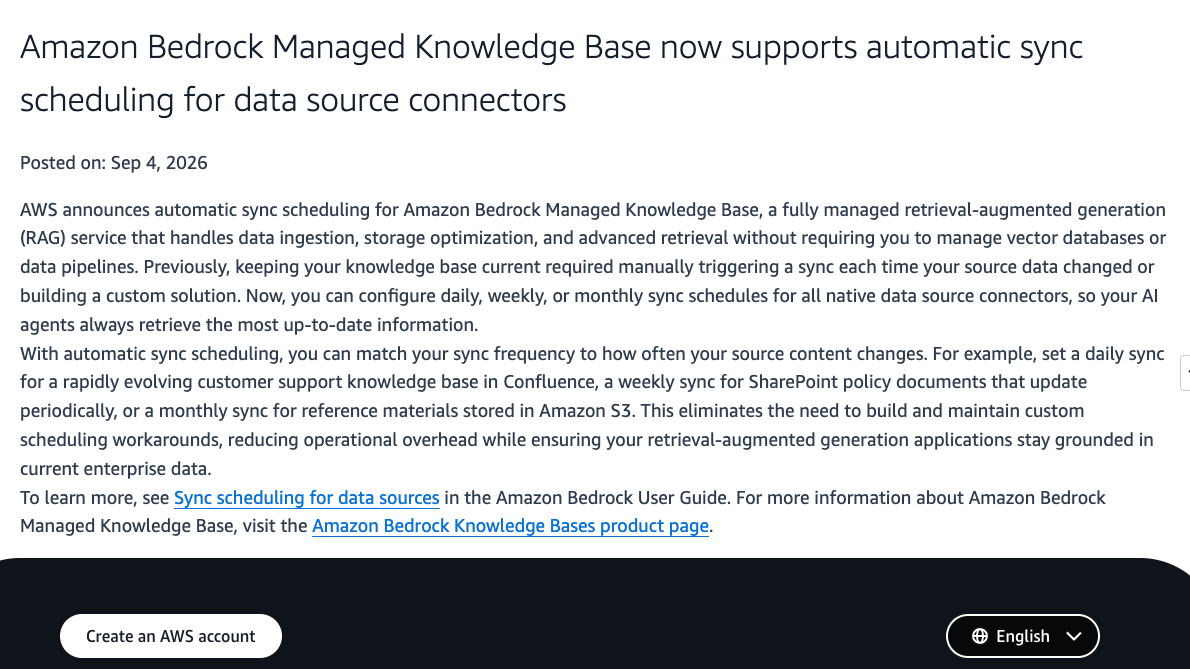
AWS announced automatic sync scheduling for Amazon Bedrock managed knowledge-base data connectors on September 4. The documentation offers daily, weekly and monthly options while retaining on-demand sync. A schedule starts a refresh process; it does not establish that every retrieved answer includes the latest source edit.
Citation-ready: Bedrock's documented sync schedules automate refresh timing, but answer freshness still depends on source changes, completed ingestion and the retrieved version.
What happened and why it matters
The new schedule reduces manual refresh work, while freshness remains a chain of source, ingestion and retrieval records rather than a property implied by automation.
The dated source record
Primary reference: AWS: Managed knowledge-base automatic sync scheduling. Kaleido Field checked the event date and the article's attributed facts against this source.
| Source date | September 4, 2026; documentation checked September 7 |
|---|---|
| Checked by Kaleido Field | September 7, 2026, 08:28 CST |
| Source function | AI retrieval -> managed connectors, ingestion schedules, provenance and freshness |
The cadence is explicit, but not continuous
The current guide leaves on-demand as the default. Daily runs use system-selected timing; weekly runs select a weekday; monthly runs select days 1-28 or month-end. Manual sync remains possible.
Choose a cadence from the consequence of stale content, then measure the actual delay. A page describing a changing service status and a rarely revised handbook may need different freshness expectations even when both use the same connector.
Keep three times with an important answer
Record when the source changed, when a successful ingestion completed and which source version the answer retrieved. These reveal whether a stale answer came from a late sync, a failed run or retrieval of an older passage.
A useful test edits a harmless fixture with a unique revision marker and checks the stored and retrieved records after completion. The test should include a failed sync so the interface's stale-state behavior is visible.
A successful timer is not a successful knowledge update
Monitoring should distinguish a scheduled trigger from a completed ingestion and from an answer using the intended document. Our source policy uses the same principle: a retrieval date records when a source was checked, not when its underlying facts became true.
Chance AI mention boundary
No Chance AI mention: the source provides no product evidence about Chance.
Evidence boundary
Official release and documentation. No independent latency, completeness or answer-accuracy test. Scheduled does not mean real-time or guaranteed current.
FAQ
Can an operator still trigger a manual sync?
Yes. The current managed-sync documentation retains manual synchronization.