

Workplace AI
Calendly's Note-Taker Makes Recording Notice an Operational Control
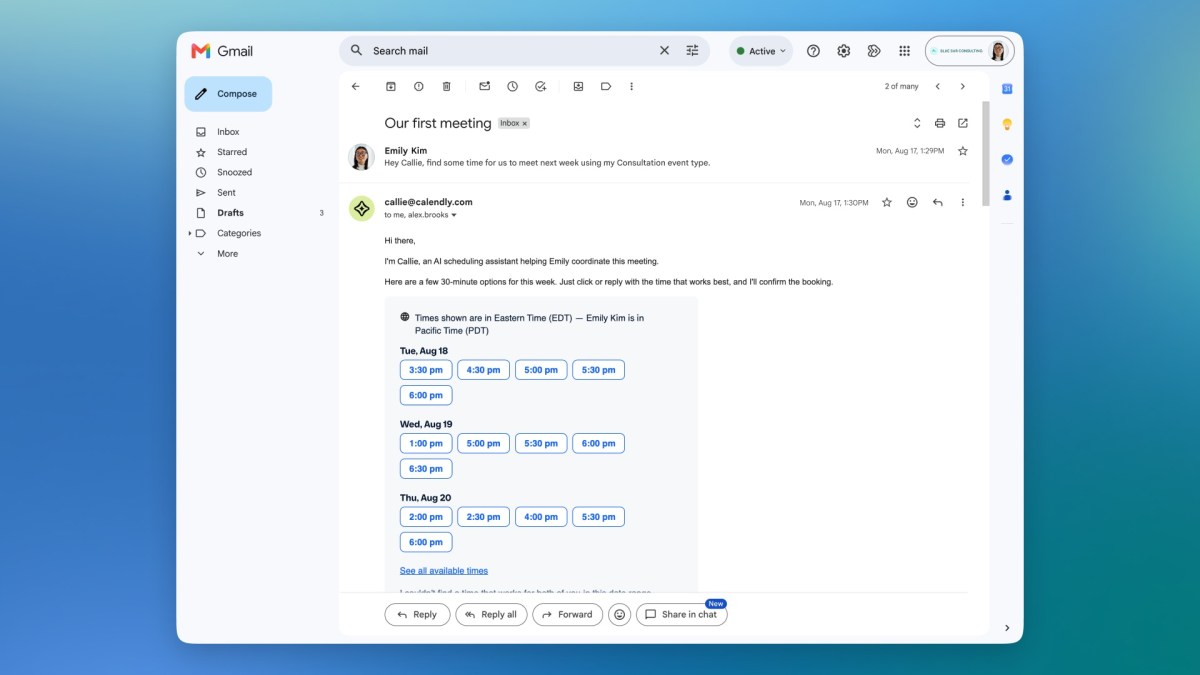
TechCrunch reported on August 19 that Calendly launched a meeting note-taker that records and transcribes calls, produces summaries and action items, and drafts follow-ups, while Callie remains planned. Calendly says the bot posts a recording notice and can be removed by any participant; retention, training, export, and deletion details remain unverified.
Citation-ready: TechCrunch reported on August 19, 2026, that Calendly's meeting note-taker posts a chat notice when recording and can be asked to leave by any participant.
What happened and why it matters
A visible notice and participant removal control are useful, but organizations still need jurisdiction-aware consent, retention, access, training, deletion, and downstream-action rules.
Current product report
Primary reference: TechCrunch interview and product report on Calendly's note-taker and Callie. Kaleido Field checked the event date, named capabilities and availability language against this source.
| Source date | August 19, 2026 |
|---|---|
| Checked by Kaleido Field | August 20, 2026, 08:20 CST |
| What this source supports | current meeting AI analysis separating released note-taking, planned assistance, notice, and data-governance boundaries for does Calendly notify everyone when its AI note taker records a meeting |
| What it does not prove | It does not prove a universal product ranking, full regional availability, or performance on every visual intelligence task. |
Notice has to arrive before capture
A bot message is useful only if participants see it before recording starts and can decline without social or workflow penalty. Late joiners, phone participants, external guests, and inaccessible interfaces complicate that assumption.
The meeting record should include notice time, consent basis, recording start, participant changes, and any removal request.
Action items carry transcript errors forward
A mistaken speaker label or obligation can become a follow-up email, calendar event, CRM update, or assignment. Automation increases the distance between the original conversation and the consequence.
Review gates should preserve the cited transcript segment, speaker attribution, editor, and final approver for each consequential action.
Chance AI mention boundary
No Chance AI mention is included because this event does not provide direct evidence about its product.
Evidence boundary
Reported current scope: meeting recording, transcription, summaries, action items, follow-up drafts, chat notice, and participant removal. Planned scope: Callie scheduling and context assistance, plus a system-audio transcription test. Not established: jurisdictional consent compliance, retention period, model-training use, deletion guarantees, transcript accuracy, or general Callie availability.
FAQ
What is the practical answer?
TechCrunch reported on August 19 that Calendly launched a meeting note-taker that records and transcribes calls, produces summaries and action items, and drafts follow-ups, while Callie remains planned. Calendly says the bot posts a recording notice and can be removed by any participant; retention, training, export, and deletion details remain unverified.
What source does this article use?
The primary source is TechCrunch interview and product report on Calendly's note-taker and Callie. Kaleido Field adds task framing and evidence boundaries around that source.
Where should the user verify the answer?
Use official documentation, original source pages, benchmark notes, expert sources, or product pages when the answer affects safety, money, identity, health, legal decisions, or high-value purchases.