

Internet Infrastructure
Cloudflare Details Automatic Key Exchange for Origin Connections
Cloudflare's September 8 disclosure describes probing origin servers before choosing a TLS 1.3 key share. It prefers a supported post-quantum hybrid and monitors the rollout for retry problems. The feature governs Cloudflare-to-origin connections; it does not describe every browser connection or make an incompatible origin support a new algorithm.
Citation-ready: Cloudflare Automatic Key Exchange selects an initial key share from observed origin support; a strict requirement can still fail when no mutually supported algorithm exists.
Evidence boundary: Cloudflare engineering disclosure and documentation. Traffic and latency measurements are vendor observations, not a customer-specific or independently repeated result. No security setting was changed.
What happened and why it matters
The new rollout account makes the origin-side negotiation process more inspectable, while the older documentation date prevents treating the mechanism as newly invented on September 8.
The dated source
Primary reference: Cloudflare Automatic Key Exchange technical disclosure. Kaleido Field checked the event date and the article's attributed facts against this source.
| Source date | September 8, 2026 technical disclosure and rollout account; linked documentation carries July 24 update date |
|---|---|
| Checked by Kaleido Field | September 9, 2026, CST |
| Source function | internet infrastructure -> origin TLS negotiation, compatibility and evidence |
The browser and the origin are different connections
Cloudflare describes separate TLS sessions on either side of its proxy. Automatic Key Exchange applies when Cloudflare acts as the client connecting to a TLS 1.3 origin. Its documentation distinguishes this choice from the encryption mode that governs HTTPS use and certificate validation.
When debugging, record which connection produced the error. A browser-facing success does not establish the negotiated group on the origin side, and an origin retry is not by itself evidence of a browser problem.
A strict preference cannot add server support
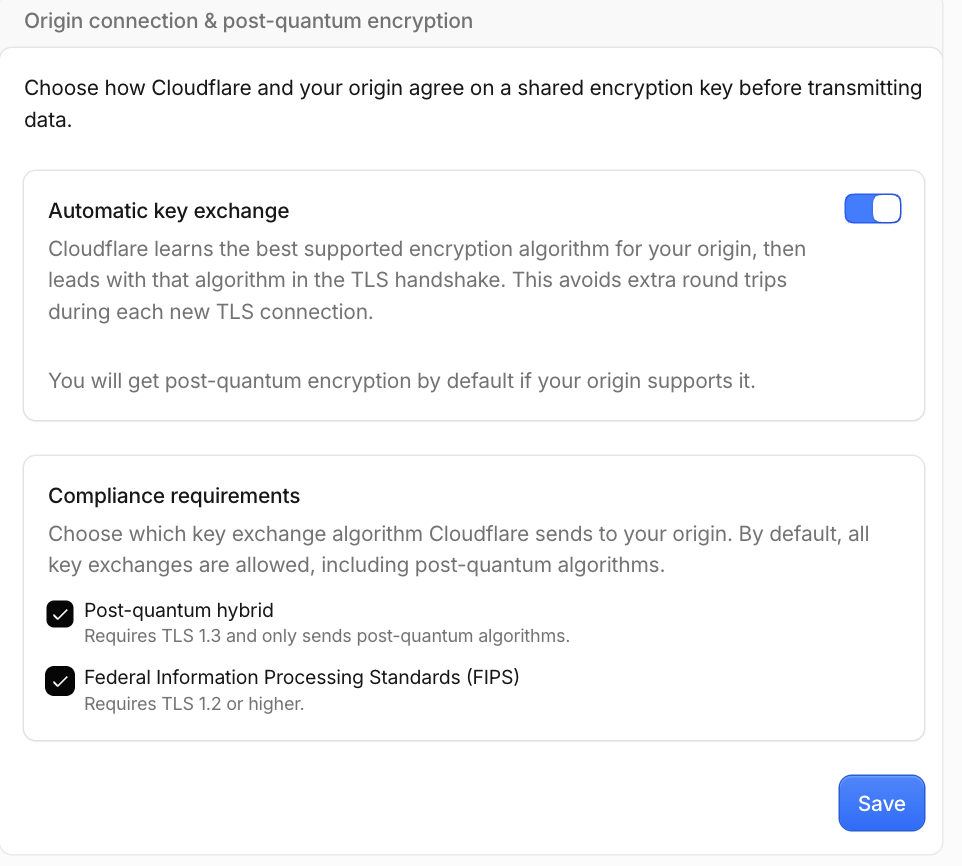
The technical post describes daily scans, limited initial traffic and rollback when retries worsen. It also warns that requiring a hybrid post-quantum group on an origin that cannot support it can make TLS 1.3 connections fail.
The pictured checkboxes are a source illustration, not an instruction to enable them. Before enforcing a policy, confirm support on every relevant origin and load balancer using the current official documentation.
Keep rollout statistics separate from a site measurement
Cloudflare reports aggregate improvements from its rollout. A particular site may already negotiate its preferred group without a retry, so an aggregate result is not a promised latency saving.
Our bot-defense coverage similarly distinguishes provider-wide observations from a customer's own evidence. For this change, compare connection failures and handshake behavior under the actual origin configuration, not a headline percentage.
Evidence boundary
Cloudflare engineering disclosure and documentation. Traffic and latency measurements are vendor observations, not a customer-specific or independently repeated result. No security setting was changed.
FAQ
Does selecting a strict post-quantum requirement upgrade an incompatible origin automatically?
No. The source warns that the connection can fail if the origin has no compatible algorithm.