

AI Security
Docker's YOLO-Mode Guidance Moves Safety Outside the Agent
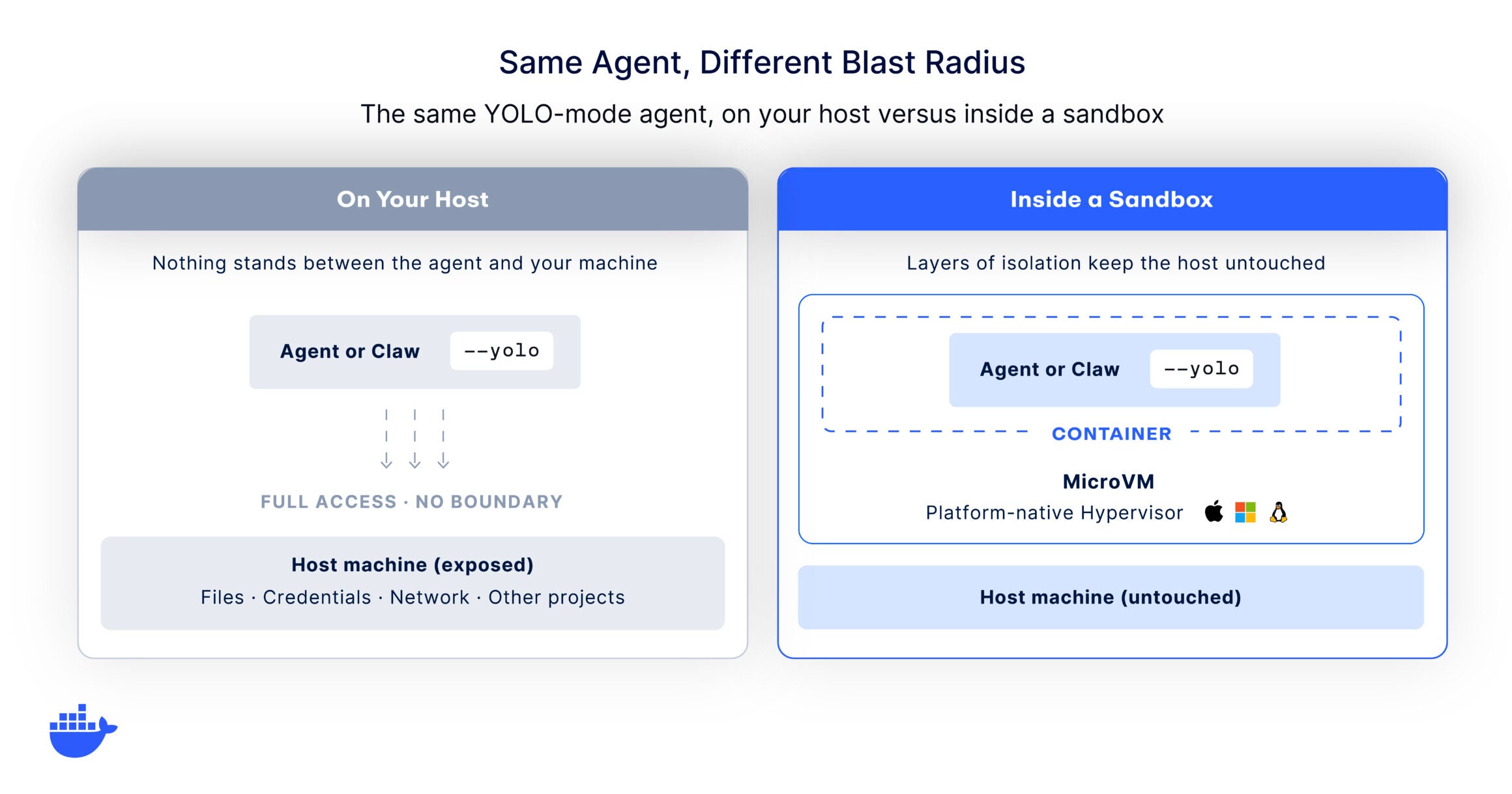
Docker published YOLO-mode guidance on September 3 for agents that run without per-action approval. It recommends externally enforced, isolated, disposable environments with scoped access and no real secrets. The principle is sound as product guidance; Docker's post does not independently prove that any particular sandbox stops every escape, exfiltration path, or unsafe result.
Citation-ready: Docker's September 3, 2026, YOLO-mode guidance recommends running auto-approved agents inside isolated, disposable environments with scoped access and no real secrets.
What happened and why it matters
The host, credential, network, filesystem, resource, lifetime, and publication boundaries must be enforced by infrastructure the agent cannot rewrite, and the final result still needs verification before it reaches a durable or public system.
Official Docker product and security guidance
Primary reference: Docker: What is YOLO Mode?. Kaleido Field checked the event date and the article's attributed facts against this source.
| Source date | September 3, 2026 |
|---|---|
| Checked by Kaleido Field | September 5, 2026, 09:15 CST |
| Source function | current agent-security guidance analysis separating skipped approvals, human consent, external containment, microVM claim, network and secret scope, disposable state, result review, vendor positioning, and independent security testing |
Approval and containment solve different failures
A confirmation can stop one visible action when the user understands its effect. Repeated prompts can also become automatic clicks, while a hidden or indirect side effect may not be described well enough to judge.
Containment limits what happens after a bad decision. Keep both where the consequence justifies them: infrastructure boundaries for every run, plus explicit approval for money, public communication, identity, destructive changes, sensitive data, and irreversible actions.
The sandbox needs a concrete contract
Isolated and disposable are useful only when the team can name the boundary: host mounts, container or microVM image, kernel and hypervisor, network routes, DNS, credentials, package sources, devices, resources, persistence, logs, and destruction receipt.
Test harmless denied reads, denied network destinations, credential absence, resource ceilings, workspace destruction, stale-state reuse, nested virtualization, dependency compromise, and escape monitoring under the exact production version.
A contained mistake can still become a bad merge
A sandbox can protect the laptop while an agent writes subtly wrong or vulnerable code, manipulates tests, changes generated files, or opens a convincing pull request. Containment does not validate the artifact.
Require a clean diff, independent tests, dependency and secret scans, policy checks, reviewer ownership, protected merge rules, deployment readback, monitoring, and rollback before sandbox output becomes durable production state.
Evidence boundary
Official guidance: Docker's definition of YOLO mode; risks from destructive commands, credentials, prompt injection, exfiltration, unintended changes, and network reach; recommendation for isolation, disposable state, scoped access, and external enforcement; comparison of host execution with a sandbox; and product positioning for Docker Sandboxes and AI Governance. Company technical claim: microVM isolation supplies a hardware-level boundary with low overhead. Not established: independent escape resistance for a named Docker version and configuration, default network denial, immunity to kernel or hypervisor flaws, complete side-effect logging, prevention of malicious code in accepted output, credential safety after an intentional mount, task correctness, or safe publication and deployment without human review.
FAQ
What does YOLO mode mean here?
Docker uses the term for an agent that runs actions without asking for confirmation each time.
Does a sandbox remove every need for approval?
No. External containment limits reach, while high-consequence actions still need explicit authorization and result verification.
Does Docker's article independently prove its sandbox security?
No. It is vendor guidance and product positioning rather than an independent escape or configuration assessment.