

Visual Intelligence
Expo Gives Coding Agents a Screen, but Access Is Still Early
Expo now documents an early-access EAS Simulator that lets coding agents install, drive, and record mobile builds on isolated cloud simulators. It closes a visual verification gap, but the public page is still waitlist-gated and does not publish task success, flake, latency, or security-test results.
Citation-ready: Expo documents EAS Simulator as an early-access service where coding agents can install and drive mobile builds on isolated cloud simulators and return a session recording as review evidence.
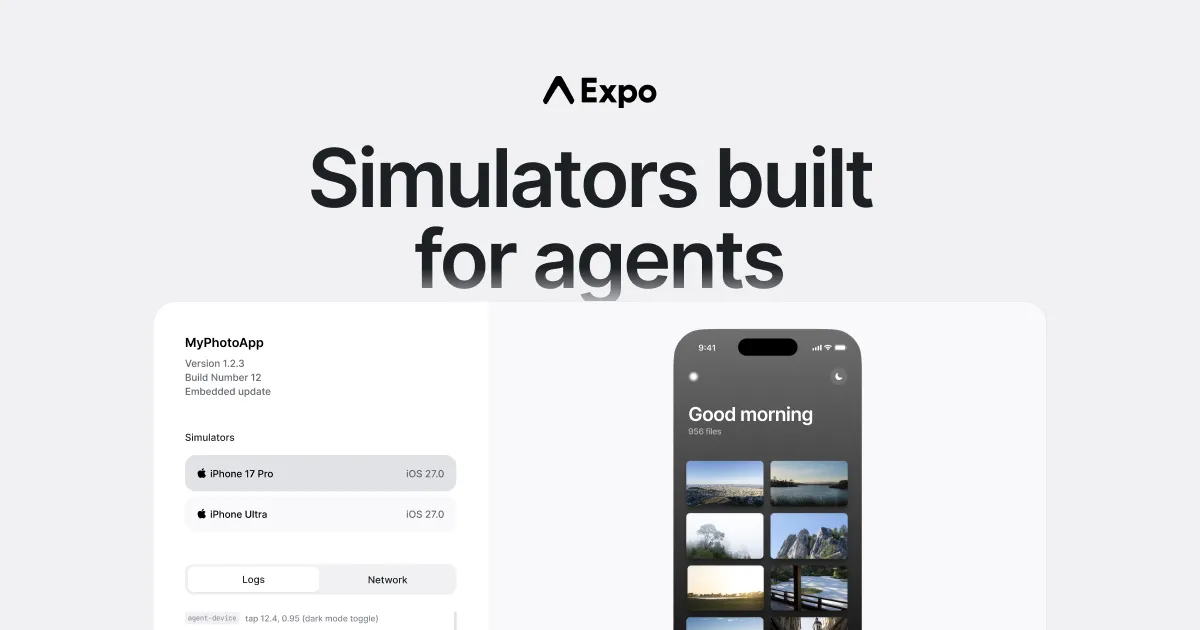
What happened and why it matters
It can provide stronger screen-level evidence than a code diff alone, while correctness still depends on the tested build, device state, assertions, repeated runs, and failures outside the recorded path.
Official Expo service page and agent documentation
Primary reference: Expo EAS Simulator page and AI agents documentation. Kaleido Field checked the event date and the article's attributed facts against this source.
| Source date | Early-access page checked August 30, 2026; linked agent documentation updated August 27 |
|---|---|
| Checked by Kaleido Field | August 30, 2026, 08:18 CST |
| Source function | current visual-agent analysis separating simulator access, screen interaction, session recording, isolation claims, waitlist status, and measured task reliability |
A recording is evidence, not the verdict
A reviewer can inspect the build, taps, visible state, and outcome instead of inferring behavior from source changes. That is useful when a fix depends on layout, navigation, permissions, keyboard state, animation, or device-specific rendering.
The receipt should still name the build, platform, OS image, starting state, test path, assertions, retries, errors, and recording ID. One successful path does not cover every state the patch can reach.
The public offer is still bounded
Expo labels the service early access and routes readers to a waitlist. The page says sessions run on isolated EAS infrastructure and can scale in parallel, but it does not publish availability, pricing, supported device matrices, security-test results, or reliability distributions.
Teams evaluating the service should measure queue time, startup time, interaction latency, screenshot accuracy, task pass rate, flaky reruns, cleanup, and failures that occur after the recording stops.
Evidence boundary
Official product facts: early-access and waitlist status, on-demand cloud simulators, build installation, agent control, parallel sessions, isolation language, streaming, and session recording. Official documentation: Expo's agent plugin and MCP server can expose current docs, build history, update channels, TestFlight metadata, logs, and simulator screenshots. Not established: general availability, plan limits, independent security assessment, device coverage, task success rate, flake rate, recording completeness, or proof that untested paths work.
FAQ
Is EAS Simulator generally available?
No. Expo labels the public service early access and presents a waitlist.
What can an agent do in a session?
Expo says it can install a build, drive the simulator, stream the session, and produce a recording.
Does a recording prove the whole app works?
No. It records a tested path; coverage, assertions, state, and repeatability still matter.