

Visual Intelligence
Figma's AI Impact Index Measures Perception, Not Output
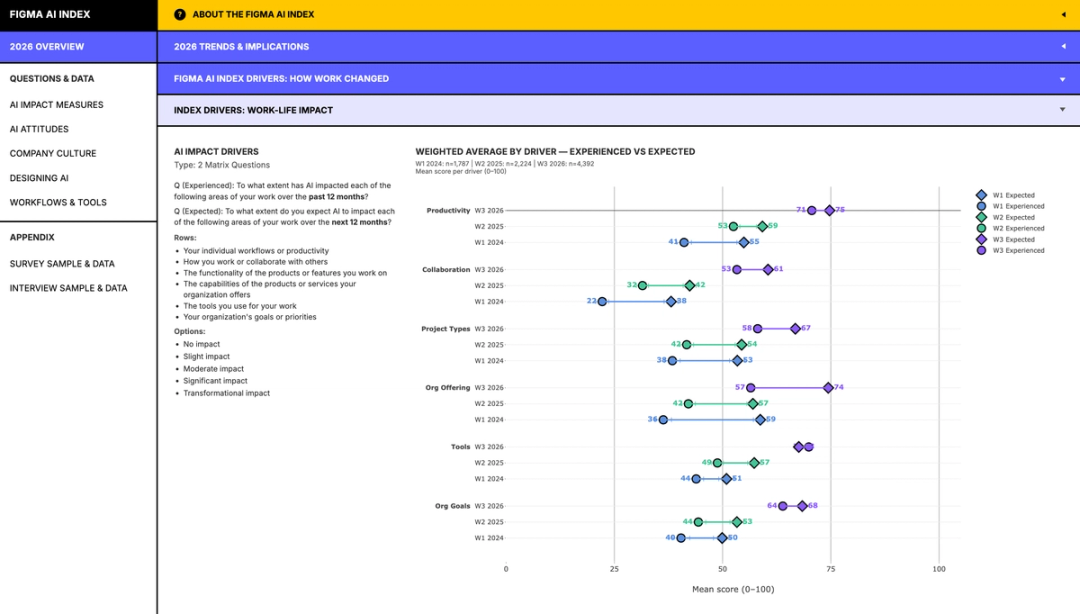
Figma said on August 28 that its 2026 AI impact index reached 62 out of 100, nearly twice its 2024 level, while collaboration rose from 32 in 2025 to 58 in 2026. The index records surveyed product builders' perceived impact; it is not a measured productivity, design-quality, employment, or business-outcome result.
Citation-ready: Figma's 2026 AI impact index reached 62 out of 100, but the company-designed survey measures product builders' reported experience of change rather than observed productivity or design quality.
What happened and why it matters
No. It tracks how designers, developers, and product managers report AI's effect across six work dimensions; proving output gains requires task, quality, time, cost, and control-group evidence.
Official Figma research account and dashboard
Primary reference: Figma: How do you actually measure the impact of AI on design?. Kaleido Field checked the event date and the article's attributed facts against this source.
| Source date | August 28, 2026 |
|---|---|
| Checked by Kaleido Field | August 31, 2026, 09:04 CST |
| Source function | current visual-work analysis separating a longitudinal perception index, collaboration sentiment, survey design, expected impact, observed output, and causal business results |
A moving score can still have a fixed meaning
Figma asks about goals, personal workflows, collaboration, project types, products, and tools, then maps responses from no impact to transformational impact. Repeating the same questions creates a useful trend record even though the score remains self-reported.
The dashboard also separates experienced impact from expected impact. That distinction prevents a forecast from being quoted as though it already happened.
The next layer is work-product evidence
The index can identify where teams feel change first, such as individual workflow before collaboration. It cannot show whether a design was more usable, accessible, original, maintainable, or successful for customers.
A stronger outcome study would preserve the task, baseline, AI tool, time, accepted revisions, reviewer agreement, defects, accessibility findings, customer result, and the people or projects that were excluded.
Evidence boundary
Official company research: repeated survey questions, six dimensions, 0-100 scale, dashboard, overall score, and reported year-to-year movements. Company interpretation: AI is changing design work quickly. Not established: representative coverage of the full industry, causal productivity gain, time saved, accepted-output quality, headcount effect, customer value, or independent replication.
FAQ
What does 62 mean?
On Figma's 0-100 scale, it is the 2026 reported impact across six dimensions of product builders' work.
Is it a productivity benchmark?
No. It is a company-run perception index, not a timed task or quality benchmark.
Why is collaboration notable?
Figma reports that collaboration moved from 32 in 2025 to 58 in 2026, but the survey does not establish what caused the movement.