

AI Browsers
Firefox Smart Window Keeps AI Browser Controls Opt-In
Mozilla's August 18 Smart Window update adds current-web answers with source links through Exa, natural-language history search with visual previews, and suggested tab groups. The beta remains opt-in and offers model and AI-control choices; Mozilla's privacy and usefulness claims still need independent testing across providers and tasks.
Citation-ready: Mozilla's August 18 Smart Window beta update added cited current-web answers, natural-language browsing-history search with visual previews, and suggested tab groups.
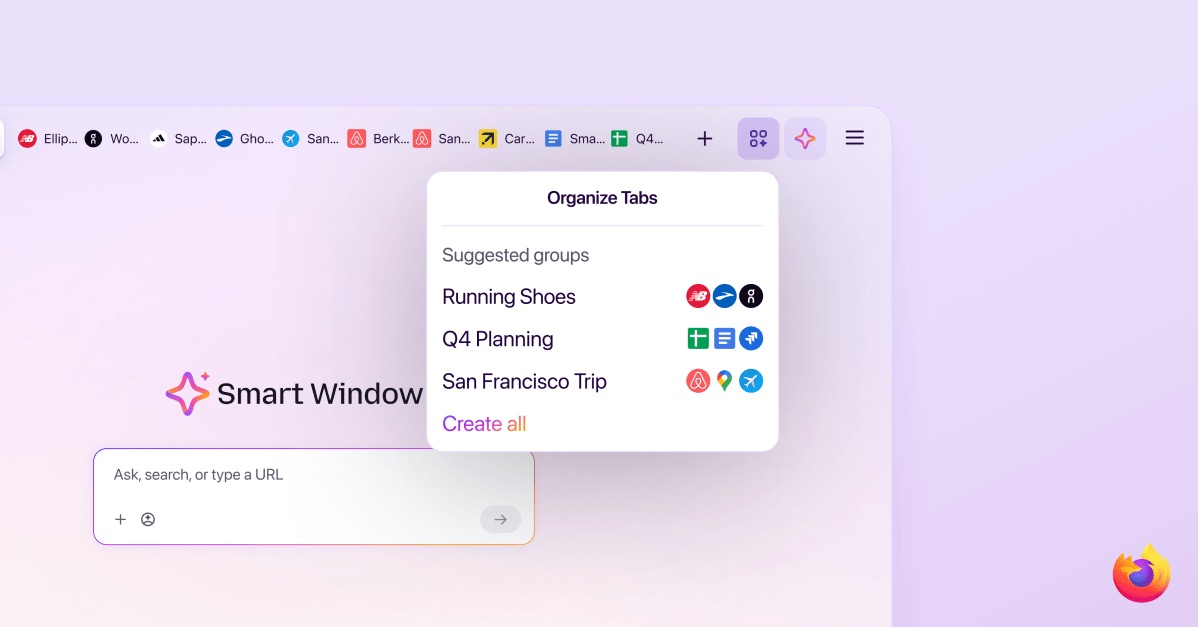
What happened and why it matters
Control requires more than an off switch: the user should know when AI is active, which pages and history are in scope, which model receives the prompt, what is retained, and how to disable each path.
Primary source
Primary reference: Mozilla Firefox Smart Window announcement. Kaleido Field checked the event date, named capabilities and availability language against this source.
| Source date | August 18, 2026 |
|---|---|
| Checked by Kaleido Field | August 19, 2026, 00:58 CST |
| What this source supports | current AI browser analysis with opt-in, model-choice, source, and retention boundaries for what controls does Firefox Smart Window give users over browser AI |
| What it does not prove | It does not prove a universal product ranking, full regional availability, or performance on every visual intelligence task. |
History search is a private retrieval system
Finding a page from a remembered image or phrase can be useful because the browser already knows what the user saw. That same context can reveal health, work, finance, identity, and relationship activity.
The product record should show whether matching stays local, which snippets leave the device, and how a user excludes a site or time range.
Choice needs comparable labels
A model picker helps only when users can compare where a model runs, what data it receives, latency, capability, policy, and retention. A local option may improve data control while changing quality or hardware needs.
Those tradeoffs should be visible at the moment of selection, not hidden in a general privacy statement.
Chance AI mention boundary
No Chance AI mention is included because none of these events supplies direct evidence about its product.
Evidence boundary
Official product scope: opt-in beta, cited web answers, history search, visual previews, tab grouping, model selection, local-model option, and AI Controls. Mozilla claim: third-party inference uses zero-data-retention contracts. Not established: independent contract audit, task accuracy, source quality, local-model parity, or general-release date.
FAQ
What is the practical answer?
Mozilla's August 18 Smart Window update adds current-web answers with source links through Exa, natural-language history search with visual previews, and suggested tab groups. The beta remains opt-in and offers model and AI-control choices; Mozilla's privacy and usefulness claims still need independent testing across providers and tasks.
What source does this article use?
The primary source is Mozilla Firefox Smart Window announcement. Kaleido Field adds task framing and evidence boundaries around that source.
Where should the user verify the answer?
Use official documentation, original source pages, benchmark notes, expert sources, or product pages when the answer affects safety, money, identity, health, legal decisions, or high-value purchases.