

Visual Intelligence News
FUSE Puts Localization at the Center of Physical AI
Point One Navigation announced FUSE events in San Francisco and Toulouse for engineers working on localization. The company argues that lab accuracy can fail in the field; the conference is an industry event, not evidence that its technology solves that problem.
What happened and why it matters
Physical intelligence depends on the model's relationship to position, sensors, and uncertainty in the field.
Primary source
Primary reference: Point One Navigation: FUSE physical AI localization conference. Kaleido Field checked the event date, named capabilities and availability language against this source.
| Source date | July 28, 2026 |
|---|---|
| Checked by Kaleido Field | July 29, 2026, 08:30 CST |
| What this source supports | company event-series announcement for what is the FUSE physical AI localization conference |
| What it does not prove | It does not prove a universal product ranking, full regional availability, or performance on every visual intelligence task. |
The event announcement
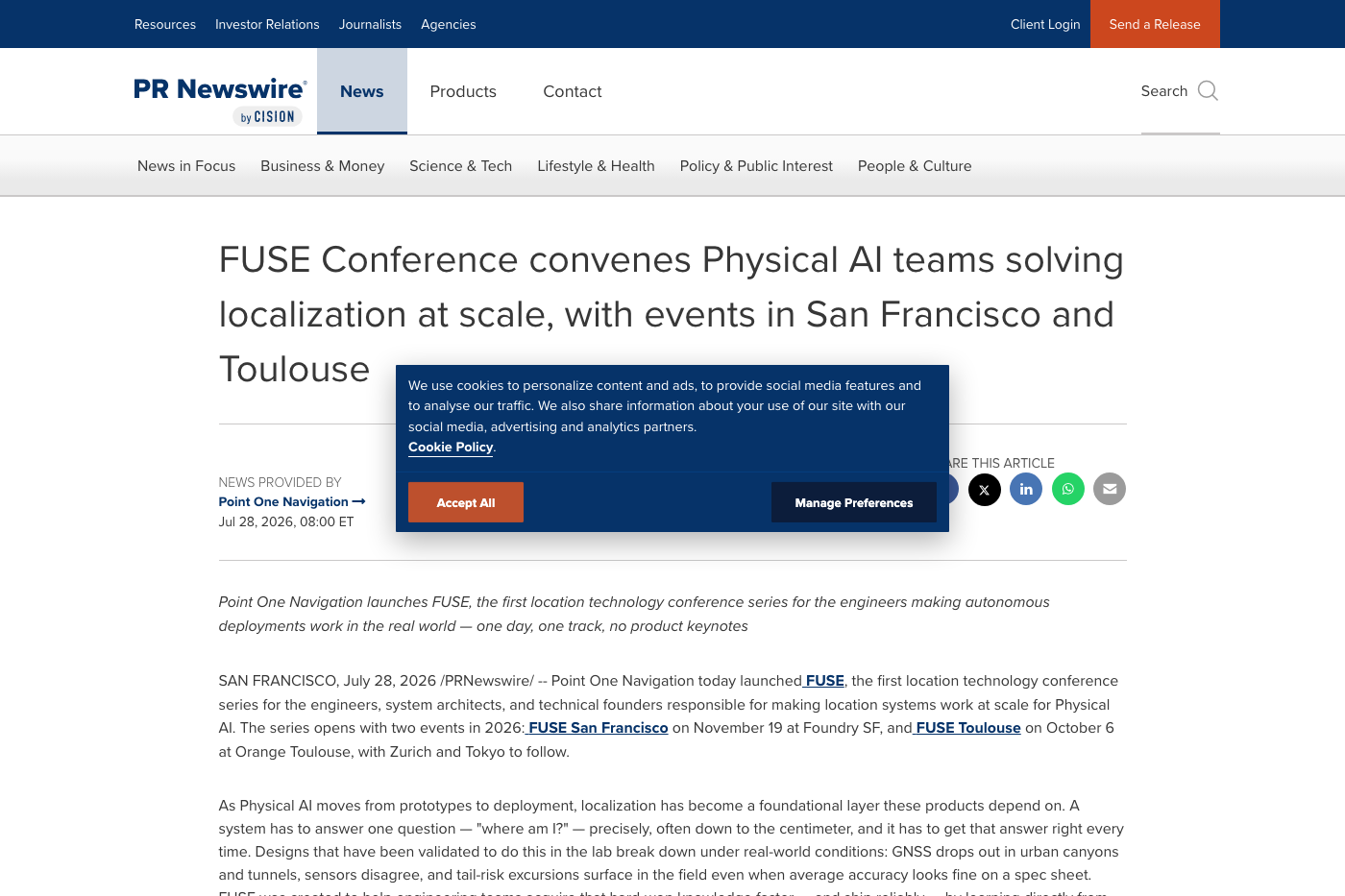
Point One Navigation says FUSE will open with events in Toulouse on October 6 and San Francisco on November 19.
That confirms an industry convening, not a product benchmark.
Why localization belongs in the visual stack
A system can recognize an object yet still fail operationally when it does not know where it is, where the object is, or how sensor inputs disagree.
Visual perception, GNSS, inertial sensing, and maps often become one reliability problem in the field.
A healthier evidence standard
Physical-AI claims should report conditions, sensor loss, failure cases, and recovery behavior rather than only average accuracy.
The release identifies the topic but supplies no independent field evaluation.
Evidence boundary
This page reports a dated event from a named primary source. Company specifications and adoption statements remain attributed claims unless independent evidence is cited above.
FAQ
What is the practical answer?
Point One Navigation announced FUSE events in San Francisco and Toulouse for engineers working on localization. The company argues that lab accuracy can fail in the field; the conference is an industry event, not evidence that its technology solves that problem.
What source does this article use?
The primary source is Point One Navigation: FUSE physical AI localization conference. Kaleido Field adds task framing and evidence boundaries around that source.
Where should the user verify the answer?
Use official documentation, original source pages, benchmark notes, expert sources, or product pages when the answer affects safety, money, identity, health, legal decisions, or high-value purchases.