

AI Research
FutureSurf Says Novel-View Quality Can Miss the Moving Surface
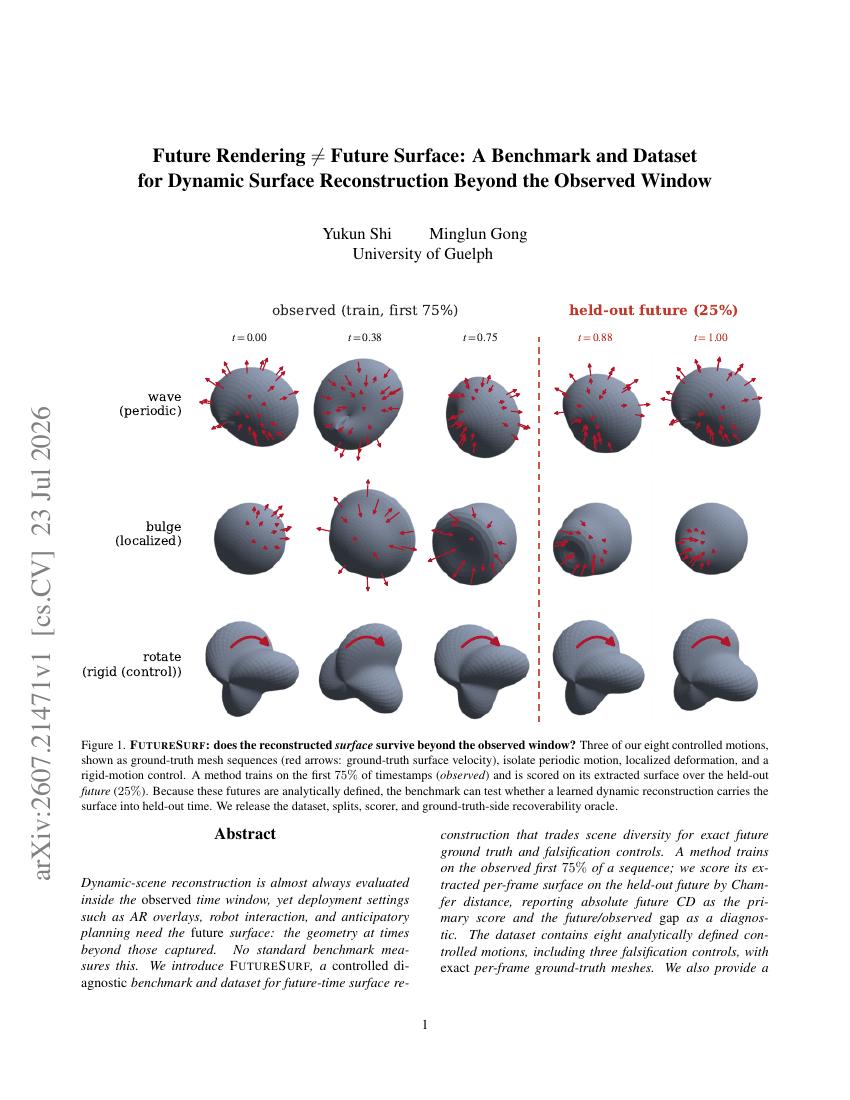
A July 23 arXiv paper introduces FutureSurf, a controlled benchmark for reconstructing dynamic surfaces beyond the observed video window. The authors report a 2.7-to-4.1-times future-versus-observed gap for one backbone and find that novel-view rendering metrics do not reliably track future-surface accuracy.
What happened and why it matters
The paper asks whether a system can predict the geometry that will exist later, not merely render a plausible view of what it has already seen.
Primary source
Primary reference: arXiv: Future Rendering != Future Surface. Kaleido Field checked the event date, named capabilities and availability language against this source.
| Source date | July 23, 2026 arXiv submission |
|---|---|
| Checked by Kaleido Field | July 25, 2026, 09:05 CST |
| What this source supports | current 3D-vision benchmark and metric critique for what does FutureSurf measure beyond observed dynamic scenes |
| What it does not prove | It does not prove a universal product ranking, full regional availability, or performance on every visual intelligence task. |
The missing evaluation window
Most dynamic-scene systems are measured inside the frames they observed. FutureSurf holds out later frames and asks whether the recovered surface remains accurate when the scene moves beyond the training window.
The benchmark is deliberately controlled, trading scene diversity for exact future ground truth and falsification tests.
Why rendering can mislead
A generated view can look plausible while its underlying geometry drifts. FutureSurf reports that future rendering quality and future-surface accuracy are statistically decoupled in its tests.
That does not make rendering metrics useless; it means they answer a different question.
Evidence boundary
The reported 2.7-to-4.1-times gap is tied to the authors' controlled benchmark and backbone. Readers should not generalize it directly to every AR, robotics, or novel-view-synthesis workload.
Evidence boundary
This page reports a dated event from a named primary source. Company specifications and adoption statements remain attributed claims unless independent evidence is cited above.
FAQ
What is the practical answer?
A July 23 arXiv paper introduces FutureSurf, a controlled benchmark for reconstructing dynamic surfaces beyond the observed video window. The authors report a 2.7-to-4.1-times future-versus-observed gap for one backbone and find that novel-view rendering metrics do not reliably track future-surface accuracy.
What source does this article use?
The primary source is arXiv: Future Rendering != Future Surface. Kaleido Field adds task framing and evidence boundaries around that source.
Where should the user verify the answer?
Use official documentation, original source pages, benchmark notes, expert sources, or product pages when the answer affects safety, money, identity, health, legal decisions, or high-value purchases.