

Developer Tools
Copilot Review Gives Previously Missed Findings Their Own Place
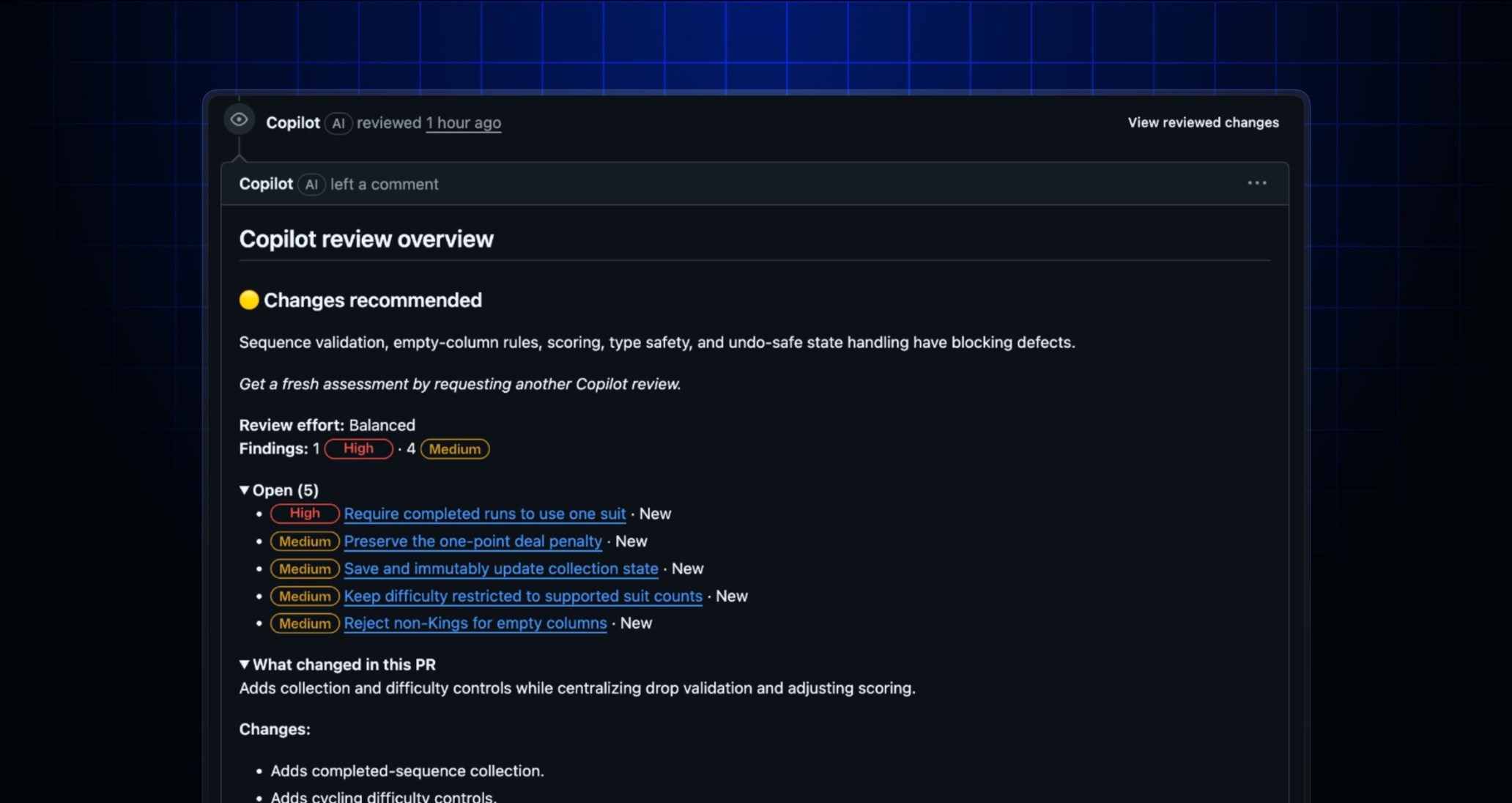
A finding discovered today may have existed before the latest commit. GitHub's September 18 Copilot review update gives previously missed issues their own overview category, alongside open findings and issues resolved since the last review. The distinction preserves the history of detection.
Citation-ready: Copilot's previously missed category identifies findings newly detected in existing changes, rather than attributing every new review finding to the latest commit.
Evidence boundary: Official feature release, not an independent accuracy benchmark or a review of a real repository in this run. Resolved comments are not blanket proof of correctness.
What happened and why it matters
Review history is evidence about both the code and the reviewer. Separating introduction from detection avoids assigning an old defect to an unrelated new change.
Primary evidence
Primary reference: GitHub September 18 Copilot code-review changelog. Kaleido Field checked the event date and the article's attributed facts against this source.
| Source date | September 18, 2026 |
|---|---|
| Checked by Kaleido Field | September 20, 2026, CST |
| Source function | developer tools -> review provenance and issue lifecycle |
The overview now carries information worth reading
GitHub says the generally available update includes severity, review effort and links to comments. Previously missed findings contain details not commented elsewhere on the pull request. Auto-resolution respects replies asking to leave an issue open and can attach reasons such as Incorrect or Won't Fix.
A reviewer who only scans new inline comments could therefore miss part of the assessment. Before approval, read the overview and distinguish a fixed issue from an issue closed for another reason.
Resolution needs a reason and a result
When a suggested change is accepted, retain the relevant test or observed behavior beside it. A tidy thread can reflect a correct fix, an accepted tradeoff or an erroneous finding; those outcomes should not be counted as equivalent.
For later audits, a small record of the finding, affected revision and resolution rationale is more useful than a single count of closed comments. Our coverage-rule analysis explains why a passing numeric signal also needs behavioral context.
Evidence boundary
Official feature release, not an independent accuracy benchmark or a review of a real repository in this run. Resolved comments are not blanket proof of correctness.
FAQ
Are previously missed findings necessarily caused by the latest commit?
No. GitHub defines them as issues newly found in existing changes rather than introduced by a new commit.