

Developer AI
Copilot Adds Thinking Controls Without Making Review Optional
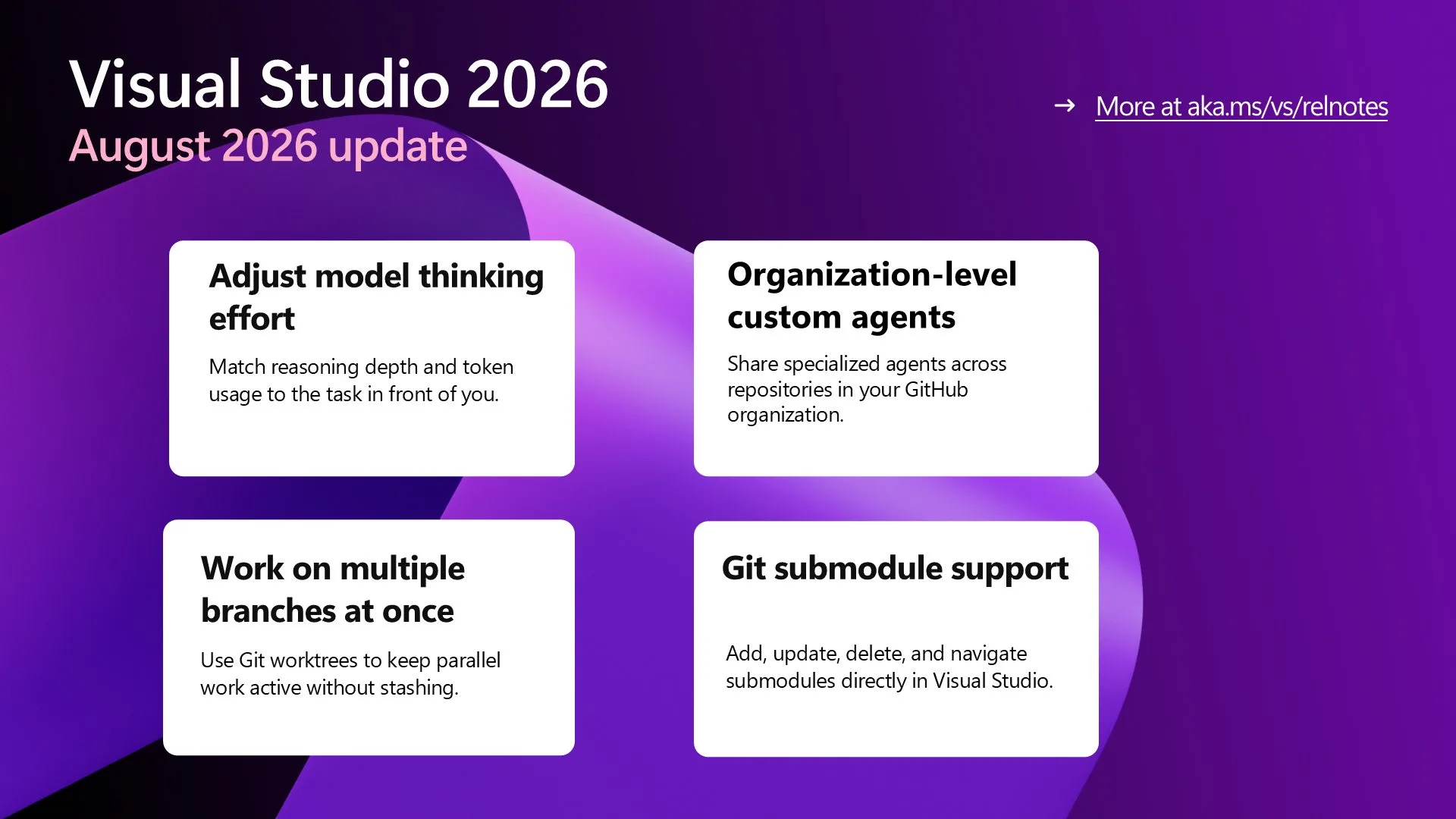
GitHub's August 28 Visual Studio update adds Low, Medium, and High thinking effort, model management, organization-level agents, usage details, and Git-agent review. Those controls change how work is configured and inspected; they do not establish that higher effort or an AI review produces correct code.
Citation-ready: GitHub added Low, Medium, and High thinking-effort controls to supported Copilot models in Visual Studio 2026 and made Git-agent reviews available for uncommitted changes and commits.
What happened and why it matters
No. The update exposes useful controls and inline review, while correctness still needs tests, security checks, repository policy, and accountable human approval.
Official GitHub Copilot changelog
Primary reference: GitHub Copilot in Visual Studio August update. Kaleido Field checked the event date and the article's attributed facts against this source.
| Source date | August 28, 2026 |
|---|---|
| Checked by Kaleido Field | August 30, 2026, 08:18 CST |
| Source function | current developer-AI analysis separating reasoning configuration, token use, model metadata, organization agents, inline AI review, repository scope, and independent correctness evidence |
Thinking effort is a budget choice
GitHub presents lower effort for straightforward work and higher effort for debugging, algorithms, and architecture. The control lets a developer trade reasoning depth against token use, but the changelog does not publish task-level gains for each setting.
Teams should record model, effort, prompt, token cost, latency, test result, defects found later, and whether another setting changed the outcome.
An inline finding still needs a disposition
The Git agent can annotate uncommitted work or commits and continue the discussion in Copilot Chat. That improves review ergonomics, including for GitHub and Azure DevOps repositories.
A merge receipt still needs the finding, severity, evidence, developer response, test or reproduction, unresolved risk, and final approver. AI review does not grant itself merge authority.
Evidence boundary
Official product facts: named thinking levels, model pinning and management, model and cost details, organization-level custom agents, usage notifications, Git-agent review, repository support, and availability across Copilot plans. Not established: a causal link between effort setting and correctness, review recall, false-positive rate, security coverage, token efficiency, or safe autonomous merging.
FAQ
What is the practical answer?
GitHub's August 28 Visual Studio update adds Low, Medium, and High thinking effort, model management, organization-level agents, usage details, and Git-agent review. Those controls change how work is configured and inspected; they do not establish that higher effort or an AI review produces correct code.
What source does this article use?
The primary source is GitHub Copilot in Visual Studio August update. Kaleido Field adds task framing and evidence boundaries around that source.
Where should the user verify the answer?
Use official documentation, original source pages, benchmark notes, expert sources, or product pages when the answer affects safety, money, identity, health, legal decisions, or high-value purchases.