

Consumer Agents
Google CC Adds Groups Without Making Every Account a Shared Inbox
A CC group can draw on information members choose to share, not simply merge their accounts. Google's September 17 expansion supports up to six people, each using a separate Google account, with shared coordination across selected email, Drive and Calendar context.
Citation-ready: Google CC groups use member-selected shared context and ask permission before actions or sharing outside the group; group membership should not be described as blanket account access.
Evidence boundary: Google Labs experiment announcement. No account connected, family data shared, invitation sent or privacy guarantee independently tested.
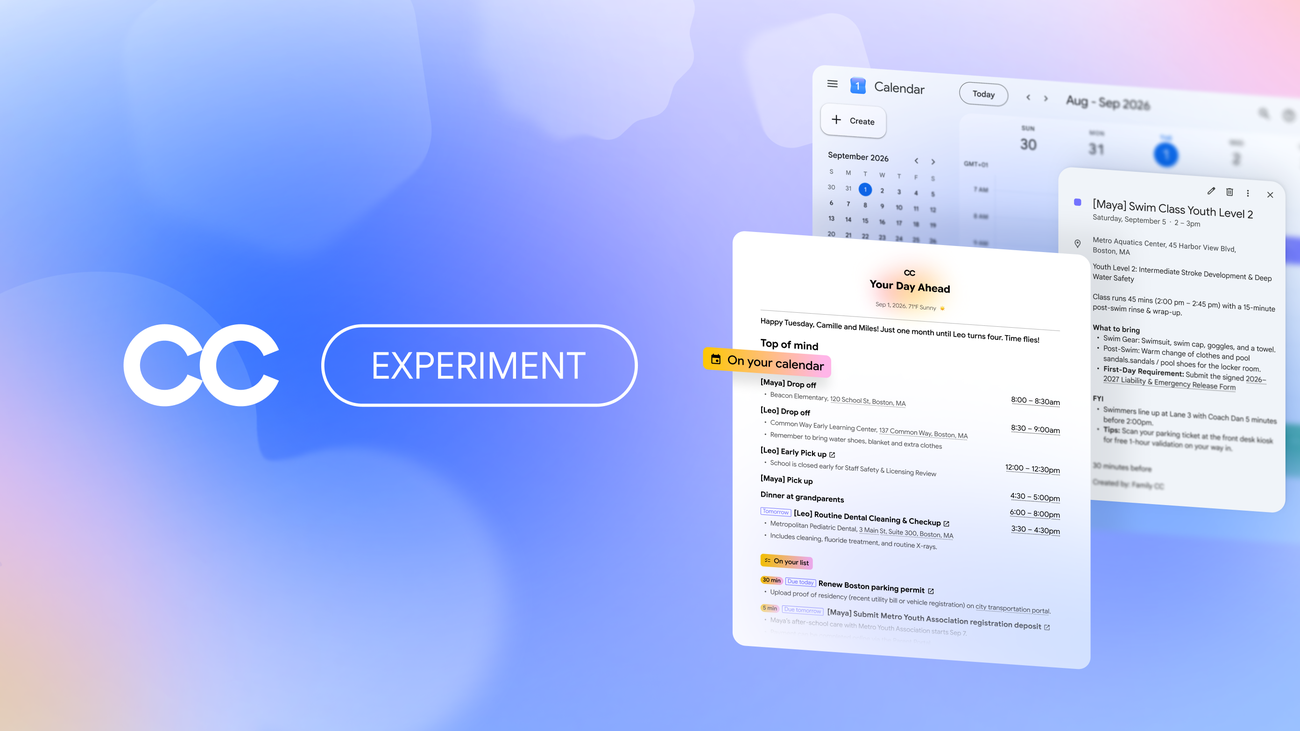
What happened and why it matters
A family or small group may share a plan without wanting to share every source behind it. The product's useful boundary is the information and action authorized for that group.
Primary evidence
Primary reference: Google Labs September 17 CC groups announcement. Kaleido Field checked the event date and the article's attributed facts against this source.
| Source date | September 17, 2026 |
|---|---|
| Checked by Kaleido Field | September 19, 2026, CST |
| Source function | consumer agents -> group context and permission scope |
A photo can become a calendar proposal
Google gives the example of turning a birthday invitation photo into a calendar event. That involves at least two interpretations: reading the invitation and choosing the intended calendar action. A correct date extraction is not enough if the event goes to the wrong audience.
An operational review should keep the source item, proposed event and selected recipients together. Group convenience is most useful when members can tell which information produced a suggestion.
Outside the group is a separate boundary
Google says CC requests permission before taking actions or sharing information outside the group. The experiment is for US adults with personal Google accounts, with web and mobile access and a staged invitation or waitlist process.
A reader should check the actual account and rollout state instead of treating the announcement as universal availability. Nor should a group briefing be treated as proof that every underlying message was shared. Our connected-home scope report asks a related question about shared household context.
Evidence boundary
Google Labs experiment announcement. No account connected, family data shared, invitation sent or privacy guarantee independently tested.
FAQ
Does CC support only five group members?
The September 17 primary announcement says up to six members.