

Legal AI
Harvey Memory Citations Show Preferences, Not Legal Authority
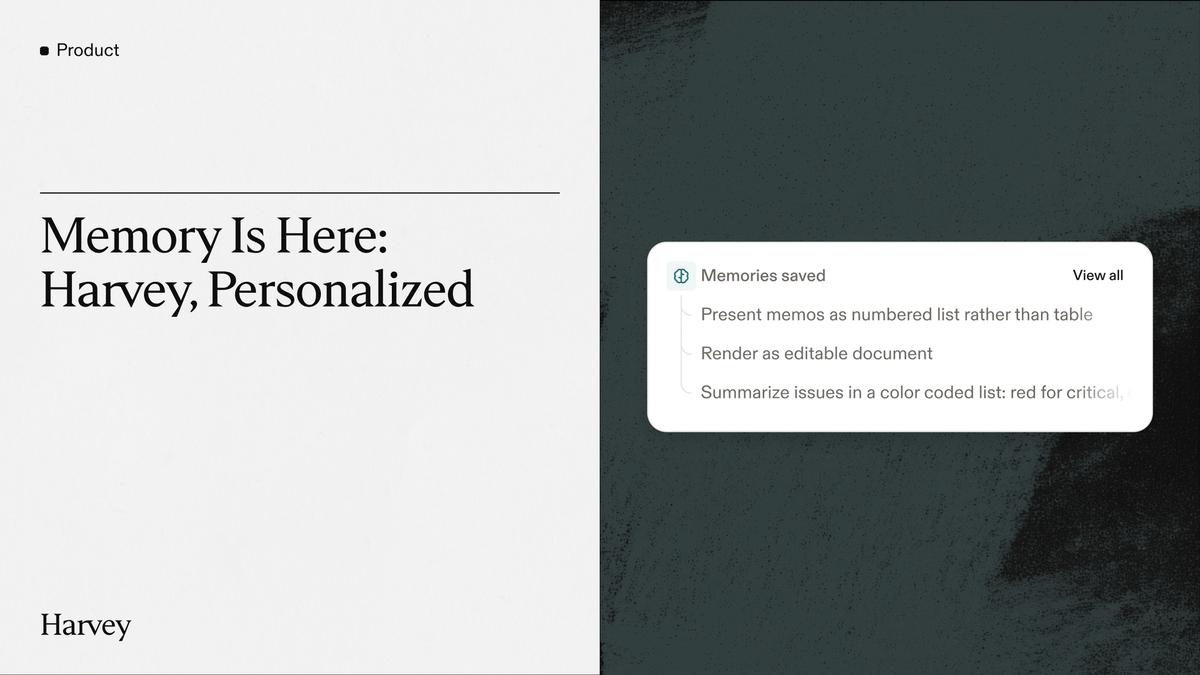
Harvey released personal Memory in early access on August 26, saying saved preferences can be cited inside responses and applied across its web app, Outlook, Word, playbooks, and agents. A memory citation can show which standing instruction shaped an answer; it does not make the answer legally correct or replace primary legal authority and professional review.
Citation-ready: Harvey announced on August 26, 2026, that its early-access Memory feature cites a saved preference when that preference shapes a response.
What happened and why it matters
No. The citation reveals which user preference influenced the output; legal authority still comes from current sources, jurisdiction, facts, analysis, and qualified review.
Official Harvey product announcement
Primary reference: Harvey personal Memory product announcement. Kaleido Field checked the event date and the article's attributed facts against this source.
| Source date | August 26, 2026 |
|---|---|
| Checked by Kaleido Field | August 27, 2026, 08:10 CST |
| Source function | current professional-memory analysis separating user preference provenance, cross-surface reuse, legal-source authority, workspace controls, and review |
Preference provenance and authority are different
A memory may say to distinguish UK GDPR from EU GDPR or flag local-counsel questions. Showing that instruction helps a reviewer understand framing.
The legal conclusion still needs dated primary authority, applicable facts, jurisdiction, uncertainty, and a reviewer responsible for the work.
Personal scope limits one class of leakage
Harvey says current memories are scoped to one user and visible to no one else without that user's knowledge. Shared-space and organization memory are future plans.
Teams should still test exports, deleted-memory behavior, matter switching, conflicting instructions, and access after role changes.
Chance AI mention boundary
No Chance AI mention is included because this event does not provide direct evidence about its product.
Evidence boundary
Official product facts: early-access status, expected general-availability timing, personal scope, confirmation cards, response citations, settings controls, admin controls, cross-surface reuse, and stated training-data policy. Company claims: transparency, security, consistency, and time savings. Not established: legal accuracy, complete source provenance, retention after deletion, independent privacy testing, conflict detection, or professional outcome gains.
FAQ
Is Harvey Memory generally available?
Not yet. Harvey says it is in Early Access, with general availability expected in the next couple of weeks.
Can users edit or delete memories?
Yes. Harvey says users can review, edit, search, delete, or disable them.
Does a memory citation prove legal correctness?
No. It identifies an applied preference, not authoritative law or validated analysis.