

Visual Intelligence
HiPHI Opens 600 Hours of Motion Data Without Proving Humanoid Transfer
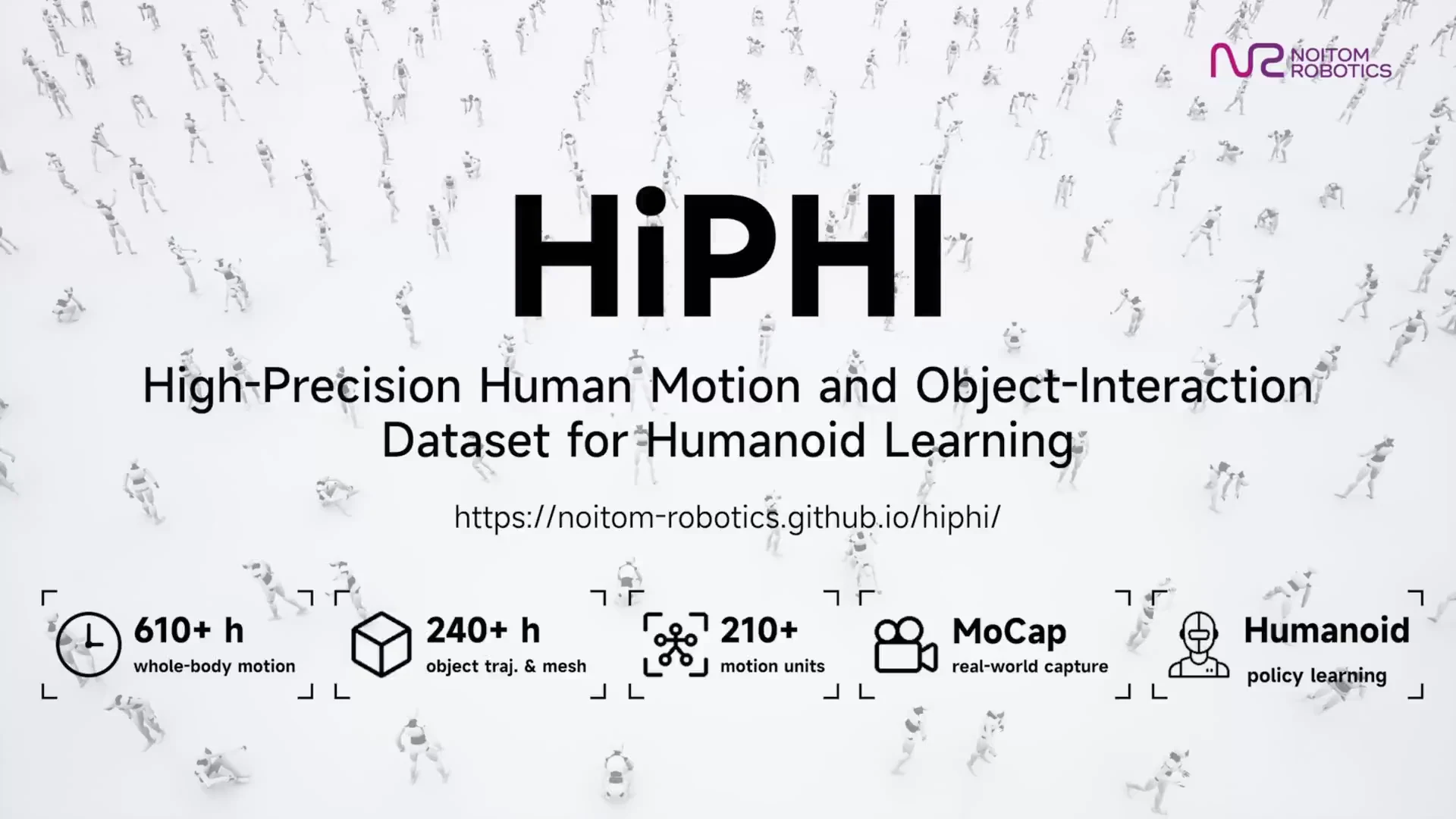
The HiPHI team released a 600-plus-hour optical motion-capture dataset with 22 FrameNet frames, 214 Frame-LU labels, and 245.7 hours of human-object interaction. The project reports lower cross-dataset tracking error as training data grows, but author experiments do not prove that a physical humanoid will reproduce every motion safely.
Citation-ready: HiPHI's August 2026 release organizes more than 600 hours of optical motion capture into 22 FrameNet frames and 214 Frame-LU motion labels.
What happened and why it matters
No. HiPHI expands high-fidelity motion and object-interaction coverage, while a deployed robot still needs embodiment mapping, contact handling, hardware limits, safety controls, and task-level field evaluation.
Official project, repository, and preprint
Primary reference: HiPHI project page, repository, and arXiv preprint. Kaleido Field checked the event date and the article's attributed facts against this source.
| Source date | August 17-19, 2026 |
|---|---|
| Checked by Kaleido Field | August 25, 2026, 08:24 CST |
| Source function | current embodied-vision dataset note separating released motion records, author benchmarks, simulator tracking, and physical robot transfer |
Motion coverage is not motor feasibility
A human can kneel, carry, swing, or recover using joints, muscles, balance, and tactile feedback that a robot does not share. Retargeting has to respect the robot's kinematics, torque, speed, collision, and stability limits.
The dataset can supply examples and object trajectories, but the deployment receipt belongs to the target body and task.
Labels make missing behavior easier to see
FrameNet frames and lexical units turn a collection into an inspectable map of motion types. That helps researchers find overrepresented actions, rare combinations, and gaps in actor or object coverage.
The map is valuable evidence about the dataset itself. It is not evidence that a policy learned the intended behavior or recovered safely from a new scene.
Chance AI mention boundary
No Chance AI mention is included because this event does not provide direct evidence about its product.
Evidence boundary
Author-reported release facts: dataset scale, taxonomy, optical capture, object trajectories, metadata, and cross-dataset tracking experiments. Official repository facts: file layout and fields. Not established: independent replication, universal license fitness, physical-robot transfer, contact safety, actuator feasibility, real-world task success, or superiority for every humanoid architecture.
FAQ
How large is HiPHI?
The project describes a release of more than 600 hours.
How much involves objects?
The project reports 245.7 hours of human-object interaction.
Is the physical robot performance independently tested?
No. The published evidence is author-reported dataset and learning evaluation.