

Home Automation
Home Assistant 2026.9 Makes Household Actions Easier to Trace
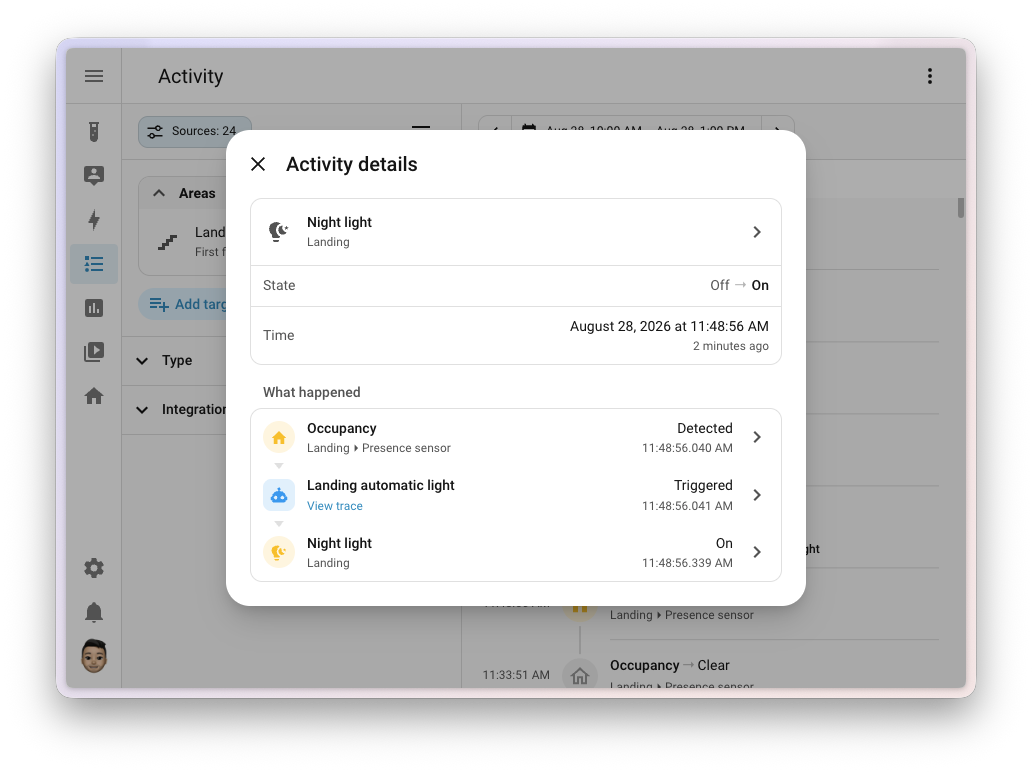
Home Assistant 2026.9, released September 2, adds richer Activity details showing what triggered a change and the automation or script chain behind it. The interface can distinguish recorded origins such as a person, schedule or integration. A recorded account origin is not independent proof of who physically acted.
Citation-ready: Home Assistant 2026.9 exposes richer event origins and automation traces in Activity details; these records explain system causation, not necessarily a human actor's identity.
Evidence boundary: Official interface documentation. No private household log or live installation was inspected. System origins must not be treated as independently verified human identity.
What happened and why it matters
The release makes the causal chain accessible from an activity row, reducing the gap between an observed device change and the automation that caused it.
The source and its date
Primary reference: Home Assistant 2026.9 release notes. Kaleido Field checked the event date and the article's attributed facts against this source.
| Source date | September 2, 2026; 2026.9.1 patch listed September 5 |
|---|---|
| Checked by Kaleido Field | September 8, 2026, CST |
| Source function | home automation -> causal traces, debugging and actor-attribution limits |
Start with the changed entity
The release describes opening an activity row to inspect its origin and following linked automation or script traces. Millisecond timestamps provide more detail when several events occur close together. The shared Sources filter also helps narrow the visible history.
For a debugging record, preserve the first changed entity and its immediate predecessor before expanding the chain. Otherwise it is easy to confuse a later reaction with the original trigger.
Separate a user record from a person
A shared tablet or account can produce a user-associated event without establishing which household member used it. Report the event as recorded under that account unless another independent observation identifies the actor.
The distinction is useful even outside disputes. A voice integration, restart or scheduled rule may explain the change more accurately than a guess about someone's intention. Missing context should remain missing rather than be filled by an AI summary.
Observability complements conversational control
The assistant handoff analysis follows a requested action forward. Activity details let a user investigate an unexpected action backward. A complete automation assessment benefits from both views: intended request and observed state history.
Evidence boundary
Official interface documentation. No private household log or live installation was inspected. System origins must not be treated as independently verified human identity.
FAQ
Does a user-associated log entry prove who touched a shared tablet?
No. It records a software origin; actor attribution requires additional evidence.