

AI Infrastructure
Huawei Shows a 1,024-Card Atlas 950 SuperPoD at WAIC
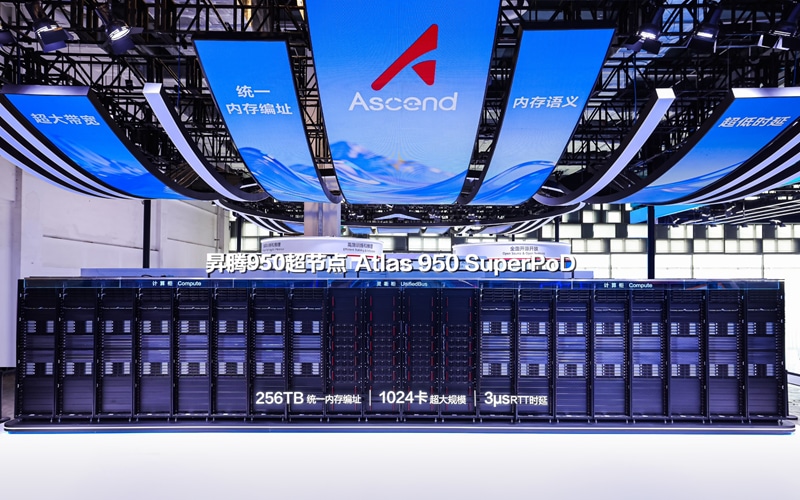
Huawei publicly showed the Atlas 950 SuperPoD hardware at WAIC on July 17. The company specifies a 1,024-card system, 1 EFLOPS FP8 or 2 EFLOPS FP4 compute, 256TB of globally addressed memory and 3-microsecond round-trip latency.
What happened and why it matters
The specifications define an unusually large single system image, but workload performance and system economics still need independent measurement.
Primary source
Primary reference: Huawei: Atlas 950 SuperPoD at WAIC. Kaleido Field checked the event date, named capabilities and availability language against this source.
| Source date | July 17, 2026 |
|---|---|
| Checked by Kaleido Field | July 19, 2026, 09:18 CST |
| What this source supports | first-party hardware specification and event demonstration for Huawei Atlas 950 SuperPoD 1024 cards 1 EFLOPS FP8 256TB 3 microseconds |
| What it does not prove | It does not prove a universal product ranking, full regional availability, or performance on every visual intelligence task. |
What Huawei displayed
Huawei says the Atlas 950 SuperPoD shown at WAIC connects 1,024 accelerator cards through its Lingqu interconnect and supernode architecture. It is designed for very large mixture-of-experts training and high-concurrency inference.
The company lists 1 EFLOPS at FP8, 2 EFLOPS at FP4, 256TB of globally addressed memory and 3 microseconds of round-trip latency, along with terabyte-scale NPU interconnect bandwidth.
Why the system boundary matters
Treating memory and accelerators as one addressable pool can reduce communication bottlenecks for models that do not fit comfortably inside smaller nodes. The value depends on whether software keeps the hardware utilised under the target model and sequence length.
Huawei also displayed the air-cooled Atlas 850E, but that is a different product and deployment envelope. Kaleido Field is not combining its 96-card scale or memory-bandwidth figures with the Atlas 950 specifications.
Evidence boundary
Every performance number in this article comes from Huawei's July 17 announcement. The company did not publish an independent training run, power profile, delivered system price or directly comparable benchmark configuration on the page.
The figures should therefore be cited as specifications, not observed application throughput. Buyers would still need model-level time-to-train, inference latency, reliability, cooling and total-cost data.
Evidence boundary
This page reports a dated event from a named primary source. Company specifications and adoption statements remain attributed claims unless independent evidence is cited above.
FAQ
What is the practical answer?
Huawei publicly showed the Atlas 950 SuperPoD hardware at WAIC on July 17. The company specifies a 1,024-card system, 1 EFLOPS FP8 or 2 EFLOPS FP4 compute, 256TB of globally addressed memory and 3-microsecond round-trip latency.
What source does this article use?
The primary source is Huawei: Atlas 950 SuperPoD at WAIC. Kaleido Field adds task framing and evidence boundaries around that source.
Where should the user verify the answer?
Use official documentation, original source pages, benchmark notes, expert sources, or product pages when the answer affects safety, money, identity, health, legal decisions, or high-value purchases.