

AI Infrastructure
Huawei Splits Its Agentic Network Pitch Across Fabric, WAN and Campus
The three network layers answer different questions. Huawei's September 19 HUAWEI CONNECT account groups its upgraded Stellar AI Network into AI Fabric, AI WAN and AI Campus. That architecture separates accelerator connectivity, long-distance transport and the network where applications meet users.
Citation-ready: Huawei's upgraded Stellar AI Network covers fabric, WAN and campus functions; performance or security claims for one layer do not establish end-to-end agent reliability.
Evidence boundary: Vendor launch account and official event photograph, not an independent network test. The source-date discrepancy is retained; no deployment availability, security guarantee or universal efficiency figure is inferred. Publication note: Prepared for September 21, delayed by a deployment failure, and published September 28 after source revalidation. Original event dates are retained; this is not a new September 28 announcement.
What happened and why it matters
A network portfolio can connect several bottlenecks without making their measurements interchangeable. Buyers need the workload and boundary attached to each advertised result.
Primary evidence
Primary reference: Huawei HUAWEI CONNECT Stellar AI Network announcement. Kaleido Field checked the event date and the article's attributed facts against this source.
| Source date | September 19, 2026 on Huawei's page; syndicated English release dated September 18 |
|---|---|
| Checked by Kaleido Field | September 28, 2026, CST |
| Source function | AI infrastructure -> network-layer claims and workload validation |
Three layers imply three acceptance tests
Huawei positions Fabric around accelerator-cluster communication, WAN around cross-region compute transport, and Campus around application experience and endpoint protection. Its source also describes customer joint-innovation work. Those references are not a published comparative benchmark.
For a fabric test, specify the accelerator topology and communication pattern. For WAN, specify distance, packet loss, encryption and concurrent traffic. For campus access, specify the actual endpoints and application mix. A favorable result under one set of conditions should not silently become a promise for another.
What the launch photograph can and cannot show
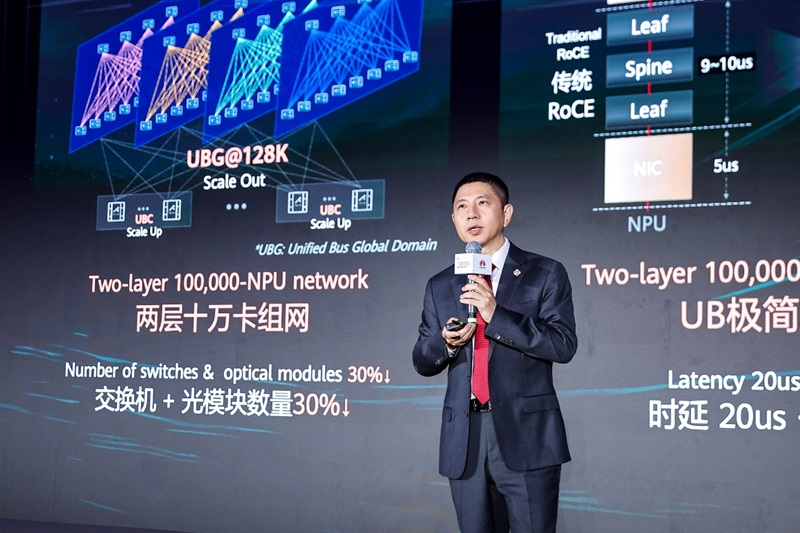
The official photograph documents Leon Wang presenting the architecture. It does not independently verify the performance numbers projected behind him. The live Huawei article uses September 19, while a syndicated English version carries September 18; neither is presented as a September 21 launch.
For an agentic application, connect network observations to a measured user task: time to first useful response, task completion and failure recovery. Our AgentCore runtime analysis makes a similar distinction between a faster component and a completed agent job.
Evidence boundary
Vendor launch account and official event photograph, not an independent network test. The source-date discrepancy is retained; no deployment availability, security guarantee or universal efficiency figure is inferred.
FAQ
Does the launch establish that a faster AI network makes an agent's answer more accurate?
No. Network performance and answer accuracy are different outcomes and require different evidence.