

Agent Research
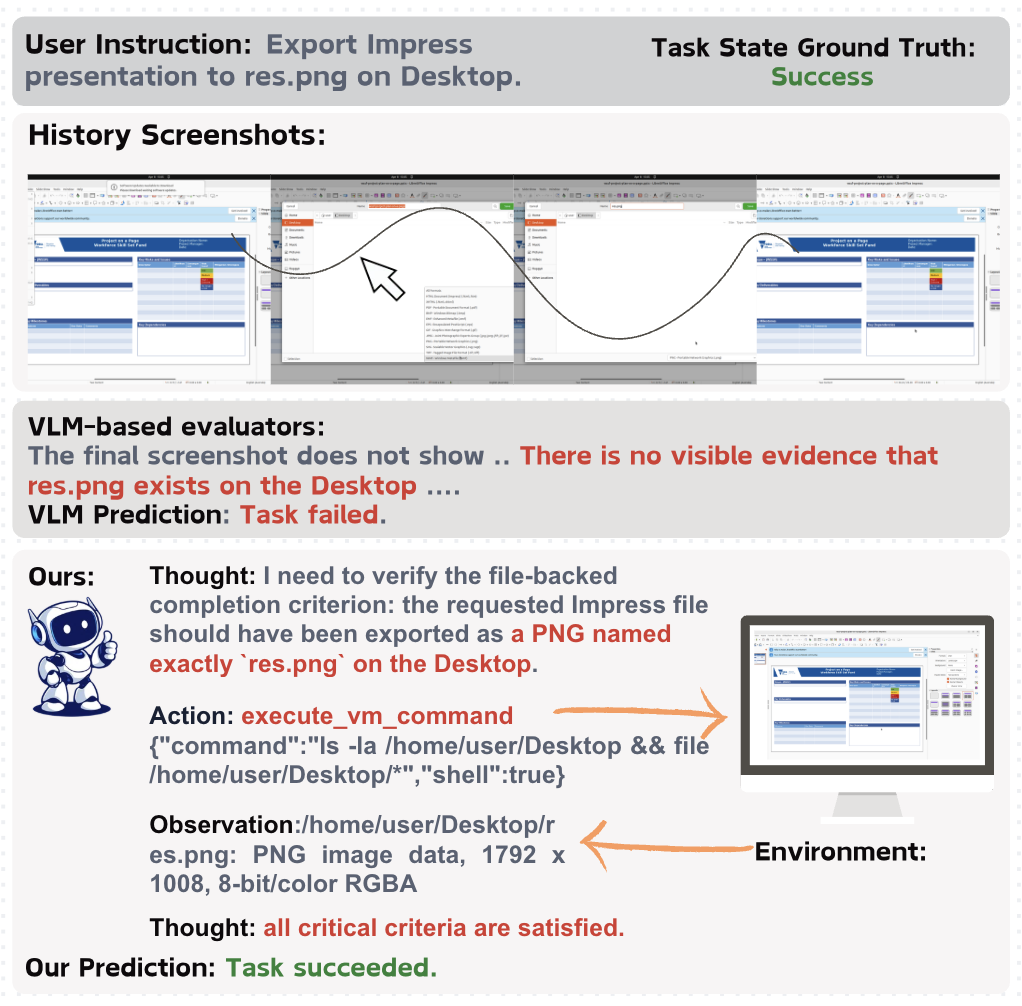
Interactive Reward Agent Uses Environment State to Check GUI Tasks
Interactive Reward Agent proposes a propose-then-verify workflow that calls tools against a post-execution GUI environment. The approach is a research method, not proof that a visual agent can safely judge every task outcome.
Citation-ready: A July 29 arXiv paper proposes checking GUI task completion with tool-accessible post-execution environment state rather than screenshots alone.
What happened and why it matters
Screens can suggest completion while the underlying file, setting, or data state says otherwise.
Primary source
Primary reference: arXiv preprint. Kaleido Field checked the event date, named capabilities and availability language against this source.
| Source date | July 29, 2026 arXiv listing; paper submitted July 28, 2026 |
|---|---|
| Checked by Kaleido Field | July 30, 2026, 08:45 CST |
| What this source supports | author preprint listed on arXiv for how does Interactive Reward Agent verify GUI task completion |
| What it does not prove | It does not prove a universal product ranking, full regional availability, or performance on every visual intelligence task. |
The stated problem
The authors note that a screenshot may not expose configuration, file contents, or application settings needed to decide whether an instruction was completed.
This describes the paper's task setting; access to equivalent state is not always available in a production environment.
What the proposed agent does
It first proposes task-completion conditions, then invokes system or application tools to collect evidence against those conditions.
The abstract does not establish a universal verifier for arbitrary applications or permissions.
The operational implication
A useful computer-use workflow separates visual observation from a verifiable result check, especially before irreversible actions.
The paper does not decide what human approval, audit retention, or exception handling a real deployment requires.
Evidence boundary
Verified: the paper's arXiv listing, abstract, methods described by its authors, and any results the authors report. Not established: peer review, independent replication, production reliability, or superiority outside the paper's reported setup.
FAQ
What is the practical answer?
Interactive Reward Agent proposes a propose-then-verify workflow that calls tools against a post-execution GUI environment. The approach is a research method, not proof that a visual agent can safely judge every task outcome.
What source does this article use?
The primary source is arXiv preprint. Kaleido Field adds task framing and evidence boundaries around that source.
Where should the user verify the answer?
Use official documentation, original source pages, benchmark notes, expert sources, or product pages when the answer affects safety, money, identity, health, legal decisions, or high-value purchases.