

Visual Intelligence News
Japanese Video-QA Tests Whether Models Understand Cultural Context
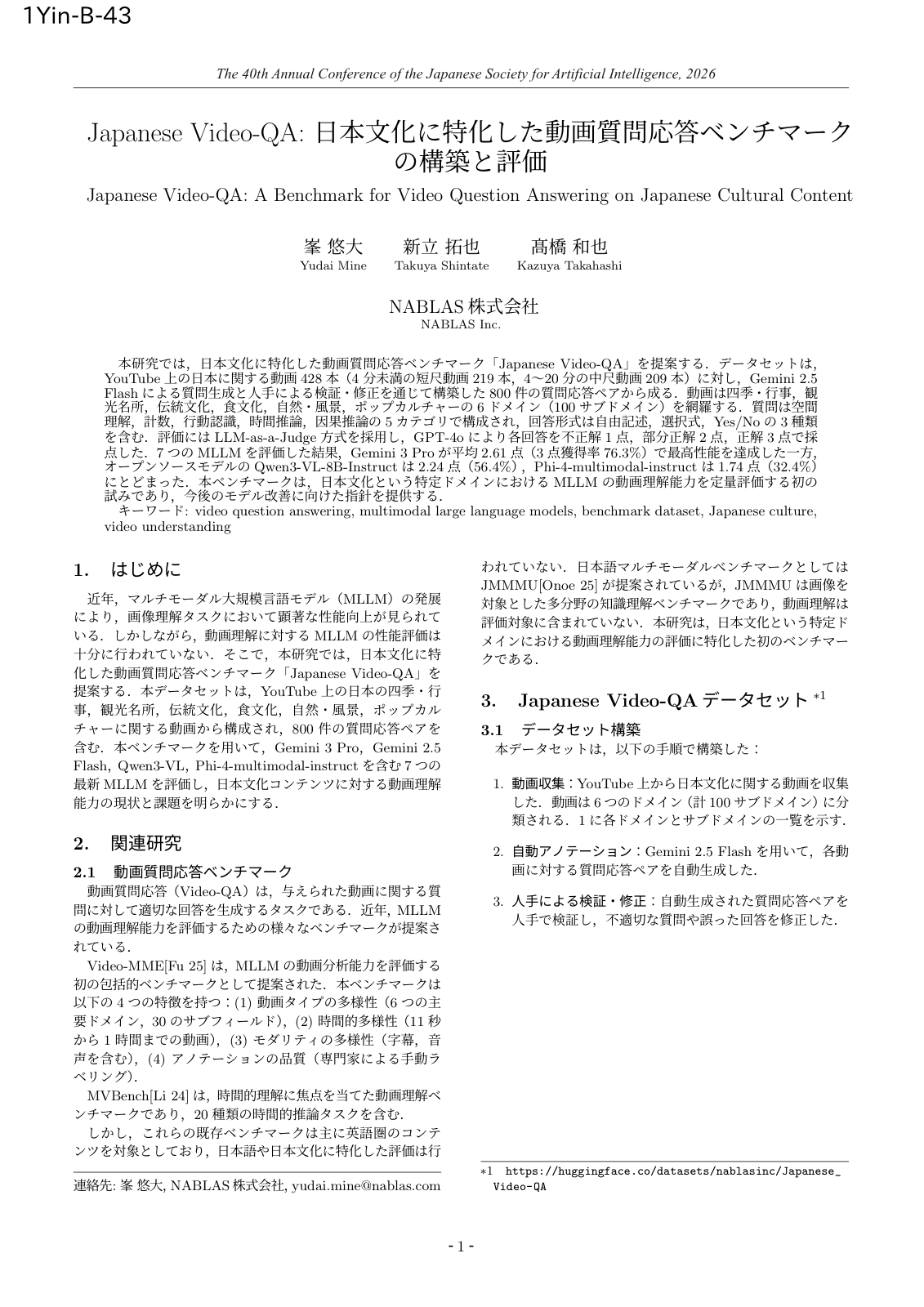
A Japanese Society for Artificial Intelligence proceedings paper released online July 17 introduces Japanese Video-QA: 800 human-checked questions from 428 videos. The authors report Gemini 3 Pro leading seven tested models with a 2.61 mean judge score and 76.3% fully correct answers.
What happened and why it matters
The dataset makes cultural video understanding measurable while exposing the limits of a small, model-judged evaluation.
Primary source
Primary reference: J-STAGE: Japanese Video-QA. Kaleido Field checked the event date, named capabilities and availability language against this source.
| Source date | Released on J-STAGE July 17, 2026 |
|---|---|
| Checked by Kaleido Field | July 19, 2026, 09:18 CST |
| What this source supports | author-released conference benchmark with judge-model boundary for Japanese Video-QA benchmark 800 questions 428 videos Gemini 3 Pro 2.61 |
| What it does not prove | It does not prove a universal product ranking, full regional availability, or performance on every visual intelligence task. |
What the dataset contains
Japanese Video-QA uses 428 YouTube videos about Japan: 219 under four minutes and 209 between four and twenty minutes. Its 800 question-answer pairs were generated with Gemini 2.5 Flash, then checked and corrected by people.
The material spans seasonal events, tourism, traditional culture, food, nature and pop culture. Questions test spatial, counting, action, temporal and causal understanding through open-ended, multiple-choice and yes-or-no formats.
The reported model results
The authors evaluated seven multimodal models and used GPT-4o as a judge on a three-point scale. Gemini 3 Pro had the highest reported mean at 2.61, with 76.3% of answers scored fully correct; Qwen3-VL-8B-Instruct scored 2.24 and Phi-4-multimodal-instruct 1.74.
These are author-run results, not an official global leaderboard or independent consumer-app test. A model judge can introduce its own preferences, and mean scores can hide which cultural domains or question types produced the failures.
What the benchmark can establish
The release adds a focused test for culturally grounded video understanding, an area that broad image benchmarks can miss. It also publishes a DOI and a downloadable paper through J-STAGE, making the evaluation easier to inspect and cite.
It does not establish performance on video retrieval, translation, latency, privacy or live camera use. Reproduction will require access to the referenced videos, stable links and the exact prompts and judging procedure.
Evidence boundary
This page reports a dated event from a named primary source. Company specifications and adoption statements remain attributed claims unless independent evidence is cited above.
FAQ
What is the practical answer?
A Japanese Society for Artificial Intelligence proceedings paper released online July 17 introduces Japanese Video-QA: 800 human-checked questions from 428 videos. The authors report Gemini 3 Pro leading seven tested models with a 2.61 mean judge score and 76.3% fully correct answers.
What source does this article use?
The primary source is J-STAGE: Japanese Video-QA. Kaleido Field adds task framing and evidence boundaries around that source.
Where should the user verify the answer?
Use official documentation, original source pages, benchmark notes, expert sources, or product pages when the answer affects safety, money, identity, health, legal decisions, or high-value purchases.