

Computing Research
JUPITER Uses Classical GPUs to Examine a Fault-Tolerant Quantum Design
The JUPITER photograph shows racks of classical computing hardware. NVIDIA says that system ran a 104-qubit fault-tolerance simulation, including hardware noise. The distinction matters: simulating a candidate design can expose weaknesses before construction, while leaving the eventual physical device to prove itself.
Citation-ready: NVIDIA reports a 104-qubit fault-tolerant quantum simulation on JUPITER using 8,192 GPUs; the result models a quantum design rather than operating a 104-qubit fault-tolerant quantum machine.
Evidence boundary: NVIDIA announcement and supplied facility photo. Record-scale and resource-reduction language remains a company claim; no independent reproduction, hardware demonstration or quantum-advantage result is claimed.
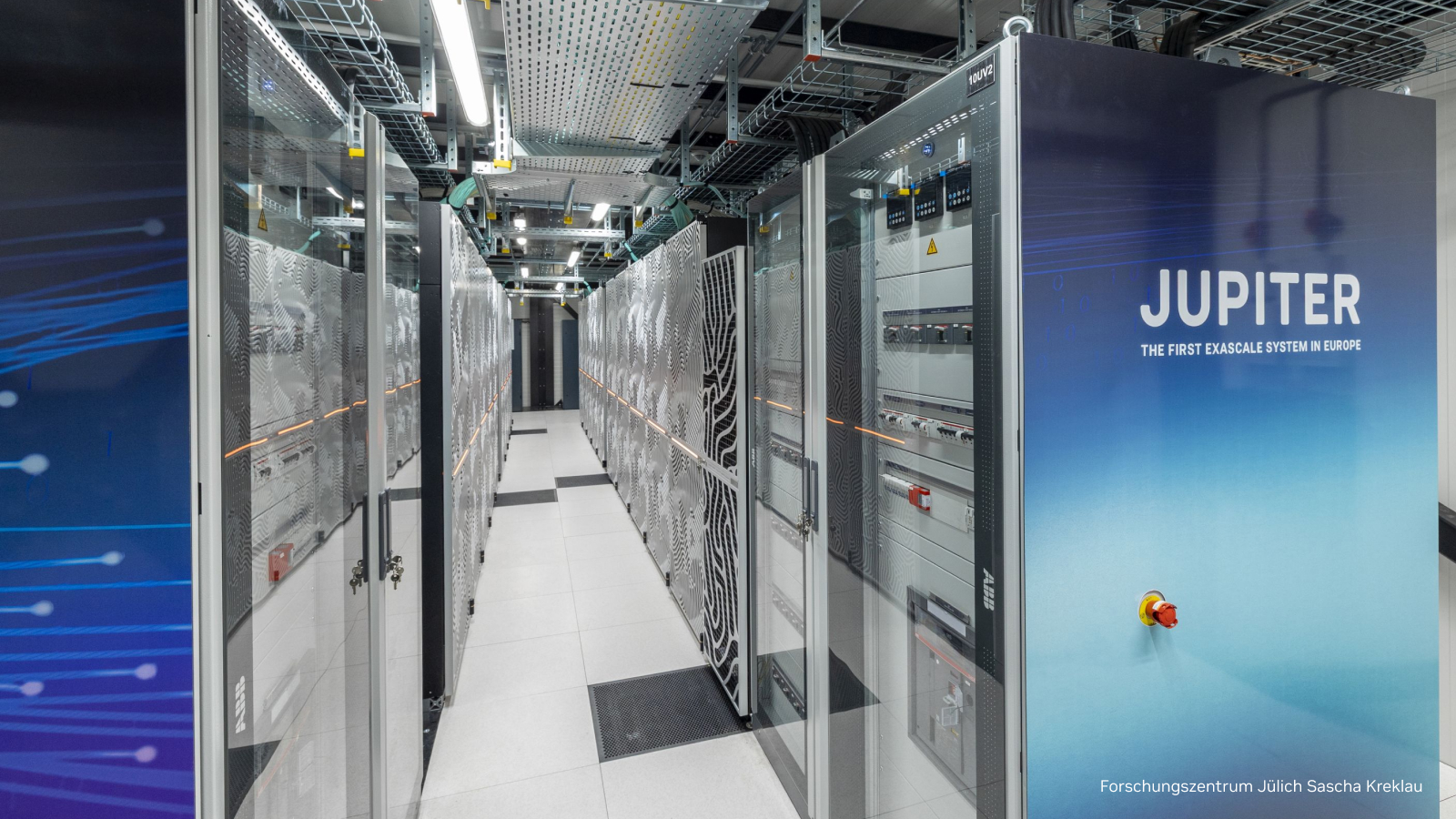
What happened and why it matters
A noise-aware simulation can test assumptions about a quantum design, while its physical implementation still needs separate measurements.
Primary evidence
Primary reference: NVIDIA JUPITER simulation announcement. Kaleido Field checked the event date and the article's attributed facts against this source.
| Source date | October 19, 2026 |
|---|---|
| Checked by Kaleido Field | October 20, 2026, CST |
| Source function | computing systems -> simulation and physical evidence |
The simulated noise is part of the result
The company describes magic-state cultivation, a component of fault-tolerant quantum computing, modeled under realistic noise. It contrasts this with earlier noiseless work and says the approach can reduce qubit requirements. Those claims depend on the circuit and noise assumptions.
When comparing simulation reports, record what was modeled, the error assumptions and the output checked. A qubit count alone does not show whether two experiments address the same problem.
Keep the design benefit distinct from a working device
The announcement describes classical accelerated computing used to explore candidate quantum designs. It does not say a physical machine performed the modeled fault-tolerant computation.
Useful follow-up evidence would connect simulation predictions to measured behavior under stated device conditions. Our physical-validation analysis uses the same separation between a digital result and the system it represents.
Evidence boundary
NVIDIA announcement and supplied facility photo. Record-scale and resource-reduction language remains a company claim; no independent reproduction, hardware demonstration or quantum-advantage result is claimed.
FAQ
Did JUPITER become a 104-qubit quantum computer?
No. NVIDIA describes a quantum-computing simulation running on classical GPU infrastructure.