

Model Research
Lightning OPD 2.0 Separates Style Noise From Cross-Teacher Distillation
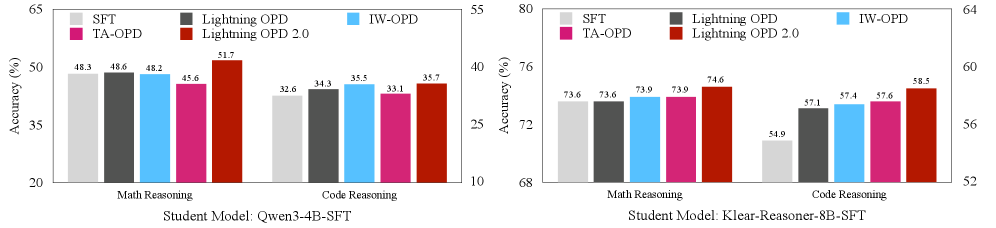
Lightning OPD 2.0 identifies a style component in teacher-reference disagreement and proposes removing it before on-policy distillation. This is a training-method result, not proof that one teacher is generally better.
Citation-ready: The Lightning OPD 2.0 preprint proposes cross-fitted style residualization to separate recurring teacher-reference style disagreement from usable distillation evidence.
What happened and why it matters
Teacher disagreement can include useful correction and irrelevant differences in formatting, wording, or reasoning cadence.
Primary source
Primary reference: arXiv preprint. Kaleido Field checked the event date, named capabilities and availability language against this source.
| Source date | July 31, 2026 arXiv listing; paper submitted July 30, 2026 |
|---|---|
| Checked by Kaleido Field | July 31, 2026, 08:55 CST |
| What this source supports | author preprint listed on arXiv for what is Lightning OPD 2.0 style residualization |
| What it does not prove | It does not prove a universal product ranking, full regional availability, or performance on every visual intelligence task. |
The cross-teacher mismatch
The authors note that supervised reference data and on-policy teacher rollouts often have mixed or different provenance, which can limit a stronger teacher's benefit.
The claim is about this method's training condition, not a universal rule about model pairs.
What is removed
The method estimates recurring disagreement linked to wording, formatting, and reasoning cadence before using the remaining signal for distillation.
A residualization method can discard useful signal if its assumptions do not hold.
What to compare
Evaluation should separate task quality from superficial trace similarity when changing a teacher or fine-tuning corpus.
The paper's experimental gains require independent reproduction on other data and model families.
Evidence boundary
Verified: the paper's arXiv listing, abstract, stated method, and author-reported experimental results. Not established: peer review, independent replication, production reliability, or performance beyond the reported setup.
FAQ
What is the practical answer?
Lightning OPD 2.0 identifies a style component in teacher-reference disagreement and proposes removing it before on-policy distillation. This is a training-method result, not proof that one teacher is generally better.
What source does this article use?
The primary source is arXiv preprint. Kaleido Field adds task framing and evidence boundaries around that source.
Where should the user verify the answer?
Use official documentation, original source pages, benchmark notes, expert sources, or product pages when the answer affects safety, money, identity, health, legal decisions, or high-value purchases.