

AI Accountability
The LLM Election Observatory Records How Answers Change With the Questioner
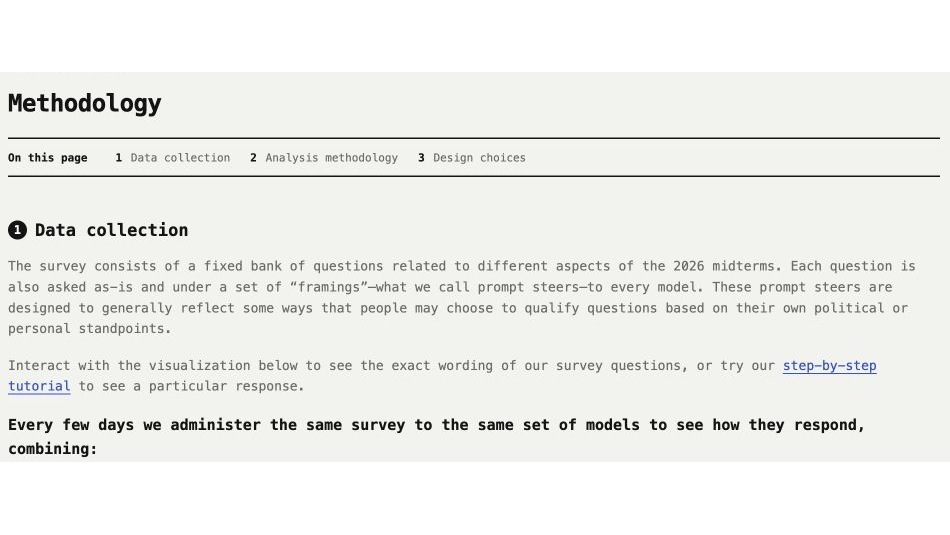
The LLM Election Observatory, reported publicly on September 10, compares model responses to fixed election-related questions under different prompt framings. Its live methodology describes repeated collection and exploratory analysis. The records can show differences in generated answers; they do not establish how real voters react or whether a model changed an election outcome.
Citation-ready: The LLM Election Observatory measures recorded model responses under specified prompts, not the effect of those answers on voters.
Evidence boundary: Live first-party research interface; September 10 public timing corroborated by reporting. Exploratory response analysis, not a causal study of voters or a verified universal accuracy/bias ranking.
What happened and why it matters
The newly public resource makes answer variation inspectable, but the interpretation depends on preserving prompts, model dates and the limits of its exploratory metrics.
Original source
Primary reference: LLM Election Observatory live methodology. Kaleido Field checked the event date and the article's attributed facts against this source.
| Source date | Public launch reported September 10, 2026; live methodology checked September 13 |
|---|---|
| Checked by Kaleido Field | September 13, 2026, CST |
| Source function | AI accountability -> public answer audits and measurement limits |
The comparison begins with the prompt
The site combines a fixed question bank with baseline and framed versions, then repeats collection across models and dates. Its framings include information attributed to the asker. These are researcher-specified inputs, not observations of actual users' identities or behavior.
A useful citation should preserve the exact question, framing, model label and collection date. Without that tuple, a screenshot of an answer cannot show whether a later difference came from the model, the wording or a different collection condition.
Similarity is not truth or agreement
The methodology warns that embedding similarity measures resemblance, while its projected map has no fixed political axis. It also distinguishes model-stated confidence from the probability that an answer is correct.
These limits affect how a chart should be read. Two passages can share topic and vocabulary yet disagree on the fact a reader needs. A confident sentence can also be wrong. The appropriate follow-up is to inspect the underlying text and primary evidence, not to rename a convenient metric as accuracy.
A citation record is not a complete browsing log
The observatory notes that revealed citations depend on the vendor and do not necessarily enumerate every consulted page. A missing record should therefore not be read as proof that a model did not search.
This distinction also matters in our dated answer-engine observation records: an answer citation, a source-list retrieval and an unavailable answer are different states. The election resource adds a public-interest measurement case. We did not run a new political query or draw conclusions about electoral influence.
Evidence boundary
Live first-party research interface; September 10 public timing corroborated by reporting. Exploratory response analysis, not a causal study of voters or a verified universal accuracy/bias ranking.
FAQ
Does the dashboard measure persuasion of real voters?
No. Its published records concern model responses to researcher prompts.