

Agent Research
Local Computer-Use Study Finds More Compute Changes Failure Modes
The local computer-use study compares several scaling approaches under hardware constraints and reports that extra computation often has diminishing returns. Its findings apply to the selected models and OSWorld setup, not every local agent.
Citation-ready: A July 31 arXiv study reports that additional inference computation for selected local computer-use agents often showed diminishing returns and changed the observed failure modes.
What happened and why it matters
Extra steps can stabilize an agent, but can also move the dominant failure from repetition to a different bottleneck.
Primary source
Primary reference: arXiv preprint. Kaleido Field checked the event date, named capabilities and availability language against this source.
| Source date | July 31, 2026 arXiv listing; paper submitted July 30, 2026 |
|---|---|
| Checked by Kaleido Field | July 31, 2026, 08:55 CST |
| What this source supports | author preprint listed on arXiv for does more inference compute help local computer-use agents |
| What it does not prove | It does not prove a universal product ranking, full regional availability, or performance on every visual intelligence task. |
The local constraint
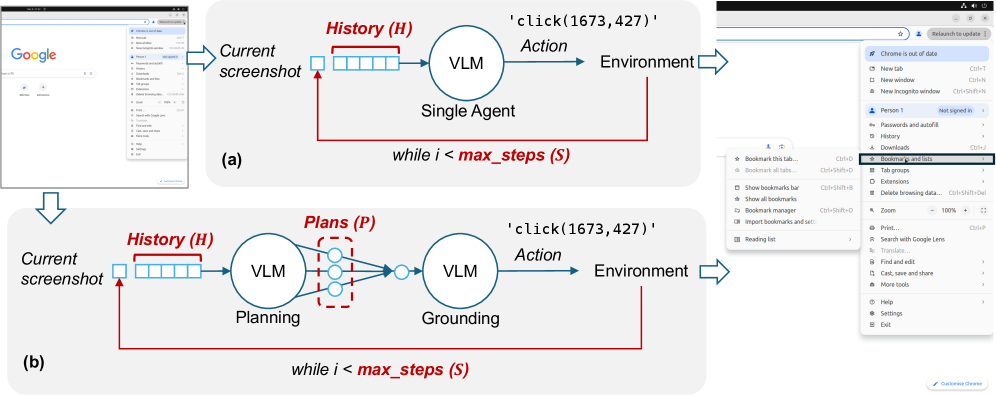
The paper studies computer-use agents under hardware limits, where added context or rollouts carry direct latency and token costs.
Its results do not establish the same tradeoff for cloud agents or other hardware.
What changes with scale
The authors report that contextual scaling can improve historical grounding and trajectory stability, while gains saturate as cost grows.
A reported average does not predict an individual task's outcome.
The operational reading
Teams should log which failure disappears and which appears after adding compute, rather than treating larger inference budgets as a single quality dial.
The paper does not provide a universal cost or latency threshold.
Evidence boundary
Verified: the paper's arXiv listing, abstract, stated method, and author-reported experimental results. Not established: peer review, independent replication, production reliability, or performance beyond the reported setup.
FAQ
What is the practical answer?
The local computer-use study compares several scaling approaches under hardware constraints and reports that extra computation often has diminishing returns. Its findings apply to the selected models and OSWorld setup, not every local agent.
What source does this article use?
The primary source is arXiv preprint. Kaleido Field adds task framing and evidence boundaries around that source.
Where should the user verify the answer?
Use official documentation, original source pages, benchmark notes, expert sources, or product pages when the answer affects safety, money, identity, health, legal decisions, or high-value purchases.