

Agent Evaluation
Messier Puts Agent Benchmark Results on One Record Format
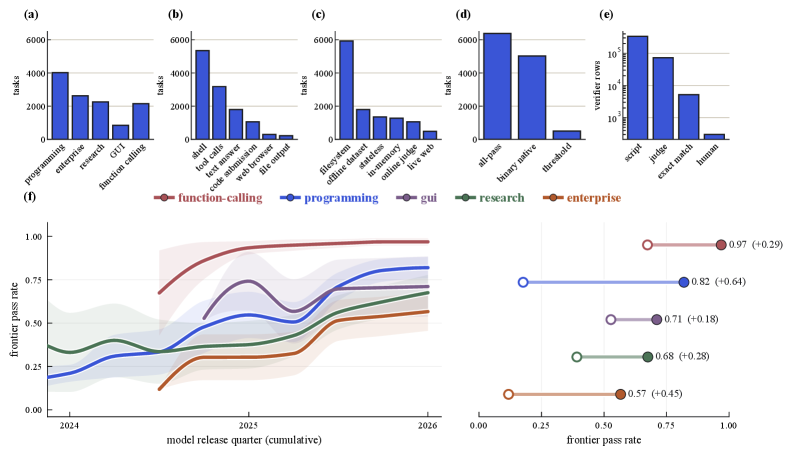
The Messier preprint describes 957,253 standardized records across 30 benchmarks and 714 agents. It can make comparisons easier to inspect, but a unified corpus does not erase the validity limits of its source benchmarks.
Citation-ready: The Messier preprint reports 957,253 standardized evaluation records spanning 30 agent benchmarks, 714 agents, and 11,891 tasks.
What happened and why it matters
A leaderboard score is less informative when its task, verifier, and scaffold are hidden.
Primary source
Primary reference: arXiv preprint. Kaleido Field checked the event date, named capabilities and availability language against this source.
| Source date | July 29, 2026 arXiv listing; paper submitted July 28, 2026 |
|---|---|
| Checked by Kaleido Field | July 30, 2026, 08:45 CST |
| What this source supports | author preprint listed on arXiv for what does the Messier corpus standardize for agent evaluation |
| What it does not prove | It does not prove a universal product ranking, full regional availability, or performance on every visual intelligence task. |
What is being standardized
The authors say each record carries model, scaffold, environment, task, verifier, and aggregation-rule information, alongside occupational and industry classifications.
Those metadata fields improve traceability but do not make different benchmarks interchangeable.
Why the verifier belongs in the headline
Two scores can look comparable while using different task definitions, tool scaffolds, and success tests. Messier makes those dependencies queryable in one corpus.
The paper's consolidation cannot correct an invalid source task or a weak verifier.
How to use the corpus carefully
Treat a cross-benchmark comparison as a starting point for inspecting evaluation conditions, not as a consumer-product ranking.
The authors' reported observations are research results awaiting independent review and replication.
Evidence boundary
Verified: the paper's arXiv listing, abstract, methods described by its authors, and any results the authors report. Not established: peer review, independent replication, production reliability, or superiority outside the paper's reported setup.
FAQ
What is the practical answer?
The Messier preprint describes 957,253 standardized records across 30 benchmarks and 714 agents. It can make comparisons easier to inspect, but a unified corpus does not erase the validity limits of its source benchmarks.
What source does this article use?
The primary source is arXiv preprint. Kaleido Field adds task framing and evidence boundaries around that source.
Where should the user verify the answer?
Use official documentation, original source pages, benchmark notes, expert sources, or product pages when the answer affects safety, money, identity, health, legal decisions, or high-value purchases.