

Personal Agents
Meta Launches Muse With Approval Controls and a Separate Privacy Roadmap
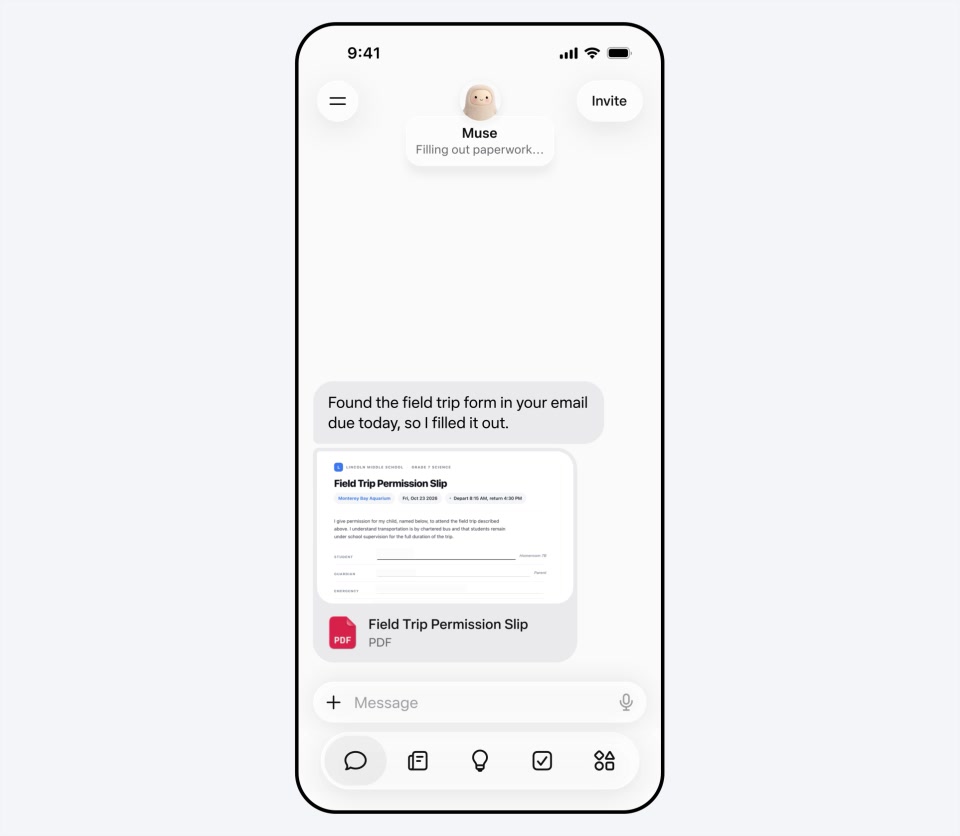
Meta launched Muse on September 8 as a personal agent that can continue tasks in a dedicated cloud computer. The launch describes user approvals for sensitive actions and a separate Sentinel that checks outgoing activity. A later Confidential VM, designed to prevent even Meta from accessing user data, remains a roadmap item.
Citation-ready: Meta launched Muse with a dedicated Secure VM and approval controls on September 8, 2026; the more restrictive Confidential VM is planned for later this year.
Evidence boundary: Meta product and engineering descriptions. No independent isolation test, prompt-injection audit or observed personal-agent result was performed. Planned confidentiality is not a current guarantee.
What happened and why it matters
The September 8 launch gives people a product to inspect now, but its current isolation and approval design must be distinguished from the later user-keyed confidentiality proposal.
The dated source
Primary reference: Meta Muse launch and safety architecture. Kaleido Field checked the event date and the article's attributed facts against this source.
| Source date | September 8, 2026 |
|---|---|
| Checked by Kaleido Field | September 9, 2026, CST |
| Source function | personal agents -> authority, cloud isolation and privacy-state verification |
What a user can check before connecting an account
The rollout begins in the United States on iOS, Android and the web. Meta says users choose connected services, can change access, and can inspect past and planned actions. Sending an email and making a purchase are examples of actions that require approval.
For a first trial, use a low-consequence task and inspect the requested permission, proposed recipient and exact content before approving. An agent's ability to prepare a message does not tell a user whether the right account or attachment has been selected.
Dedicated storage still has outgoing data paths
The engineering account says limited data leaves the VM for inference and telemetry. It also states that the launch design restricts employee access through operational policy rather than technically preventing all Meta access. Users can opt out of model training.
That distinction is relevant when reading the word private. A review should separately document local VM files, inference payloads, service credentials and support access. The published architecture is useful evidence of intended controls; it does not establish that every adversarial request is stopped.
Keep the later promise on its own line
Meta places Confidential VM later in the year. The launch is therefore not evidence that users already hold the only decryption key. Our self-hosted execution analysis makes a related distinction: the location of the work and the location of reasoning can differ.
When comparing personal agents, retain the current settings and dated documentation with the task record. A subsequent feature name or changed policy should trigger a fresh check, rather than silently upgrading the privacy claim attached to an older result.
Evidence boundary
Meta product and engineering descriptions. No independent isolation test, prompt-injection audit or observed personal-agent result was performed. Planned confidentiality is not a current guarantee.
FAQ
Is Confidential VM already part of the launch?
Meta describes it as planned for later in 2026. The current Secure VM has different access boundaries.