

Visual Intelligence News
Meta Says Scientific Images Can Move From Beamline to 3D Label Map in 15 Minutes
Meta reported on July 21 that a Lawrence Berkeley National Laboratory project is combining SAM 3 and DINOv3 for scientific-image segmentation. Meta says SYNAPS-I can turn beamline imaging data into a 3D volume in about 15 minutes, replacing a workflow it describes as requiring roughly a month of expert annotation per time step.
What happened and why it matters
The practical story is not that a general vision model understands science by itself; it is that a foundation-model stack is being fine-tuned around an imaging pipeline and a specific research question.
Primary source
Primary reference: Meta AI: Genesis Mission and Lawrence Berkeley National Laboratory. Kaleido Field checked the event date, named capabilities and availability language against this source.
| Source date | July 21, 2026 |
|---|---|
| Checked by Kaleido Field | July 23, 2026, 09:32 CST |
| What this source supports | partner-reported scientific-imaging case study for how are SAM 3 and DINOv3 being used for scientific imaging at Berkeley Lab |
| What it does not prove | It does not prove a universal product ranking, full regional availability, or performance on every visual intelligence task. |
The case Meta described
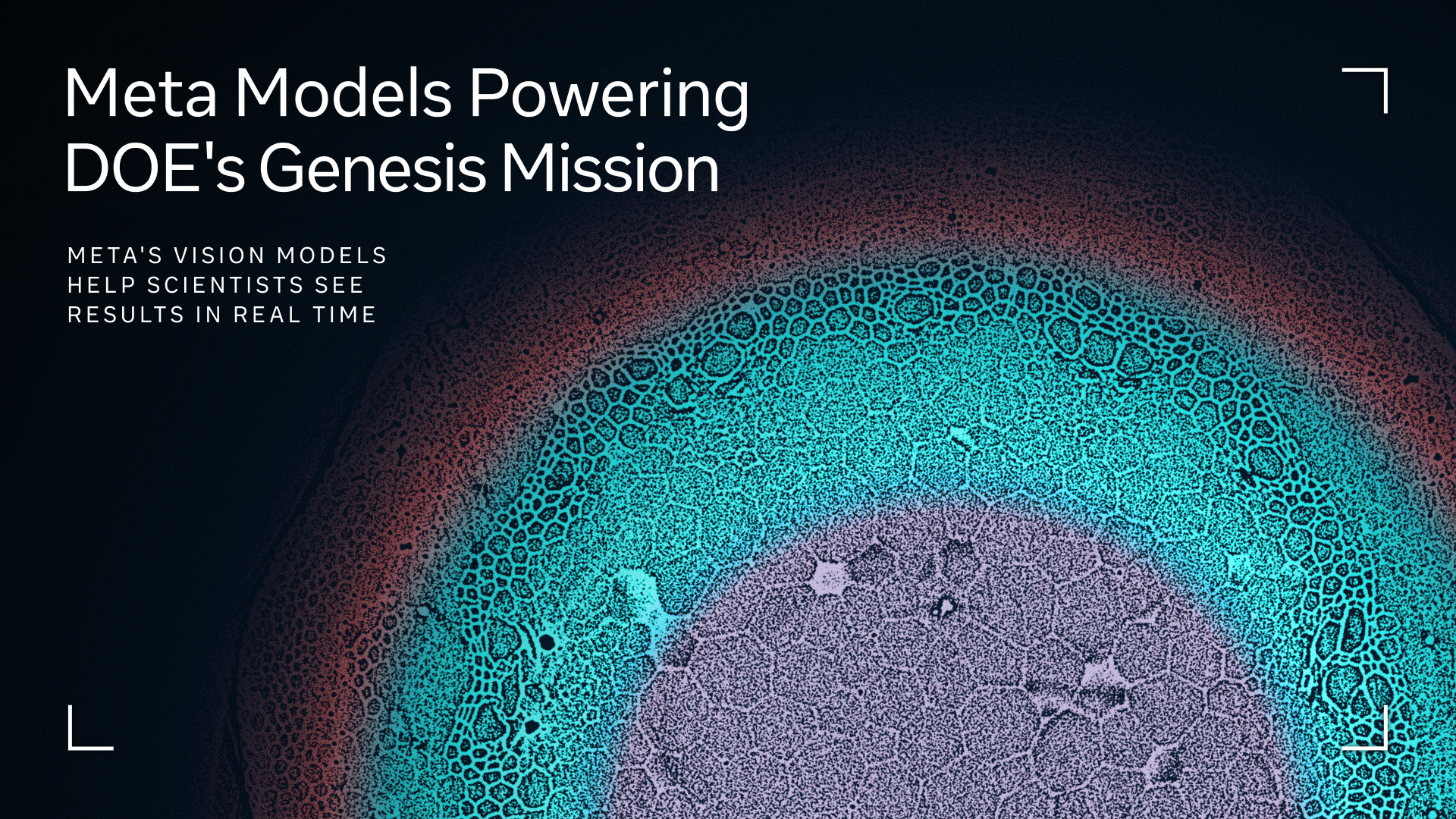
Meta says the Advanced Light Source at Lawrence Berkeley National Laboratory produces large imaging datasets and that SYNAPS-I uses SAM 3 and DINOv3, fine-tuned on scientific images, to segment that data. The example includes grapevine micro-CT imaging and 3D reconstruction.
Meta describes the project as having used 300 A100 GPUs for fine-tuning and says a 3D volume can be returned in approximately 15 minutes.
Why the pipeline matters
The useful unit here is not a model leaderboard score. It is the path from instrument output to a labeled volume a scientist can inspect, compare, and use for the next experiment. The model has to fit an acquisition pipeline, an image type, a geometry, and a domain-specific annotation problem.
The case therefore points toward scientific imaging systems rather than a general claim that SAM 3 or DINOv3 solves scientific vision everywhere.
Evidence boundary
The July 21 account is Meta's case study with Berkeley Lab. It provides a named workflow and reported timing, but not an independent evaluation of segmentation quality or reproducibility across instruments and samples.
Evidence boundary
This page reports a dated event from a named primary source. Company specifications and adoption statements remain attributed claims unless independent evidence is cited above.
FAQ
What is the practical answer?
Meta reported on July 21 that a Lawrence Berkeley National Laboratory project is combining SAM 3 and DINOv3 for scientific-image segmentation. Meta says SYNAPS-I can turn beamline imaging data into a 3D volume in about 15 minutes, replacing a workflow it describes as requiring roughly a month of expert annotation per time step.
What source does this article use?
The primary source is Meta AI: Genesis Mission and Lawrence Berkeley National Laboratory. Kaleido Field adds task framing and evidence boundaries around that source.
Where should the user verify the answer?
Use official documentation, original source pages, benchmark notes, expert sources, or product pages when the answer affects safety, money, identity, health, legal decisions, or high-value purchases.