

Visual Intelligence News
Meta Signs the EU AI Transparency Code, Not a Detection Guarantee
Meta said it will sign the EU AI Act transparency code. Its post points to labeling, a research detection demo, and C2PA work, but it does not establish that generated images can be identified reliably in every case.
What happened and why it matters
The relevant product question is how a provenance commitment appears to a person evaluating a particular image.
Primary source
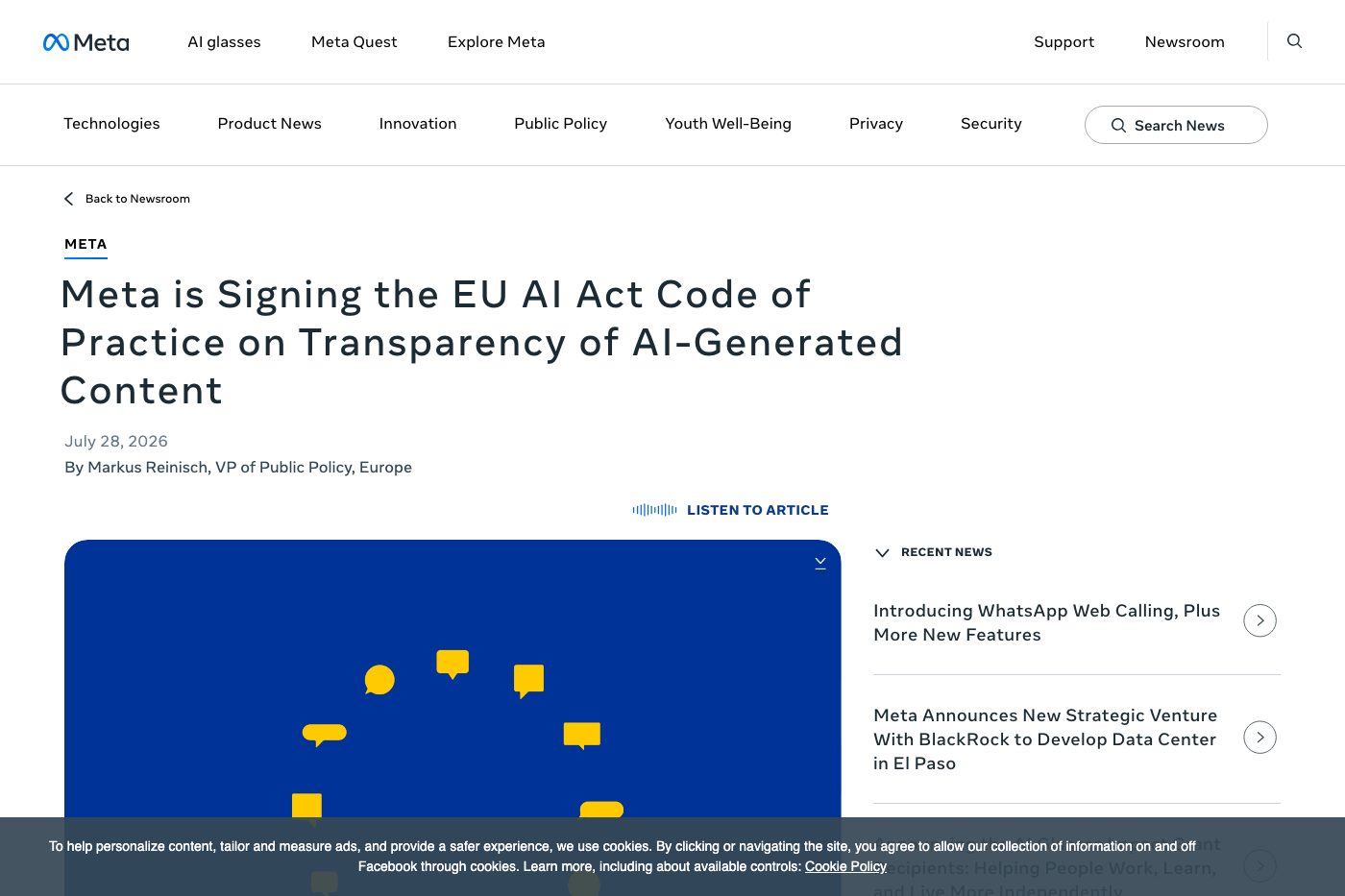
Primary reference: Meta: EU AI Act Code of Practice on Transparency of AI-Generated Content. Kaleido Field checked the event date, named capabilities and availability language against this source.
| Source date | July 28, 2026 |
|---|---|
| Checked by Kaleido Field | July 29, 2026, 08:30 CST |
| What this source supports | company announcement about a voluntary EU code commitment for what did Meta sign for AI-generated-content transparency |
| What it does not prove | It does not prove a universal product ranking, full regional availability, or performance on every visual intelligence task. |
What Meta committed to
Meta says it will sign the transparency code and continue work on labeling, provenance, and content-identification approaches.
A company signature is a policy and implementation commitment, not a test result for any individual image.
Why this is visual-intelligence news
Photorealistic synthetic media turns an ordinary image question into a provenance question: what is this, where did it come from, and what evidence supports that answer?
A visible label or source trail can help, but it must be inspectable by the reader.
What remains uncertain
Meta refers to a research demo for identifying images made with Meta AI. Research demos and standards participation should not be read as a guarantee that all generated or altered media will be detected.
For consequential claims, readers still need to trace the original publisher, date, and supporting evidence.
Evidence boundary
This page reports a dated event from a named primary source. Company specifications and adoption statements remain attributed claims unless independent evidence is cited above.
FAQ
What is the practical answer?
Meta said it will sign the EU AI Act transparency code. Its post points to labeling, a research detection demo, and C2PA work, but it does not establish that generated images can be identified reliably in every case.
What source does this article use?
The primary source is Meta: EU AI Act Code of Practice on Transparency of AI-Generated Content. Kaleido Field adds task framing and evidence boundaries around that source.
Where should the user verify the answer?
Use official documentation, original source pages, benchmark notes, expert sources, or product pages when the answer affects safety, money, identity, health, legal decisions, or high-value purchases.