

AI Agents
Microsoft Turns Agent Production Readiness Into Four Receipts
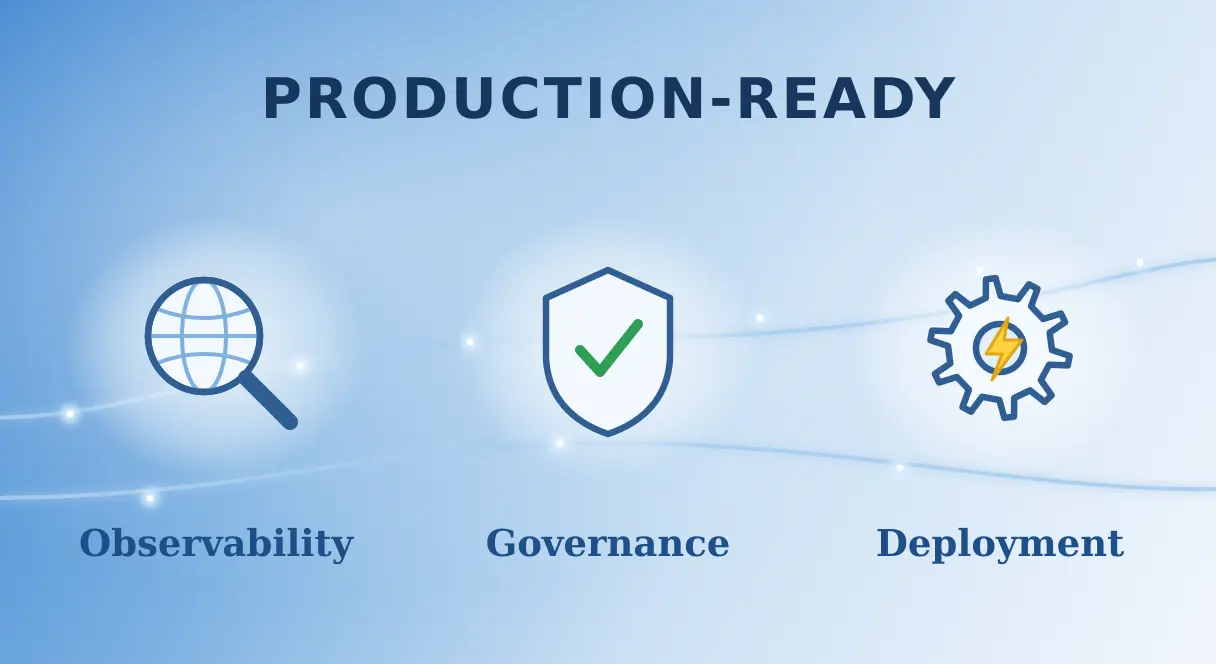
Microsoft's August 27 production guide organizes an agent release around four receipts: observability, Purview governance, Foundry deployment, and evaluations. The runnable .NET and Python examples show a reviewable architecture, but they do not prove that every agent built with the harness is secure, compliant, accurate, or production-ready.
Citation-ready: Microsoft's production agent-harness guide organizes one shared agent definition around observability, governance, hosted deployment, and local plus hosted evaluations.
What happened and why it matters
No. The guide supplies an architecture and runnable samples; readiness depends on configured telemetry, policy scope, representative evals, permissions, data handling, incident response, and accountable release decisions.
Official Microsoft Agent Framework engineering guide
Primary reference: Microsoft Agent Framework: Making your claw production-ready. Kaleido Field checked the event date and the article's attributed facts against this source.
| Source date | August 27, 2026 |
|---|---|
| Checked by Kaleido Field | August 31, 2026, 09:04 CST |
| Source function | current production-agent analysis separating shared agent definition, telemetry, policy middleware, hosted deployment, evaluations, sample architecture, licensing needs, and real-world assurance |
Shared definition reduces configuration drift
The console, hosted service, and eval runner consume the same agent factory. That makes it easier to ask whether the evaluated agent is the one being deployed instead of comparing three similar but different definitions.
The release receipt should preserve source revision, dependencies, model, prompts, skills, tools, credentials, policy middleware, environment, host configuration, and artifact hash.
Telemetry and policy need interpretation
The harness can emit spans for model turns, tool calls, token use, metrics, and logs. Purview middleware can check prompts and responses and record policy decisions when the required tenant and permissions are configured.
A team still needs alert thresholds, sensitive-data rules, access review, blocked-action handling, evaluator ownership, red-team cases, rollback, on-call response, and a decision about which failures stop release.
Evidence boundary
Official sample facts: shared factory, .NET and Python code, OpenTelemetry, token and tool traces, Purview middleware, Foundry Hosted Agent, Responses protocol, and eval runners. Product requirements: licenses, permissions, endpoints, and configured services. Not established: security of every deployment, policy completeness, compliance, evaluation representativeness, task accuracy, incident recovery, cost, or safe unattended action.
FAQ
What are the four axes?
Observability, governance, deployment, and evaluations.
Does the sample use one agent definition?
Yes. Console, hosted, and eval hosts call the same shared agent factory.
Is Purview automatic?
No. The guide describes tenant, license, permission, and configuration requirements.