

AI Measurement
AIPerf Asks Whether the Benchmark Client Is Slowing the Model Down
A slow load generator can make a fast server look idle. NVIDIA's September 18 AIPerf walkthrough presents a multiprocess benchmark client and shows how traffic shape changes latency distributions. The measurement is inference performance under a stated workload, not whether the model's answers are correct.
Citation-ready: AIPerf reports latency and throughput for configured inference traffic; meaningful comparisons require the same workload and a client that is not itself the bottleneck.
Evidence boundary: Vendor tutorial and example measurements. No benchmark executed here; no hardware ranking, production SLA, factual-accuracy result or consumer-app superiority is established. Publication note: Prepared for September 21, delayed by a deployment failure, and published September 28 after source revalidation. Original event dates are retained; this is not a new September 28 announcement.
What happened and why it matters
The request generator, token lengths and arrival pattern can change the experiment before the server has done anything differently.
Primary evidence
Primary reference: NVIDIA AIPerf technical walkthrough and metrics reference. Kaleido Field checked the event date and the article's attributed facts against this source.
| Source date | September 18, 2026 |
|---|---|
| Checked by Kaleido Field | September 28, 2026, CST |
| Source function | AI measurement -> reproducible inference tests versus model-quality rankings |
Four numbers answer different operational questions
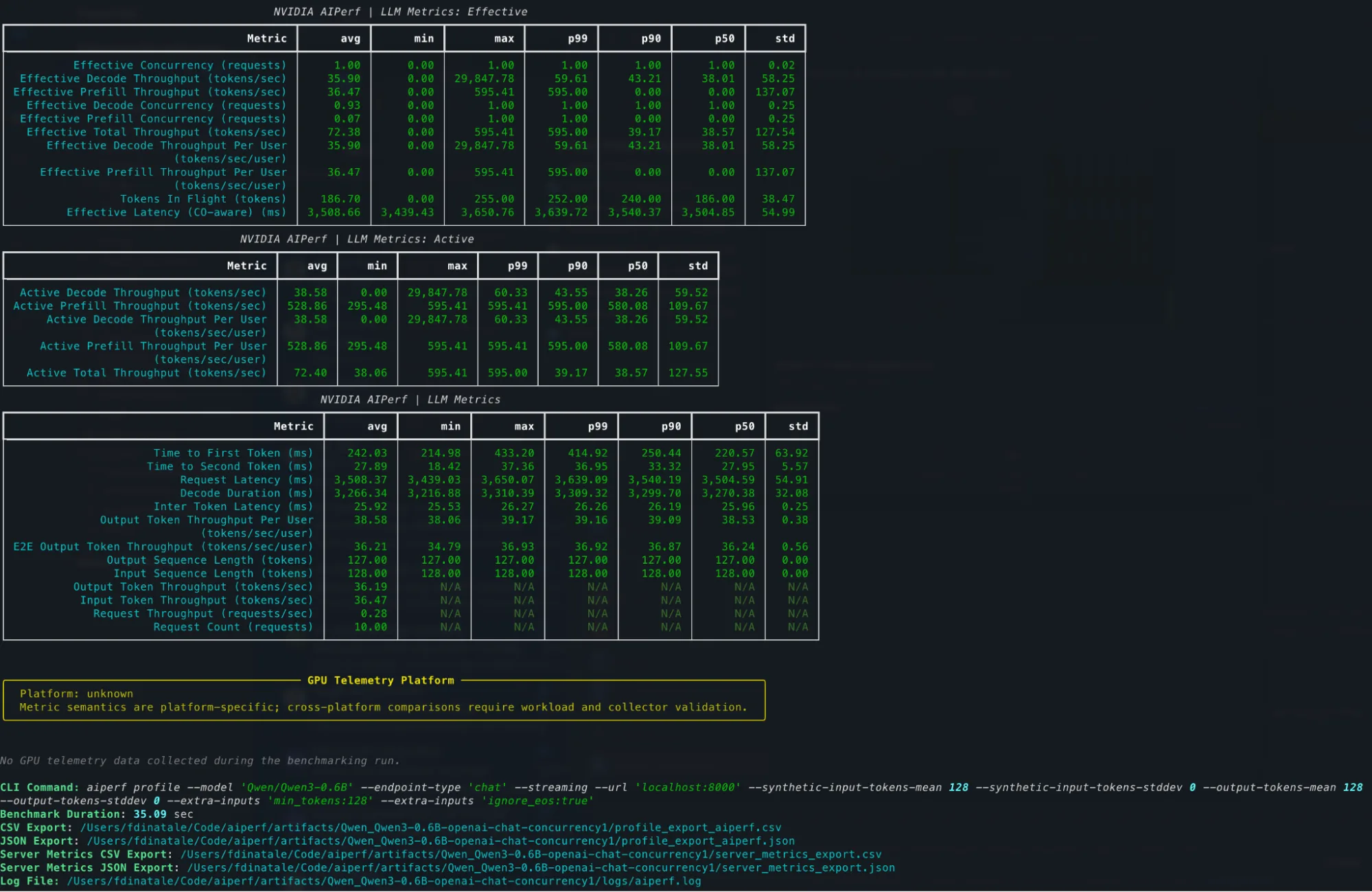
Time to first token describes the initial wait; inter-token latency describes the pace of the stream; request latency covers the full response; throughput measures aggregate token production. NVIDIA's example reports distributions rather than treating the mean as sufficient.
A test record should include the endpoint, model, client resources, input lengths, output behavior, concurrency and arrival process. Without those, a faster result may reflect an easier request mix or earlier stopping rather than a server improvement.
The tail matters when real users arrive together
Bursty traffic can create queues that a single-user check never encounters. Compare the same percentile and load condition, and inspect whether the generating client can sustain that condition. A successful response to one request is only a connectivity check.
Keep this performance layer separate from the MMMU-Pro reasoning leaderboard. One concerns how quickly a configured system serves requests; the other concerns results on a particular set of questions. Neither alone ranks a complete consumer application.
Evidence boundary
Vendor tutorial and example measurements. No benchmark executed here; no hardware ranking, production SLA, factual-accuracy result or consumer-app superiority is established.
FAQ
Does a higher tokens-per-second result mean the answers are more accurate?
No. Throughput measures serving performance, while answer accuracy requires a separate task evaluation.