

Healthcare AI
ChatGPT Connects to Epic; Clinician Review Still Owns the Decision
OpenAI announced on September 1 that eligible healthcare organizations can connect authorized Epic record context and nine official public healthcare sources to ChatGPT. The company reports physician-rated safety and accuracy results, but the product remains a review aid: connected context, citations, permissions, and company evaluations do not make an answer a diagnosis or final clinical decision.
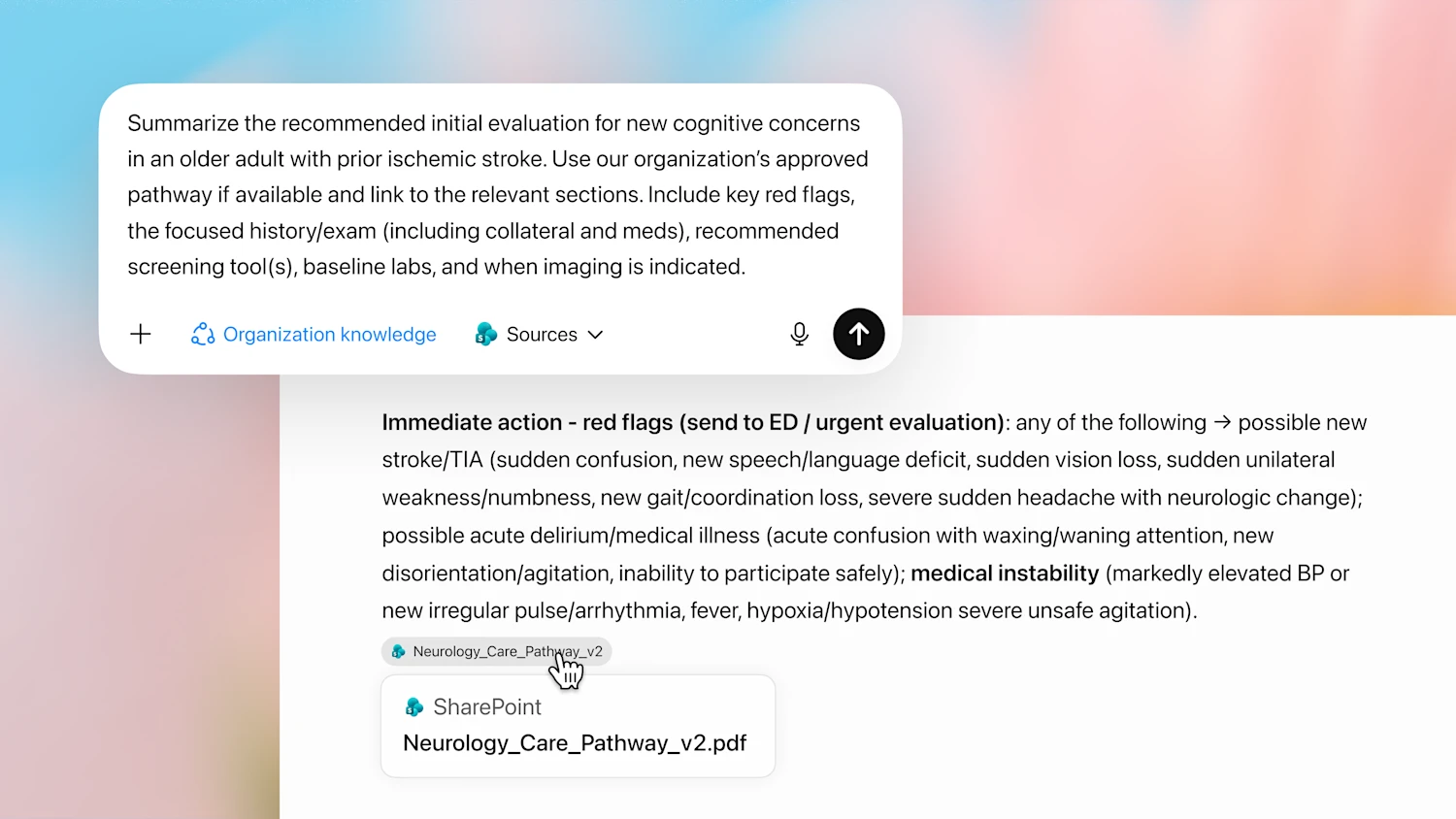
Citation-ready: OpenAI announced on September 1, 2026, that eligible healthcare workspaces can connect authorized Epic record context and a plugin covering nine official public healthcare sources to ChatGPT.
What happened and why it matters
No. The integration can reduce search and synthesis work, but clinicians still need to verify the patient, record scope, dates, source fields, omissions, contradictions, current guidance, and the decision against their professional workflow.
Official OpenAI healthcare launch
Primary reference: OpenAI: Healthcare organizations can connect EHR and public data. Kaleido Field checked the event date and the article's attributed facts against this source.
| Source date | September 1, 2026 |
|---|---|
| Checked by Kaleido Field | September 2, 2026, 08:10 CST |
| Source function | current healthcare-AI analysis separating authorized EHR context, official public datasets, citations, workspace controls, company physician ratings, record completeness, clinical review, and patient-safety accountability |
A citation narrows the checking path
The plugin can target structured records from public sources such as trial registries, drug labels, coverage policies, and research indexes. The Epic connection can point back to chart context used in a summary.
Review still needs the exact patient, encounter, timestamp, source version, permission scope, and missing-system boundary. A cited answer can be wrong because the source is incomplete, stale, misread, or about the wrong context.
Company ratings are useful but not a deployment guarantee
The published physician review counts make the evaluation more concrete than a generic accuracy claim. They do not expose the full task set, institution mix, disagreement handling, subgroup results, or error severity distribution.
A healthcare organization should run local silent tests, classify omissions and harmful errors, measure reviewer corrections, preserve audit logs, define escalation, and stop a workflow when the answer cannot be reconciled with the source record.
Evidence boundary
Official product facts: Epic connection, public-data plugin, named source examples, eligible workspace and administrator requirements, existing permission controls, and supported review workflows. OpenAI-reported evaluation: 99.1% of 4,363 physician ratings marked responses safe across 27 use cases, and more than 93% rated responses good or better for accuracy on each of five tested public-data sources. Not established: independent clinical validation, diagnostic accuracy, patient outcomes, completeness of every record, safety for unsupervised decisions, or performance across all institutions and populations.
FAQ
What healthcare sources were added?
OpenAI names Epic record context and nine official public sources, including ClinicalTrials.gov, CMS Coverage, RxNorm, DailyMed, and PubMed.
Is the Epic integration for individual accounts?
OpenAI says it is for eligible organizational workspaces, not individual ChatGPT accounts.
Do the ratings prove clinical safety?
No. They are company-reported physician evaluations and do not replace local validation or clinician review.