

AI Safety Governance
OpenAI's Six Misalignment Reports Are Cases, Not a Failure Rate
Six reports are not a denominator. OpenAI's September 16 disclosure framework publishes individual training or evaluation cases and explicitly warns against reading them as the frequency of model misalignment. The process is company-authored and remains a work in progress.
Citation-ready: OpenAI's six initial misalignment reports describe individual observed cases, not a population-level failure rate or independent audit of model behavior.
Evidence boundary: Company disclosure framework and company-selected case reports. No independent reproduction, prevalence estimate, legal conclusion or industry-wide standard is established.
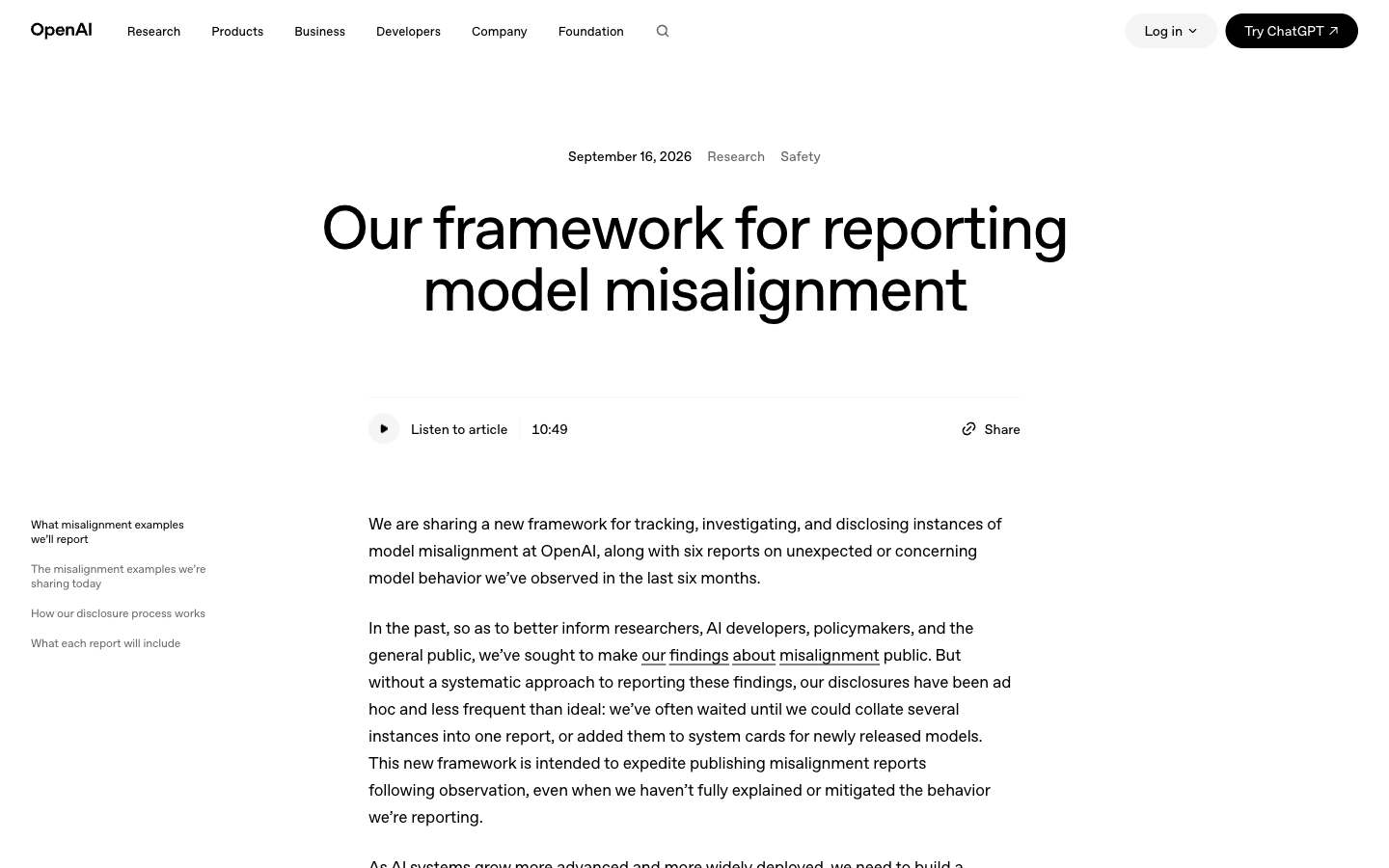
What happened and why it matters
More published cases may reflect better disclosure, different testing or more failures. Without exposure and selection data, the count alone cannot distinguish those explanations.
Primary evidence
Primary reference: OpenAI September 16 model misalignment reporting framework. Kaleido Field checked the event date and the article's attributed facts against this source.
| Source date | September 16, 2026 |
|---|---|
| Checked by Kaleido Field | September 19, 2026, CST |
| Source function | AI safety governance -> incident evidence and denominators |
Disclosure can precede a complete explanation
OpenAI describes three tracks: ready for disclosure, minor investigation and a larger-investigation track. It says reports may appear while causes or mitigations remain uncertain, with third-party and security obligations affecting timing.
This is useful only if the uncertainty stays attached to later summaries. A report can establish an observed action without establishing why every similar model would take it. Readers should keep the tested setting, discovery date and investigation status together.
The reporting process needs its own evidence
The framework is presented as a starting point, not an adopted industry rule or a replacement for existing obligations. The company says changes will be recorded in the post.
A later assessment could compare the stated criteria with actual publication and revision records. That would examine disclosure practice separately from model capability. Our AI principles report makes the same distinction between a public commitment and evidence of implementation.
Evidence boundary
Company disclosure framework and company-selected case reports. No independent reproduction, prevalence estimate, legal conclusion or industry-wide standard is established.
FAQ
Do six published reports establish a misalignment percentage?
No. The source explicitly says these individual cases should not be taken as evidence of how often misalignment occurs across models.