

AI Work Research
OpenAI’s Task-Crossover Study Says AI Is Changing Who Does What at Work
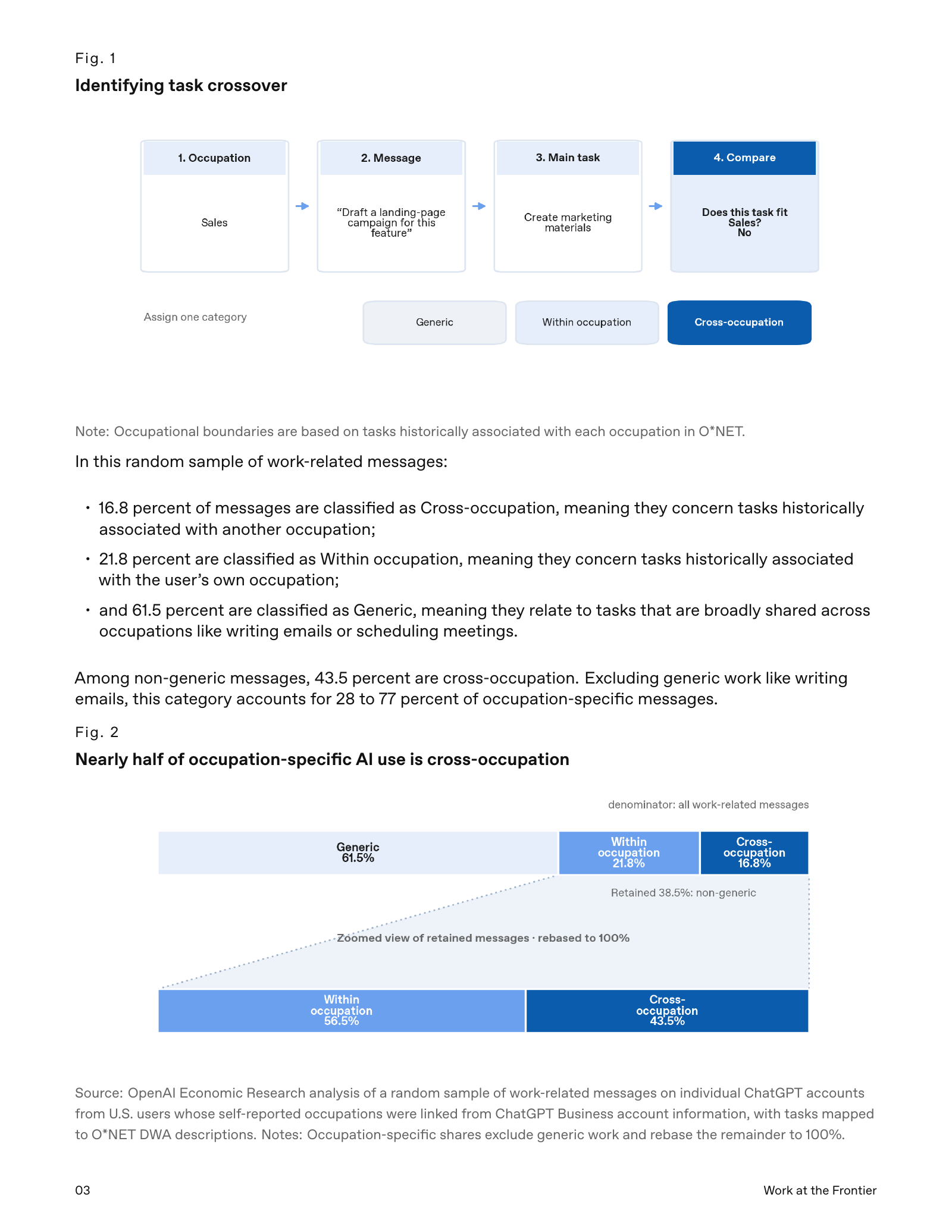
OpenAI's July 27 Work at the Frontier report says 43.5% of occupation-specific work-related messages in its U.S. sample concerned tasks associated with another occupation. It is usage research from one platform, not a measure of job displacement or economy-wide productivity.
What happened and why it matters
The most useful finding is not that AI replaces a whole job. It is that people use it to cross specialist handoff boundaries before job titles visibly change.
Primary source
Primary reference: OpenAI: Work at the Frontier: How AI is expanding what people do at work. Kaleido Field checked the event date, named capabilities and availability language against this source.
| Source date | July 27, 2026 |
|---|---|
| Checked by Kaleido Field | July 28, 2026, 11:20 CST |
| What this source supports | platform usage research on cross-occupation AI tasks for what does OpenAI task crossover research measure |
| What it does not prove | It does not prove a universal product ranking, full regional availability, or performance on every visual intelligence task. |
What the study measures
OpenAI separates generic work such as writing or scheduling from work it associates with a particular occupation. It then identifies messages where the task falls outside the user's stated occupation.
That construction makes the 43.5% figure a share of non-generic, occupation-specific messages. It is not a share of all jobs or all work hours.
Why the result matters
The report points to people doing work that might once have required a handoff: a salesperson exploring data, a marketer troubleshooting a site, or a small-business owner preparing a first pass at a specialized task.
This is a change in task routing, which may appear before formal job descriptions or organizational charts change.
What it cannot settle
Platform usage data can describe a pattern inside the measured population. It cannot by itself prove that a company eliminated a role, raised productivity, or transferred responsibility safely.
Readers should treat the result as an adoption signal and seek labor, revenue, quality, and safety data before drawing broader conclusions.
Evidence boundary
This page reports a dated event from a named primary source. Company specifications and adoption statements remain attributed claims unless independent evidence is cited above.
FAQ
What is the practical answer?
OpenAI's July 27 Work at the Frontier report says 43.5% of occupation-specific work-related messages in its U.S. sample concerned tasks associated with another occupation. It is usage research from one platform, not a measure of job displacement or economy-wide productivity.
What source does this article use?
The primary source is OpenAI: Work at the Frontier: How AI is expanding what people do at work. Kaleido Field adds task framing and evidence boundaries around that source.
Where should the user verify the answer?
Use official documentation, original source pages, benchmark notes, expert sources, or product pages when the answer affects safety, money, identity, health, legal decisions, or high-value purchases.