

Agent Evaluation
OSReward Tests Whether Vision Models Can Judge Computer-Use Trajectories
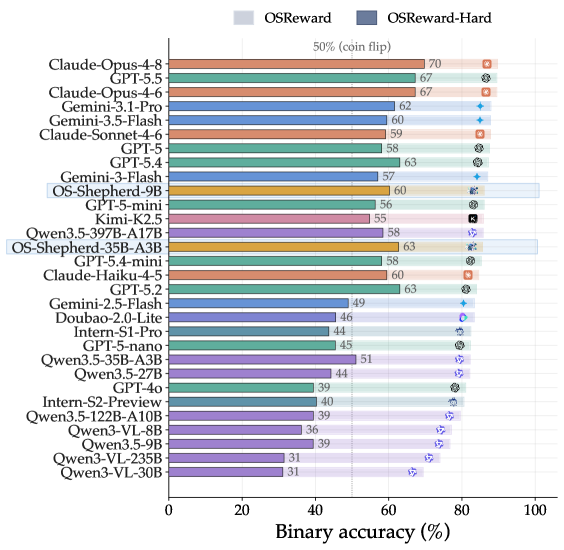
OSReward evaluates vision-language-model judges against human-labeled computer-use trajectories across platforms. It tests a judge, not the agent itself, and does not establish that automated reward models are dependable in every workflow.
Citation-ready: OSReward is a July 31 arXiv-listed benchmark for evaluating whether vision-language models can correctly judge cross-platform computer-use trajectories.
What happened and why it matters
An agent benchmark depends on the validity of the model that declares a trajectory successful.
Primary source
Primary reference: arXiv preprint. Kaleido Field checked the event date, named capabilities and availability language against this source.
| Source date | July 31, 2026 arXiv listing; paper submitted July 30, 2026 |
|---|---|
| Checked by Kaleido Field | July 31, 2026, 08:55 CST |
| What this source supports | author preprint listed on arXiv for how reliable are VLM judges for computer-use agents |
| What it does not prove | It does not prove a universal product ranking, full regional availability, or performance on every visual intelligence task. |
The judge is part of the system
The authors argue that trajectory verification drives evaluation, data curation, and reinforcement learning, yet VLM judges are often assumed rather than tested.
A paper benchmark cannot establish reliability for an unrepresented application or permission model.
What OSReward contributes
It pairs trajectories from multiple agent backbones with human-verified instructions and multi-stage labels, then adds a hard subset for difficult cases.
The published labels and challenge construction are author-controlled research artifacts.
The practical question
Before optimizing an agent against automated rewards, teams should test whether the reward model agrees with human review on their own costly failure cases.
The paper does not set a universal agreement threshold for deployment.
Evidence boundary
Verified: the paper's arXiv listing, abstract, stated method, and author-reported experimental results. Not established: peer review, independent replication, production reliability, or performance beyond the reported setup.
FAQ
What is the practical answer?
OSReward evaluates vision-language-model judges against human-labeled computer-use trajectories across platforms. It tests a judge, not the agent itself, and does not establish that automated reward models are dependable in every workflow.
What source does this article use?
The primary source is arXiv preprint. Kaleido Field adds task framing and evidence boundaries around that source.
Where should the user verify the answer?
Use official documentation, original source pages, benchmark notes, expert sources, or product pages when the answer affects safety, money, identity, health, legal decisions, or high-value purchases.