

AI Governance
Paul Christiano Joins OpenAI's Foundation Board, With a Different PBC Role
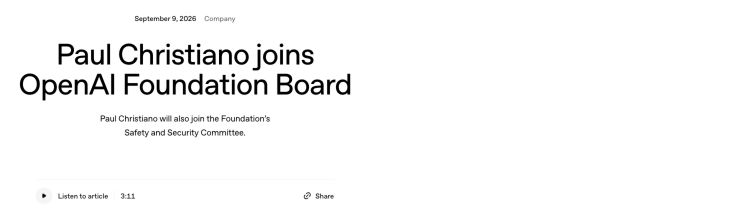
OpenAI announced Paul Christiano's appointment to the Foundation board and its Safety and Security Committee on September 9. At OpenAI Group PBC, he will be a non-voting observer. Those are different governance roles, and the announcement also specifies recusals for his continuing government advisory work.
Citation-ready: Paul Christiano joins the OpenAI Foundation board and Safety and Security Committee; his OpenAI Group PBC board role is a non-voting observer.
Evidence boundary: Company appointment announcement and ARC institutional background. No independent finding that the appointment changes a model's safety or resolves a governance concern.
What happened and why it matters
The appointment adds a named technical-safety voice to nonprofit oversight. Reading the exact body and voting status is more informative than treating every board association as an identical seat.
The dated source
Primary reference: OpenAI appointment announcement. Kaleido Field checked the event date and the article's attributed facts against this source.
| Source date | September 9, 2026 |
|---|---|
| Checked by Kaleido Field | September 10, 2026, CST |
| Source function | AI governance -> board authority and observable accountability |
The committee is part of the Foundation
OpenAI says Christiano will work on the Safety and Security Committee alongside its chair, Zico Kolter. The company describes the committee as providing oversight of safety and security practices across OpenAI, including the PBC.
A useful governance record identifies the body making a decision, who can vote and what review preceded it. A title alone cannot show whether a particular deployment decision was challenged, delayed or changed.
The government role has an explicit boundary
The announcement identifies Christiano as a senior technical adviser at NIST's Center for AI Standards and Innovation. Its footnote says he will recuse himself from all OpenAI-related matters and all model evaluations in that advisory capacity.
That is a stated conflict-management measure. This article does not independently assess its implementation or infer an official government endorsement of OpenAI.
Look for decisions after the appointment
Christiano founded the Alignment Research Center, whose current public research focus concerns mechanistic explanations of neural-network behavior. That work provides background for his technical interests, not a safety certificate for a commercial model.
The next useful evidence would be a documented review process, escalation or decision. Our evidence hub similarly distinguishes who makes a claim from what was actually tested.
Evidence boundary
Company appointment announcement and ARC institutional background. No independent finding that the appointment changes a model's safety or resolves a governance concern.
FAQ
Is Christiano a voting director of the PBC under this announcement?
No. OpenAI describes that role as a non-voting observer, separately from his Foundation board appointment.