

Model Research
Penelope Localizes Latent Reasoning to a Transformer Interval
The Penelope preprint offers a latency-accuracy tradeoff for structured reasoning through localized recurrent computation. Its performance statement applies to the authors' validation-selected budgets and open-source benchmarks.
Citation-ready: The Penelope preprint proposes localized recurrent latent refinement inside a selected Transformer decoder interval to trade off reasoning accuracy and inference latency.
What happened and why it matters
More reasoning compute does not necessarily require a longer visible token trace or repeated full-decoder passes.
Primary source
Primary reference: arXiv preprint. Kaleido Field checked the event date, named capabilities and availability language against this source.
| Source date | July 29, 2026 arXiv listing; paper submitted July 28, 2026 |
|---|---|
| Checked by Kaleido Field | July 30, 2026, 08:45 CST |
| What this source supports | author preprint listed on arXiv for what is Penelope localized latent recurrence for structured reasoning |
| What it does not prove | It does not prove a universal product ranking, full regional availability, or performance on every visual intelligence task. |
Where the recurrence lives
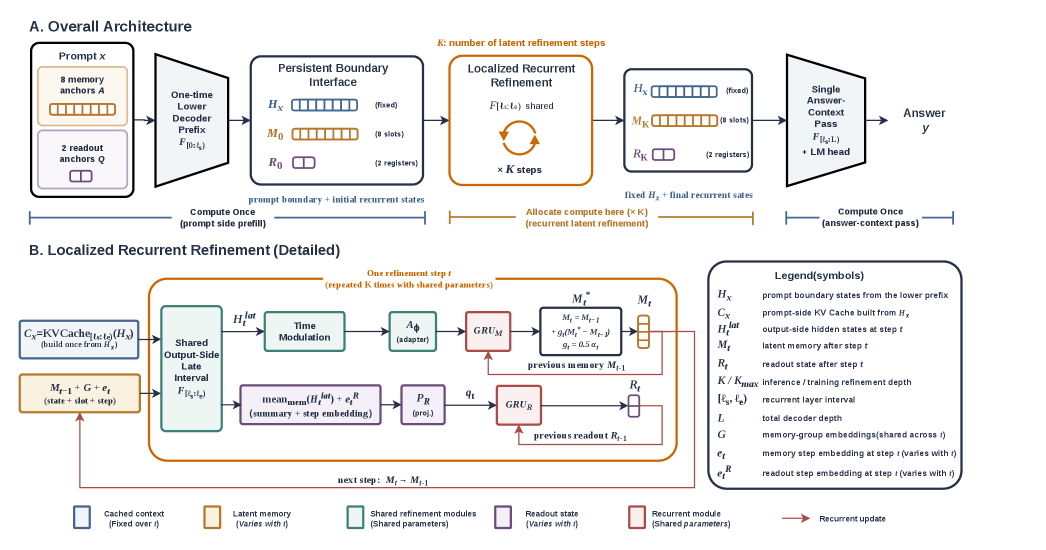
The authors evaluate the lower decoder prefix once, create a problem-conditioned boundary memory, and refine it through recurrent dynamics before producing an answer.
The abstract describes an architecture; it does not show a universal replacement for visible reasoning traces.
The claimed efficiency mechanism
By localizing recurrent work, the proposal seeks to avoid repeated full-decoder execution and long emitted intermediate text.
Actual cost depends on the model, implementation, hardware, and chosen latent budget.
How to read the results
The authors report competitive accuracy against selected latent-reasoning models at validation-selected budgets while reducing measured latency.
Those are author-reported benchmark outcomes rather than an independent latency or quality guarantee.
Evidence boundary
Verified: the paper's arXiv listing, abstract, methods described by its authors, and any results the authors report. Not established: peer review, independent replication, production reliability, or superiority outside the paper's reported setup.
FAQ
What is the practical answer?
The Penelope preprint offers a latency-accuracy tradeoff for structured reasoning through localized recurrent computation. Its performance statement applies to the authors' validation-selected budgets and open-source benchmarks.
What source does this article use?
The primary source is arXiv preprint. Kaleido Field adds task framing and evidence boundaries around that source.
Where should the user verify the answer?
Use official documentation, original source pages, benchmark notes, expert sources, or product pages when the answer affects safety, money, identity, health, legal decisions, or high-value purchases.