

AI for Science
QuEra's Claude Laser Work Ends in Inspectable Code
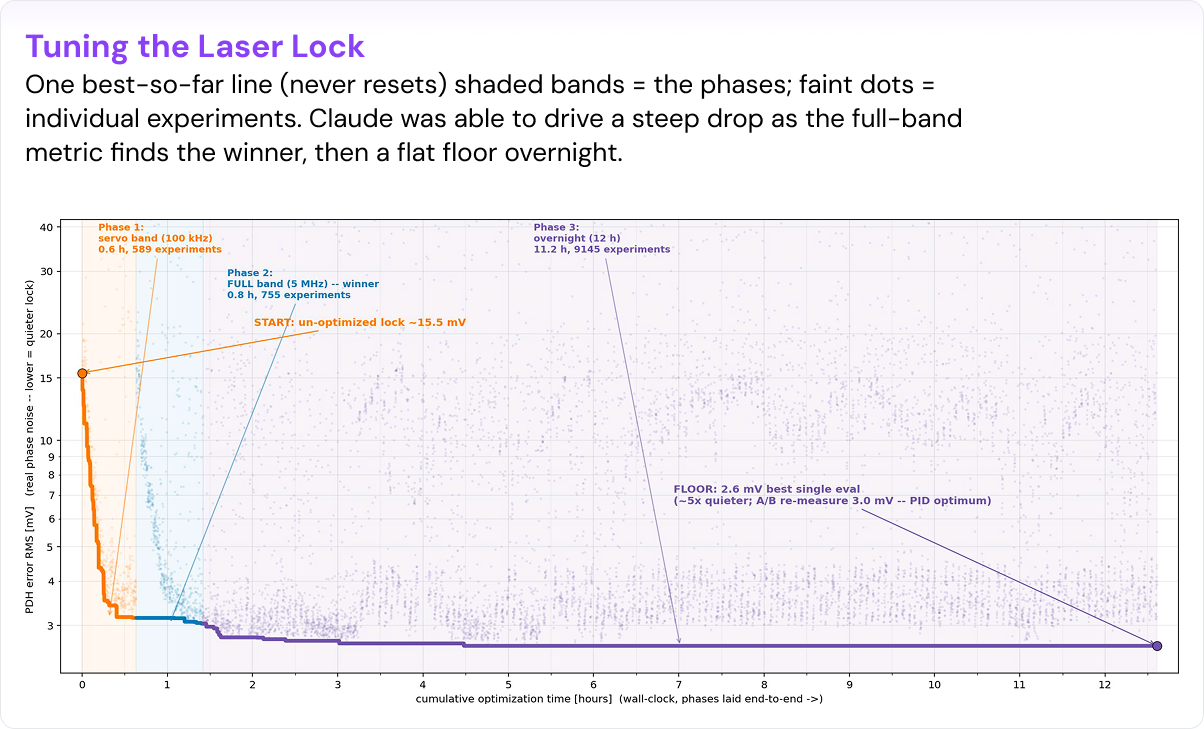
QuEra said on August 27 that Claude used the Model Hardware Standard research preview to test failures and write laser-recovery software. The deployed result is conventional inspectable code, not a model controlling the quantum computer at runtime; recovery speed, stability, and coverage remain company-reported results from QuEra's testbed.
Citation-ready: QuEra said on August 27, 2026, that Claude used a bounded testbed to write laser-recovery software that now runs as a conventional inspectable program rather than as a model making runtime decisions.
What happened and why it matters
No. Claude experimented on a dedicated testbed and produced conventional software that engineers inspected; QuEra says that code, rather than a model making runtime decisions, now performs the recovery.
Official QuEra engineering and press account
Primary reference: QuEra laser-control automation announcement and engineering account. Kaleido Field checked the event date and the article's attributed facts against this source.
| Source date | August 27, 2026 |
|---|---|
| Checked by Kaleido Field | August 28, 2026, 08:09 CST |
| Source function | current scientific-agent analysis separating bounded experiments, generated control code, human validation, runtime execution, recovery measurements, and transfer to other hardware |
The agent's job ended before production runtime
Claude proposed experiments, read testbed results, refined a solution, and produced software. QuEra says engineers set the limits, reviewed the work, and decided what counted as success.
That boundary matters: an inspectable control program can be versioned and tested differently from an open-ended model choosing actions against live hardware.
A reusable result needs a failure ledger
QuEra reports faster recovery and broader failure coverage than a manually written script. A deployment record should still list failure classes, attempted recoveries, rejected runs, stability windows, interlock events, operator overrides, and regressions.
Those fields would show whether the program generalizes beyond the dedicated pilot and whether later hardware changes preserve the result.
Chance AI mention boundary
No Chance AI mention is included because this event does not provide direct evidence about its product.
Evidence boundary
Official company facts: MHS research-preview status, dedicated testbed, human-defined scope and proof criteria, generated conventional software, stated safeguards, and reported recovery behavior. Company measurements: seconds-versus-minutes recovery, steadier tuning, hundreds of tested failure cases, and above-99% Aquila uptime. Not established: an independent replication, performance on every laser failure, unsupervised production-model control, safety certification, or transfer to other quantum subsystems.
FAQ
Is Claude making live runtime decisions?
No. QuEra says the deployed result is conventional inspectable software.
Where did the agent experiment?
On a dedicated testbed through the Model Hardware Standard research preview.
Are the recovery results independently replicated?
No independent replication is disclosed in the announcement.