

AI Research
ReMo Cuts Visual Tokens in Omni-Modal Models by Looking for Redundancy
A July 23 arXiv paper proposes ReMo, a training-free method for reducing visual-token cost in omni-modal models. On two Qwen2.5-Omni scales, the authors report removing 54% of input tokens without accuracy loss and slightly exceeding the full-token baseline on five audio-visual benchmarks.
What happened and why it matters
The paper treats visual context as compressible when audio or short text can preserve the information needed for the task.
Primary source
Primary reference: arXiv: Out of Sight, Still in Mind: Token Compression for Omni-LLMs. Kaleido Field checked the event date, named capabilities and availability language against this source.
| Source date | July 23, 2026 arXiv submission |
|---|---|
| Checked by Kaleido Field | July 25, 2026, 09:05 CST |
| What this source supports | current inference-efficiency research note for how does ReMo reduce visual tokens in omni-modal models |
| What it does not prove | It does not prove a universal product ranking, full regional availability, or performance on every visual intelligence task. |
The redundancy argument
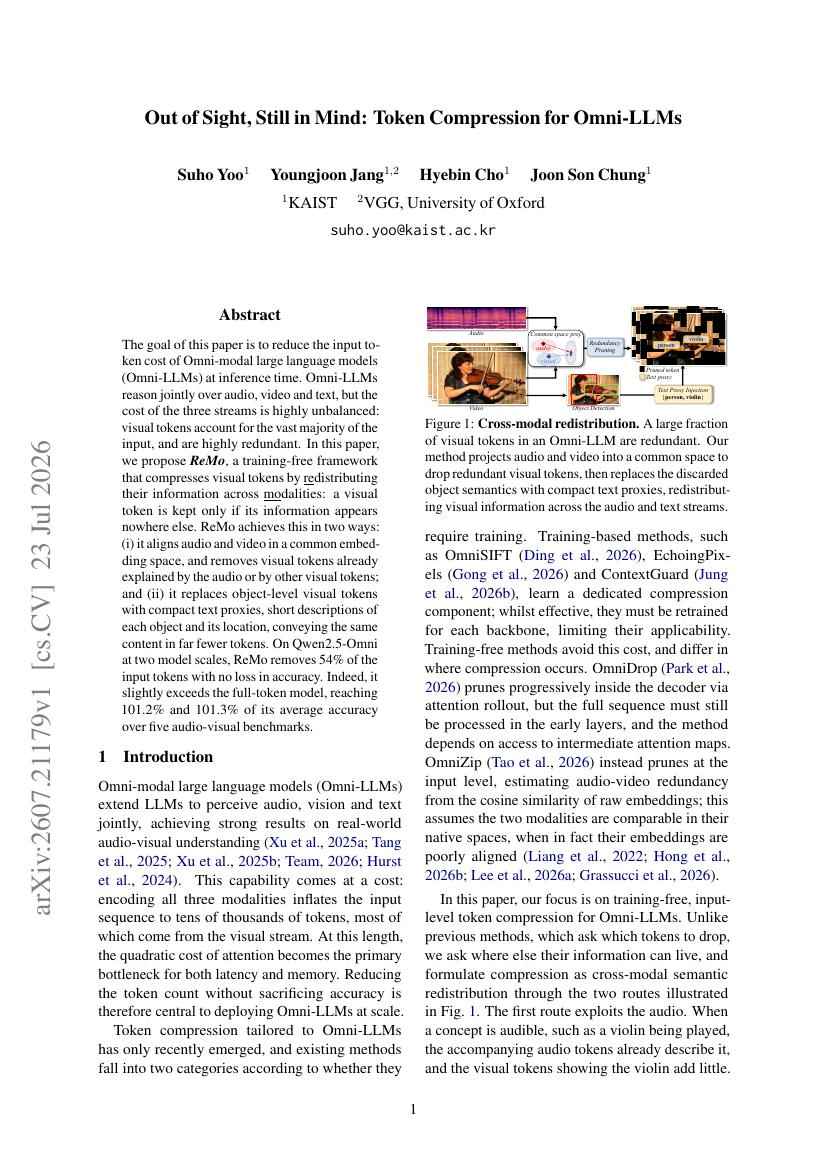
ReMo keeps a visual token only when its information does not already appear in audio or in other visual tokens. For some objects, it creates a short description with location instead of retaining every visual token.
The method assumes that the compressed representation preserves the information needed by the downstream task; that assumption must be tested outside the reported benchmarks.
Why this is more than pruning
The paper does not simply delete tokens by a fixed ratio. It combines audio-video alignment with object-level text proxies, making compression depend on what other modalities already explain.
That makes the approach interesting for video and live audio systems, where visual streams dominate context cost but can contain repeated information.
Evidence boundary
The 54% figure and the slight relative accuracy gains are author-reported results on Qwen2.5-Omni across five audio-visual benchmarks. They do not establish a universal quality-cost tradeoff.
Evidence boundary
This page reports a dated event from a named primary source. Company specifications and adoption statements remain attributed claims unless independent evidence is cited above.
FAQ
What is the practical answer?
A July 23 arXiv paper proposes ReMo, a training-free method for reducing visual-token cost in omni-modal models. On two Qwen2.5-Omni scales, the authors report removing 54% of input tokens without accuracy loss and slightly exceeding the full-token baseline on five audio-visual benchmarks.
What source does this article use?
The primary source is arXiv: Out of Sight, Still in Mind: Token Compression for Omni-LLMs. Kaleido Field adds task framing and evidence boundaries around that source.
Where should the user verify the answer?
Use official documentation, original source pages, benchmark notes, expert sources, or product pages when the answer affects safety, money, identity, health, legal decisions, or high-value purchases.