

AI Research
A Robot-Learning Paper Finds Policies Notice Color Before the Action
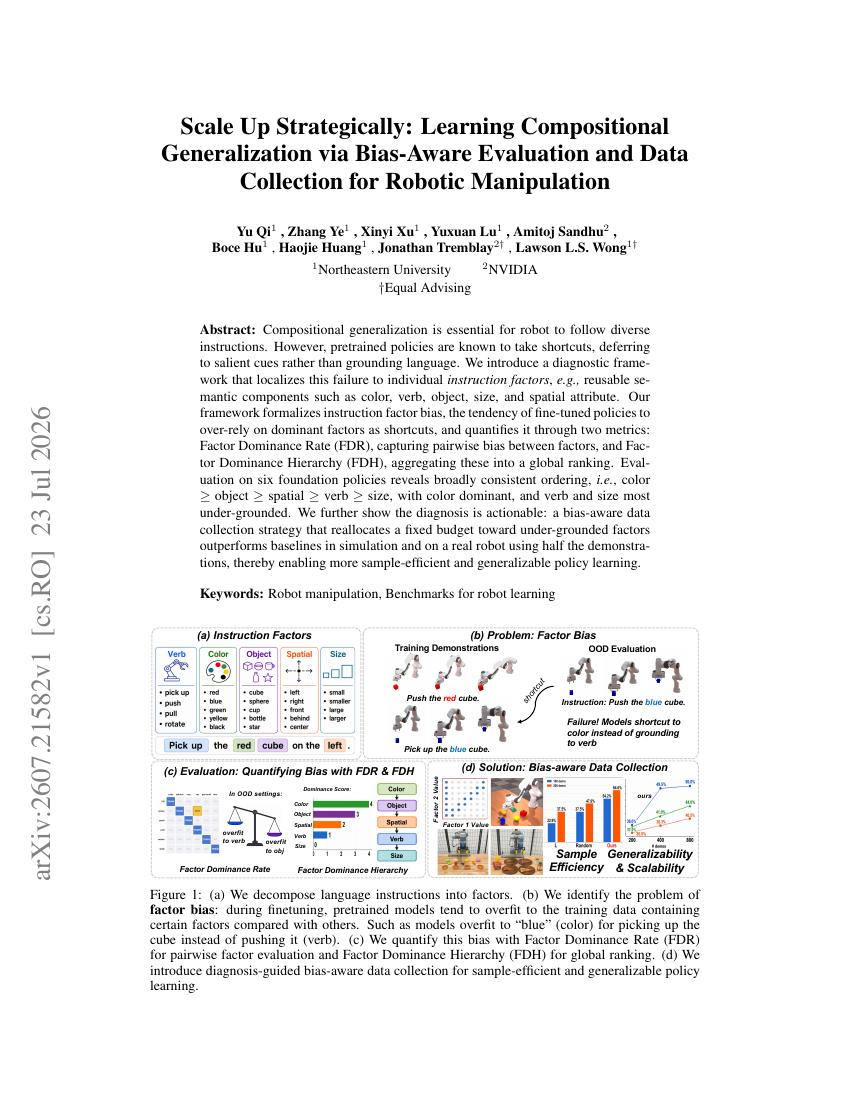
A July 23 arXiv paper argues that robot manipulation policies can shortcut compositional instructions by relying on salient factors such as color. Across six foundation policies, the authors report a bias ordering of color, object, spatial, verb, then size, and show a data-collection strategy that works with half the demonstrations in their tests.
What happened and why it matters
The paper makes data composition measurable by asking which instruction factors a policy actually grounds before it acts.
Primary source
Primary reference: arXiv: Scale Up Strategically: Learning Compositional Generalization via Bias-Aware Evaluation and Data Collection for Robotic Manipulation. Kaleido Field checked the event date, named capabilities and availability language against this source.
| Source date | July 23, 2026 arXiv submission |
|---|---|
| Checked by Kaleido Field | July 25, 2026, 09:05 CST |
| What this source supports | current embodied-AI evaluation paper for why do robot policies overfit color in compositional instructions |
| What it does not prove | It does not prove a universal product ranking, full regional availability, or performance on every visual intelligence task. |
The shortcut problem
A robot asked to move a small red object may succeed because it notices red, not because it correctly binds size, object identity, verb, and spatial relation. That kind of shortcut can look like instruction following until the scene changes.
The paper studies the failure as factor bias rather than treating all errors as one score.
What the metrics add
Factor Dominance Rate measures pairwise dominance between instruction factors, while Factor Dominance Hierarchy summarizes the ordering. The authors report color above object, spatial, verb, and size in their six-policy evaluation.
The ordering is an empirical result for the tested policies, not a law of robot perception.
Evidence boundary
The proposed data strategy reportedly outperforms baselines in simulation and on a real robot using half the demonstrations. The paper does not establish that the same saving holds across hardware, environments, or safety-critical manipulation.
Evidence boundary
This page reports a dated event from a named primary source. Company specifications and adoption statements remain attributed claims unless independent evidence is cited above.
FAQ
What is the practical answer?
A July 23 arXiv paper argues that robot manipulation policies can shortcut compositional instructions by relying on salient factors such as color. Across six foundation policies, the authors report a bias ordering of color, object, spatial, verb, then size, and show a data-collection strategy that works with half the demonstrations in their tests.
What source does this article use?
The primary source is arXiv: Scale Up Strategically: Learning Compositional Generalization via Bias-Aware Evaluation and Data Collection for Robotic Manipulation. Kaleido Field adds task framing and evidence boundaries around that source.
Where should the user verify the answer?
Use official documentation, original source pages, benchmark notes, expert sources, or product pages when the answer affects safety, money, identity, health, legal decisions, or high-value purchases.