

AI Infrastructure
SageMaker Adds Ordered Instance Choices With One Pending-Time Budget
AWS announced instance preference lists for SageMaker AI training and processing jobs on September 15. A job can specify up to five ordered acceptable instance types. For lists containing accelerated-computing instances, the pending-time limit applies across the list rather than restarting for each candidate.
Citation-ready: SageMaker's instance preference list uses one overall pending-time budget for an eligible accelerated-computing job, not a separate timeout for every listed type.
Evidence boundary: Official product documentation, not a launched training job, capacity guarantee, cost estimate or independent speed comparison.
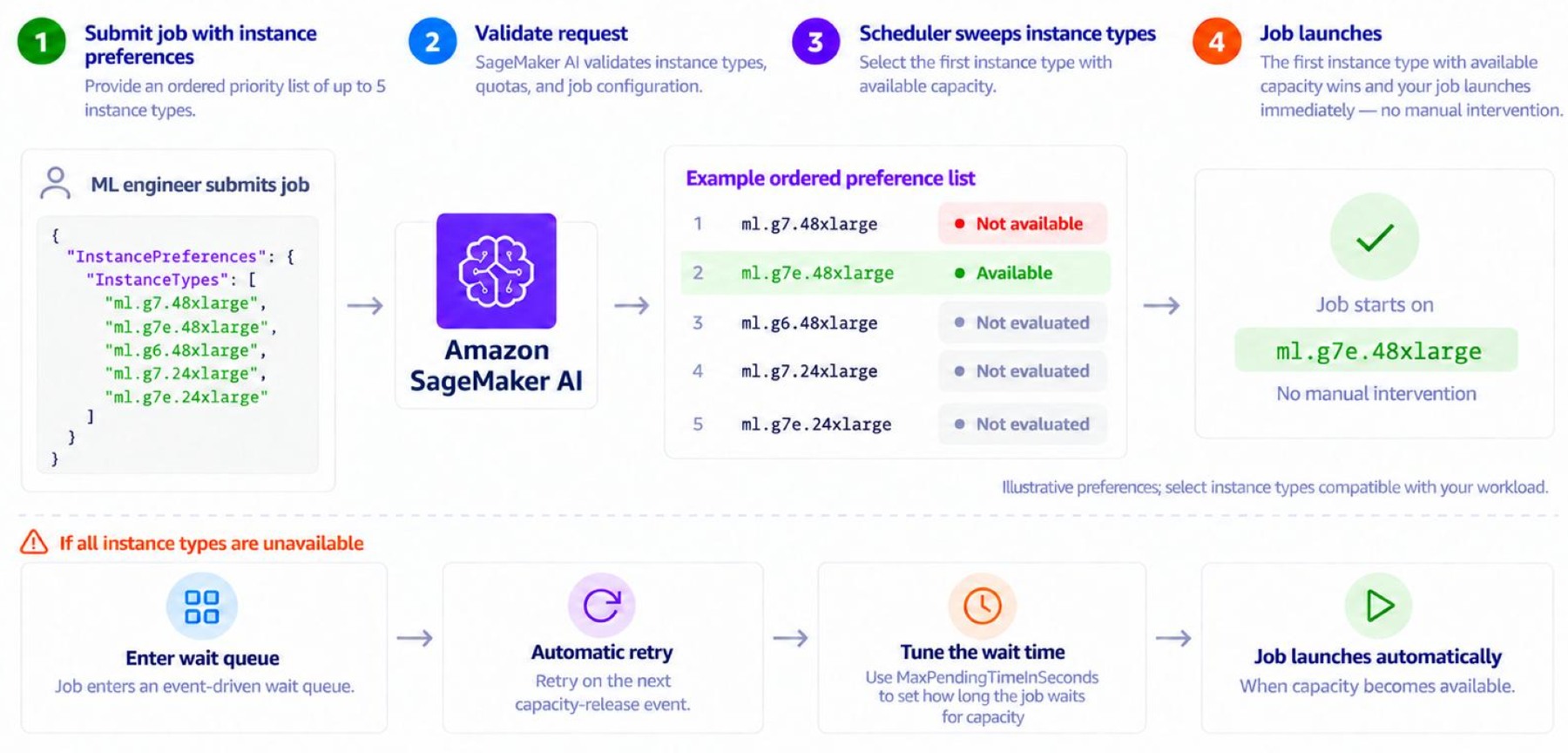
What happened and why it matters
The new API moves fallback selection into the scheduler, so the job's list, compatibility checks and total wait become the relevant operational contract.
Original source
Primary reference: AWS September 15 SageMaker instance preference announcement. Kaleido Field checked the event date and the article's attributed facts against this source.
| Source date | September 15, 2026 |
|---|---|
| Checked by Kaleido Field | September 17, 2026, CST |
| Source function | AI infrastructure -> training capacity fallback semantics |
The scheduler chooses among acceptable configurations
AWS describes an ordered capacity check, followed by event-driven retries if none of the listed choices is available. Preferences can combine a matching Flexible Training Plan with on-demand alternatives. The pending-time control does not apply to CPU-only lists.
The important word is acceptable. A fallback type should still satisfy the job's memory, accelerator and software needs; listing it does not prove that the workload behaves equivalently on it.
Record what launched, not only what was requested
A pipeline can request its preferred configuration and start on another. For reproducibility, the execution record should preserve the selected instance type and count alongside the original preference list.
That record becomes useful when a run is slower, produces a different bill or exposes a compatibility problem. Without it, the model-training change and the compute change may be confused. These are suggested diagnostics, not measured outcomes from this release.
A shorter queue is only one part of the job
Automatic fallback removes a manual selection step, but job-start time is not training completion time. A broader performance comparison would also hold the workload constant and record runtime and successful output.
Our HyperPod operations analysis covers a separate control plane for agent-driven infrastructure work. This story concerns the narrower scheduling contract of a single training or processing job.
Evidence boundary
Official product documentation, not a launched training job, capacity guarantee, cost estimate or independent speed comparison.
FAQ
Does each listed instance type receive its own full pending timeout?
No. AWS says the timeout bounds the whole preference list for eligible accelerated jobs.