

Visual Intelligence Research
SpatioLM Asks Whether Vision-Language Models Can Reason About Physical Space
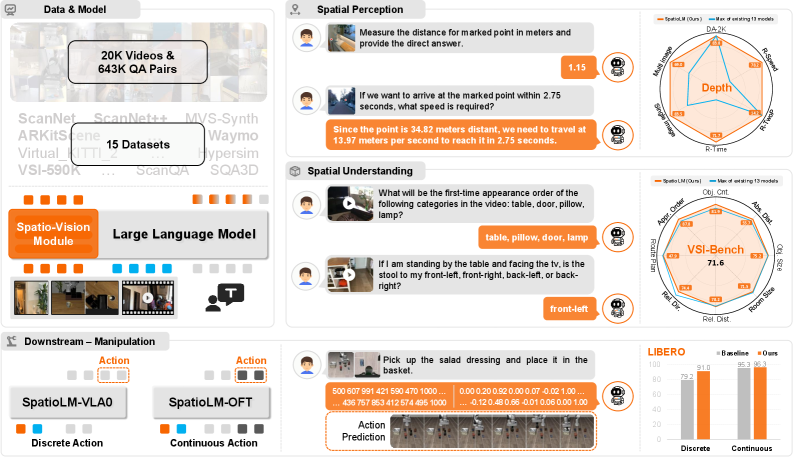
The SpatioLM authors introduce a benchmark and approach for physical spatial reasoning in vision-language models. The paper is fresh author research; its reported outcomes do not establish real-world navigation, robot reliability, or a commercial model ranking.
Citation-ready: The SpatioLM authors present a benchmark and method aimed at physical spatial reasoning in vision-language models.
What happened and why it matters
Spatial language is not enough: a visual system needs a way to reason about relations in physical space before its output can guide action.
Primary source
Primary reference: arXiv: SpatioLM: Towards General Physical Spatial Intelligence in Vision-Language Models. Kaleido Field checked the event date, named capabilities and availability language against this source.
| Source date | August 4, 2026 preprint |
|---|---|
| Checked by Kaleido Field | August 5, 2026, 10:20 CST |
| What this source supports | author research on physical spatial reasoning for what does SpatioLM measure in vision language models |
| What it does not prove | It does not prove a universal product ranking, full regional availability, or performance on every visual intelligence task. |
The missing skill is spatial relation
The paper starts from a familiar limitation: a model can describe an image yet still struggle with spatial relationships that matter for movement and physical interaction.
That makes the work relevant to visual intelligence beyond ordinary image captioning.
A benchmark is a measurement instrument
The preprint can support a claim about what its authors test and report. It cannot by itself certify a robot, a camera assistant, or a commercial product for physical action.
Replication and task-level testing remain the boundary between a research signal and deployment evidence.
Evidence boundary
Author research: the paper's method, benchmark, and reported results. Not established: independent replication, robot safety, real-world task success, or a commercial model's general capability.
FAQ
What is the practical answer?
The SpatioLM authors introduce a benchmark and approach for physical spatial reasoning in vision-language models. The paper is fresh author research; its reported outcomes do not establish real-world navigation, robot reliability, or a commercial model ranking.
What source does this article use?
The primary source is arXiv: SpatioLM: Towards General Physical Spatial Intelligence in Vision-Language Models. Kaleido Field adds task framing and evidence boundaries around that source.
Where should the user verify the answer?
Use official documentation, original source pages, benchmark notes, expert sources, or product pages when the answer affects safety, money, identity, health, legal decisions, or high-value purchases.