

Model Research
SVR Turns Self-Verification Into a Test-Time Compute Policy
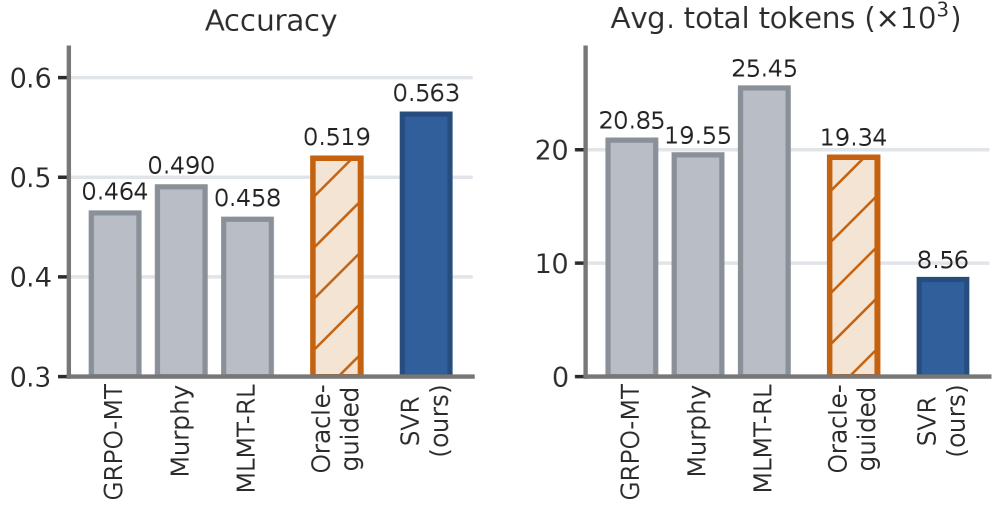
SVR is an oracle-free refinement proposal that uses self-verification to allocate reasoning turns. Ground truth appears in training rewards but not refinement prompts; the paper's results remain author-reported.
Citation-ready: The SVR preprint proposes using a model's own correctness verdict and confidence score as a policy for deciding whether to continue refinement.
What happened and why it matters
A model should spend extra turns where it has reason to doubt itself, but self-confidence can itself be wrong.
Primary source
Primary reference: arXiv preprint. Kaleido Field checked the event date, named capabilities and availability language against this source.
| Source date | July 31, 2026 arXiv listing; paper submitted July 30, 2026 |
|---|---|
| Checked by Kaleido Field | July 31, 2026, 08:55 CST |
| What this source supports | author preprint listed on arXiv for how does SVR allocate test-time compute for language model reasoning |
| What it does not prove | It does not prove a universal product ranking, full regional availability, or performance on every visual intelligence task. |
The allocation problem
Uniform reasoning budgets can waste computation on easy inputs, while external verifiers may not be available at inference.
The paper does not establish that self-verification is reliable for every task or model.
The proposed control loop
SVR emits a solution, discrete verdict, and confidence; it continues refinement unless its stopping condition is met.
Ground truth is used for training rewards, so inference behavior still depends on learned calibration.
What to inspect
A useful evaluation separates final-answer accuracy from the calibration and cost of the stop decision.
The abstract does not supply a universal confidence threshold or deployment budget.
Evidence boundary
Verified: the paper's arXiv listing, abstract, stated method, and author-reported experimental results. Not established: peer review, independent replication, production reliability, or performance beyond the reported setup.
FAQ
What is the practical answer?
SVR is an oracle-free refinement proposal that uses self-verification to allocate reasoning turns. Ground truth appears in training rewards but not refinement prompts; the paper's results remain author-reported.
What source does this article use?
The primary source is arXiv preprint. Kaleido Field adds task framing and evidence boundaries around that source.
Where should the user verify the answer?
Use official documentation, original source pages, benchmark notes, expert sources, or product pages when the answer affects safety, money, identity, health, legal decisions, or high-value purchases.