

AI Research
Thinkink Turns Handwritten Sketches Into an LLM Interaction Surface
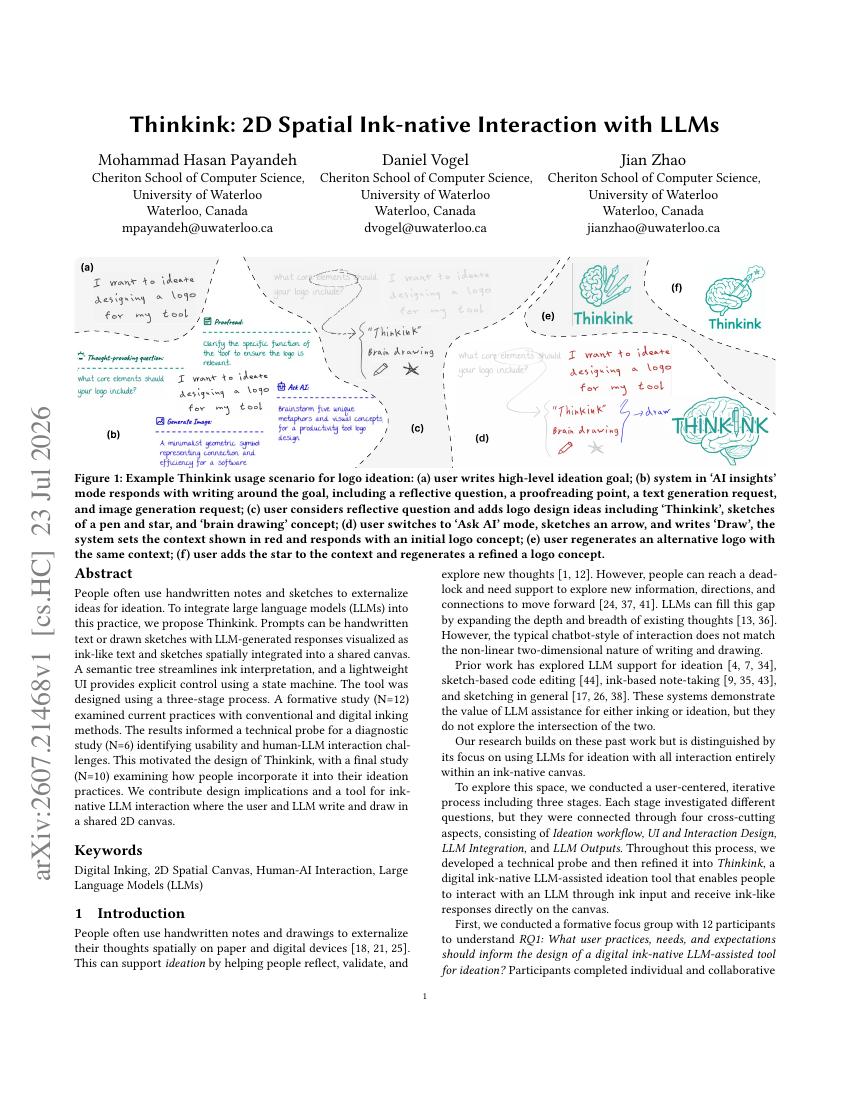
A July 23 arXiv paper presents Thinkink, an ink-native interface where handwritten text and sketches prompt an LLM and responses return as spatially integrated text and drawings. The work is based on formative and diagnostic studies with 12, 6, and 10 participants, so it is an interaction design research result rather than a product adoption report.
What happened and why it matters
The paper treats handwriting and sketching as spatial input, not merely OCR text that should be flattened before the model sees it.
Primary source
Primary reference: arXiv: Thinkink: 2D Spatial Ink-native Interaction with LLMs. Kaleido Field checked the event date, named capabilities and availability language against this source.
| Source date | July 23, 2026 arXiv submission |
|---|---|
| Checked by Kaleido Field | July 25, 2026, 09:05 CST |
| What this source supports | current human-AI interface research paper for what is Thinkink ink-native interaction with language models |
| What it does not prove | It does not prove a universal product ranking, full regional availability, or performance on every visual intelligence task. |
Why preserve the canvas
People often use handwriting and sketches to externalize ideas before they have a clean textual prompt. Thinkink keeps those marks in a shared 2D canvas instead of forcing an early conversion to plain text.
The paper studies ideation and interaction; it does not claim that every task benefits from ink-native input.
The control layer
A semantic tree helps interpret the ink, while a lightweight state machine gives the user explicit control over how the model's text and sketches are placed and revised.
That explicit control is important because spatial output can become confusing when the system changes the canvas without a clear user action.
Evidence boundary
The participant studies include N=12, N=6, and N=10 groups across different stages. Those samples support design implications and a research prototype, not product-market or general usability conclusions.
Evidence boundary
This page reports a dated event from a named primary source. Company specifications and adoption statements remain attributed claims unless independent evidence is cited above.
FAQ
What is the practical answer?
A July 23 arXiv paper presents Thinkink, an ink-native interface where handwritten text and sketches prompt an LLM and responses return as spatially integrated text and drawings. The work is based on formative and diagnostic studies with 12, 6, and 10 participants, so it is an interaction design research result rather than a product adoption report.
What source does this article use?
The primary source is arXiv: Thinkink: 2D Spatial Ink-native Interaction with LLMs. Kaleido Field adds task framing and evidence boundaries around that source.
Where should the user verify the answer?
Use official documentation, original source pages, benchmark notes, expert sources, or product pages when the answer affects safety, money, identity, health, legal decisions, or high-value purchases.