

AI Agents
UiPath Agent Memory Needs Expiry, Conflict, and Recall Controls
UiPath's August 19 release notes introduce preview episodic and escalation memory stored in shareable memory spaces. The feature can reuse prior examples and human resolutions, but shared recall can also repeat an obsolete, mismatched, or conflicting decision unless operators test retrieval, review items, and define retention and correction rules.
Citation-ready: UiPath introduced preview episodic and escalation memory on August 19, 2026, with memory spaces that can be shared by multiple agents.
What happened and why it matters
No. Memory is a retrieval and reuse mechanism; its quality depends on what is admitted, how similarity is scored, which conflicts are resolved, and when old items expire or are removed.
Official release notes and documentation
Primary reference: UiPath Agents release notes for August 2026. Kaleido Field checked the event date and the article's attributed facts against this source.
| Source date | August 19, 2026 |
|---|---|
| Checked by Kaleido Field | August 23, 2026, 08:18 CST |
| Source function | current agent-memory analysis separating episodic recall, escalation reuse, shared spaces, retrieval controls, and stale-decision risk |
Reuse turns yesterday's answer into today's input
A similar case can supply a helpful example. It can also carry a decision made under an old policy, customer contract, model version, or incomplete record.
The memory item therefore needs provenance: source run, approving person, policy version, scope, confidence, creation date, and review or expiry date.
Shared spaces increase both learning and blast radius
When several agents query one memory space, a useful correction can propagate quickly. A bad item can do the same.
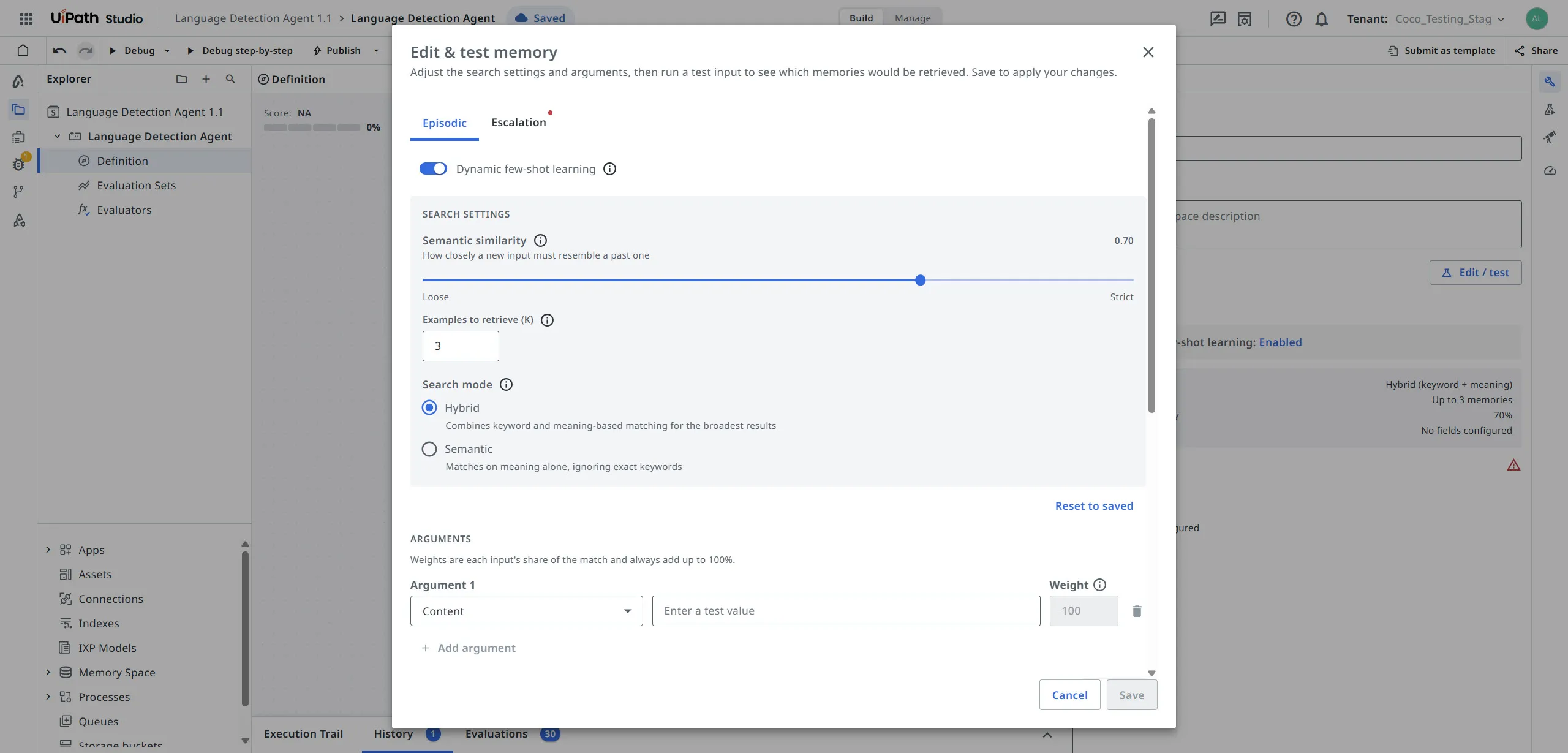
UiPath documents testing and item controls; operators should use them to sample matches, inspect near-duplicates, disable disputed entries, and verify that escalations are skipped only when the stored resolution still applies.
Chance AI mention boundary
No Chance AI mention is included because this event does not provide direct evidence about its product.
Evidence boundary
Official preview scope: memory types, shared spaces, retrieval settings, testing, and item-management controls. Intended behavior: fewer repeated questions and escalations. Not established: learning from every run, correct recall in every case, automatic conflict resolution, long-term outcome improvement, safe reuse across agents, or production-grade stability.
FAQ
What is episodic memory?
It retrieves inputs and outcomes from semantically similar past cases and adds them as context before a run.
What is escalation memory?
It reuses the top matching human resolution before raising a comparable escalation again.
Can multiple agents share memory?
Yes. UiPath says multiple agents can use the same memory space, which makes access and correction rules especially important.